Showing posts with label NASA. Show all posts

Wednesday, July 23, 2014

NASA: The Solar Super Storm Of 2012

image

Credit NASA


# 8859


Although it sounds like science fiction, two years ago today the earth narrowly (by cosmic standards) missed being hit by a massive solar storm that had the potential to knock our technology-dependant society back a hundred years. 


Back in 2010 we looked at the granddaddy of all known solar storms, the Carrington Event of 1859, and have revisited the topic a number of times since then, including:


NASA: Solar Max Is Finally Here

Solar Storms, CMEs & FEMA

NASA Braces For Solar Disruptions


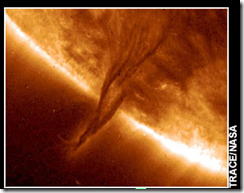
While this solar cycle has produced the weakest solar maximum in living memory, it also produced – on July 23rd, 2012 – the largest known solar flare in 155 years.  A double-whammy solar flare that rivaled, or perhaps even exceeded, the power of the 1859 Carrington event.


One that - had it erupted a week earlier – would have directly impacted earth.


A Solar Flare is the brief, sudden release of radiation energy (X-Ray, Gamma Rays, & energetic particles (protons and electrons)) from the surface of the sun, generally in the vicinity of an active sunspot.


Solar flares are rated as either C Class (minor), M Class (Moderate), or X Class (extreme), and while the electromagnetic radiation they release can reach earth in only about 8 minutes time, their effects are mostly limited to disrupting communications and potentially damaging satellites.


A CME (Coronal Mass Ejection) is the ejection of a massive amount of plasma (electrons and protons & small quantities of helium, oxygen, and iron) from the the sun that may last for hours. Some of this plasma falls back into the sun, but trillions of tons can escape and if aimed in their direction, impact surrounding planets.


A CME may arrive on earth – 93 millions miles distant from the sun – 48 to 72 hours after it is observed, and spark a Geomagnetic Storm.   


While they pose no direct physical danger to us on the earth’s surface (we are protected by the earths magnetic field and atmosphere), a large CME can wreak havoc with electronics, power generation, and radio communications.


All of which brings us to a report, and 4 minute video, from NASA on this second anniversary of the earth almost getting clobbered by a `Carrington class’ solar storm.  First the links, and excerpts, and then I’ll be back with more.


Near Miss: The Solar Superstorm of July 2012

July 23, 2014: If an asteroid big enough to knock modern civilization back to the 18th century appeared out of deep space and buzzed the Earth-Moon system, the near-miss would be instant worldwide headline news.

Two years ago, Earth experienced a close shave just as perilous, but most newspapers didn't mention it. The "impactor" was an extreme solar storm, the most powerful in as much as 150+ years.

"If it had hit, we would still be picking up the pieces," says Daniel Baker of the University of Colorado. 

splash

A ScienceCast video recounts the near-miss of a solar superstorm in July 2012. Play it

(Continue . . . )


From my perspective, that wasn’t a `near miss’ . . .  that was more of a `near hit’.


And even more sobering is this assessment, suggesting the odds of earth being struck by one of these solar super storms is actually a lot higher than we’ve previously thought.  Again from the NASA article:


In February 2014, physicist Pete Riley of Predictive Science Inc. published a paper in Space Weather entitled "On the probability of occurrence of extreme space weather events."  In it, he analyzed records of solar storms going back 50+ years.  By extrapolating the frequency of ordinary storms to the extreme, he calculated the odds that a Carrington-class storm would hit Earth in the next ten years.


The answer: 12%.


FEMA takes these solar storms seriously, and in 2010 held a major table-top exercise in anticipation of the upcoming solar maximum. According to a tweet from FEMA Director Craig Fugate back in 2011, they now include a solar weather update in their daily briefings.


A 30 page PDF file is available for download from the FEMA library on this exercise which envisioned a `near worst-case scenario’.

Managing Critical Disasters in the Transatlantic Domain - The Case of a Geomagnetic Storm


In 2009 the National Academy of Sciences produced a 134 page report on the potential damage that another major solar flare could cause in Severe Space Weather Events—Understanding Societal and Economic Impacts.
image

You can download the PDF for free from the National Academies Press at the above link.


In November of 2012 the U.S. National Intelligence Council released a report called  "Global Trends 2030: Alternative Worlds" that tries to anticipate the global shifts that will likely occur over the next two decades (see Black Swan Events). Making their top 10 list was:


7. Solar Geomagnetic Storms

"Solar geomagnetic storms could knock out satellites, the electric grid, and many sensitive electronic devices. The recurrence intervals of crippling solar geomagnetic storms, which are less than a century, now pose a substantial threat because of the world's dependence on electricity," the report says.


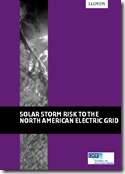
And last year Lloyds of London issued a risk assessment for the insurance industry called Solar storm Risk to the north American electric grid which calls another `Carrington’ class event inevitable, and the effects likely catastrophic, but the timing is unknowable.


Solar storms are among a number of plausible low-probability, high-impact events that – while not anything I would lie awake at night worrying about – are nevertheless worth considering as part of a balanced `All Hazards’ approach to preparedness.


In the 2011 OECD Report: Future Global Shocks report, the authors concentrated most of their attention on five highly disruptive future shock events.


  • A Pandemic
  • A Cyber Attack
  • A Financial Crisis
  • A Geomagnetic Storm
  • Social Unrest/Revolution


While all of these are difficult to prepare for, the truth is -  if you are well prepared for an earthquake or a hurricane - you are automatically in a better position to deal with the disruptions caused by these more exotic threats. Some resources to get you started on the road to `all threats’ preparedness include:


FEMA http://www.fema.gov/index.shtm

READY.GOV http://www.ready.gov/

AMERICAN RED CROSS http://www.redcross.org/


And some of my preparedness blogs, including:

When 72 Hours Isn’t Enough

The Gift Of Preparedness: 2013

In An Emergency, Who Has Your Back?

Wednesday, June 11, 2014

NASA: Solar Max Is Finally Here


image

An M2 (medium) Class solar flare, with CME and an S1 (minor) Class Radiation storm recorded by NASA on June 7th, 2011.


# 8728


My fascination with the sun began more than a half century ago, and it’s all really Dr. Frank Baxter’s fault.   For those of us of a certain age in this country, the Bell Telephone Science Series featuring `Dr. Research (Baxter) was our first real introduction to science. 


For a nostalgic serving of retro solar scienceOUR MR. SUN  (1956) staring Dr. Frank Baxter and Eddie Albert is available on the Internet Archive.  What this old film lacks in 21st century science, it makes up with charm.

image

Dr. Research (Frank Baxter)


Science, and our understanding of the sun, has grown remarkably over the past half century, but the star at the center of our solar system still holds many mysteries.  Many of my readers are aware that we’ve been waiting . .  and waiting . . .and waiting for the sun’s `11 year-cycle’ to peak to its `Solar Maximum’ for three years.


Five years ago, some scientists were predicting one of the strongest Solar Max’s on record by about 2011. 


That didn’t happen.  Instead, today - several years later than expected - the sun has finally reached solar maximum, and it is the weakest maximum observed in a century..


First a report from NASA, after which I’ll be back with a bit more:


Solar Mini-Max

June 10, 2014:  Years ago, in 2008 and 2009 an eerie quiet descended on the sun.  Sunspot counts dropped to historically-low levels and solar flares ceased altogether.  As the longest and deepest solar minimum in a century unfolded, bored solar physicists wondered when "Solar Max" would ever return.

They can stop wondering. "It's back," says Dean Pesnell of the Goddard Space Flight Center.  "Solar Max has arrived."

splash

A new ScienceCast video examines the curious Solar Max of 2014.  Play it

Pesnell is a leading member of the NOAA/NASA Solar Cycle Prediction Panel, a blue-ribbon group of solar physicists who meet from time to time to forecast future solar cycles.  It's not as easy as it sounds. Although textbooks call it the "11-year solar cycle," the actual cycle can take anywhere from 9 to 14 years to complete.  Some Solar Maxes are strong, others weak, and, sometimes, as happened for nearly 70 years in the 17th century, the solar cycle can vanish altogether. 

Pesnell points to a number of factors that signal Solar Max conditions in 2014: "The sun's magnetic field has flipped; we are starting to see the development of long coronal holes; and, oh yes, sunspot counts are cresting."

(Continue . . .)


Despite its weak showing, yesterday the sun produced two  X-class solar flares – albeit on the incoming limb of the sun – and not earth directed.  The sun spots responsible for that double-whammy are still flickering with magnetic instability, and will rotate into a geo-effective position over the next couple of days.

Today’s report from NASA references a large CME (Coronal Mass Ejection) in 2012 that - had it been earth-directed- could have caused a great deal of damage.


Indeed, this "Mini-Max" has already unleashed one of the strongest storms in recorded history.  On July 23, 2012, a plasma cloud or "CME" rocketed away from the sun as fast as 3000 km/s, more than four times faster than a typical eruption. The storm tore through Earth orbit, but fortunately Earth wasn't there. Instead it hit NASA's STEREO-A spacecraft, which recorded the event for analysis.  Researchers now believe the eruption was as significant as the iconic Carrington Event of 1859—a solar storm that set telegraph offices on fire and sparked Northern Lights as far south as Hawaii. If the 2012 "superstorm" had hit Earth, the damage to power grids and satellites would have been significant.


Long time readers will remember that I described this `Carrington Event’ in some detail in 2010, and have talked about some of the planning and preparation being done by NASA, the Military, and FEMA  in anticipation of another major solar storm (see NASA Braces For Solar Disruptions).


This isn’t science fiction.   Although no one knows when the next major solar flare will head in our direction. It could happen today, or it might not happen for decades.


Smaller, but disruptive solar storms have caused serious power outages and communications disruptions in recent decades, including the infamous Quebec power outage of 1989, and a 2003 solar storm that damaged a number of satellites and also caused some power outages in Europe.


In 2009 the National Academy of Sciences produced a 134 page report on the potential damage that another major solar flare could cause in Severe Space Weather Events—Understanding Societal and Economic Impacts.


In November of 2012 the U.S. National Intelligence Council released a report called  "Global Trends 2030: Alternative Worlds" that tries to anticipate the global shifts that will likely occur over the next two decades (see Black Swan Events).


Making their top 10 list (coming in at #7) was:


7. Solar Geomagnetic Storms

"Solar geomagnetic storms could knock out satellites, the electric grid, and many sensitive electronic devices. The recurrence intervals of crippling solar geomagnetic storms, which are less than a century, now pose a substantial threat because of the world's dependence on electricity," the report says.


And last year Lloyds of London issued a risk assessment for the insurance industry called Solar storm Risk to the north American electric grid which calls another `Carrington’ class event inevitable, and the effects likely catastrophic, but the timing is unknowable.


While the odds of us seeing a `Carrington Event’ during this upcoming solar maximum are fairly low, they are not zero. Solar flares of this size are predicted to impact earth every 150 years, so  it may be decades before another one comes our way.  

I certainly don’t advocate lying awake at night worrying about solar flares (I certainly don’t!).  But I do believe that we all need to be prepared to deal with a variety of disaster scenarios.


The simple truth is, if you are well prepared to deal with an earthquake, pandemic, or a hurricane . . you are automatically in a better position deal with any other disaster, including low probability-high impact events like massive solar storms. 


An `All Hazards’ preparedness approach, rather than concentrating on a single perceived threat, is by far the best way to go.


Whether you live in the United States, the UK, or anywhere else in the world, you can find good preparedness information at the following links:


FEMA http://www.fema.gov/index.shtm

READY.GOV http://www.ready.gov/

AMERICAN RED CROSS http://www.redcross.org/


And lastly, you may wish to revisit some of my preparedness essays, including:


In An Emergency, Who Has Your Back?

An Appropriate Level Of Preparedness

Thursday, November 28, 2013

NASA Webcast: Comet ISON’s Close Encounter With Our Sun

image

Photo Credit NASA


# 8014


It’s been touted as possibly the brightest comet in a century, but first ISON must survive a close encounter with the sun as it reaches perihelion: just 1 million miles above the surface.  Will it survive?  


No one is quite sure, but NASA will be live streaming video coverage, and expert commentary this afternoon.


WATCH LIVE THURSDAY: Comet ISON Buzzes the Sun - NASA Webcast @ 1 p.m. ET

by SPACE.com Staff   |   November 27, 2013 12:00pm ET

NASA will hold a live Google+ hangout on Thursday (Nov. 28) to webcast the solar passage of Comet ISON as it whips around the sun. The webcast will begin at 1 p.m. EST (1800 GMT) and last until 3:30 p.m. EST (2030 GMT). You will be able to watch the webcast live in the window below at the start time. LATEST STORY: Comet ISON's Thursday Sun Encounter a Thanksgiving Feast for NASA

Tuesday, August 06, 2013

NASA: The Approaching Solar Maximum

image

An M2 (medium) Class solar flare, with CME and an S1 (minor) Class Radiation storm recorded by NASA on June 7th, 2011.


# 7543


Last week several major media outlets carried a story that claimed the earth `narrowly missed’ being hit by a `catastrophic’ solar flare last month.  The story – which described a `Carrington’ class CME – was picked up, and repeated by a number of blogs.


And had it been true . . . it would have been quite the story.


But according to Spaceweather.com (an excellent resource for space weather data), no such flare erupted from our sun in July, as explained in this FACT CHECK


SPACE WEATHER FACT CHECK: Many readers are asking about a report in the Washington Examiner, which states that a Carrington-class solar storm narrowly missed Earth two weeks ago. There was no Carrington-class solar storm two weeks ago. On the contrary, solar activity was low throughout the month of July. The report is erroneous. The possibility of such a storm is, however, worth thinking about: A modern Carrington event would cause significant damage to our high-tech society. Solar flare alerts: text, voice.


I described the infamous Carrington Event in some detail back in 2010, but briefly:


In September of 1859 Richard Carrington, a renowned English astronomer, observed and recorded a tremendous solar flare that – were it to be repeated today – would wreck havoc with our modern electronic infrastructure.


This solar storm induced electrical currents in the newly built telegraph grid, shocking operators and starting fires.   Had it occurred today, much of the world’s electrical grid could be fried.


Another large (albeit smaller) event took place in 1921, but again, the technology of the day wasn’t terribly vulnerable to the effects of the storm.


However, in 1989 a geomagnetic storm fried several large power transformers in Quebec, causing a province-wide blackout.  And in 2003, a number of satellites were severely damaged by an extremely powerful CME which also caused some power outages in Europe.  


While it may not happen for decades, massive solar flares and CMEs are threats that NASA, FEMA, and other agencies take seriously (see Solar Storms, CMEs & FEMA).


Last December the U.S. National Intelligence Council released a report called  "Global Trends 2030: Alternative Worlds" that tries to anticipate the global shifts that will likely occur over the next two decades (see Black Swan Events).


Making their top 10 list (coming in at #7) was:


7. Solar Geomagnetic Storms

"Solar geomagnetic storms could knock out satellites, the electric grid, and many sensitive electronic devices. The recurrence intervals of crippling solar geomagnetic storms, which are less than a century, now pose a substantial threat because of the world's dependence on electricity," the report says.


And this year Lloyds of London issued a risk assessment for the insurance industry called Solar storm Risk to the north American electric grid which calls another `Carrington’ class event inevitable, and the effects likely catastrophic, but the timing is unknowable.

image


And last year, with the next solar maximum expected in 2013, the UK government updated their National Risk Register For Civil Emergencies to include severe space weather as a national threat (see  UK: Civil Threat Risk Assessment).

severe space weather – Space weather covers a range of different phenomena, including solar fares, coronal mass ejections and solar energetic particle
events. Severe space weather can cause disruption to a range of technologies and infrastructure, including communications systems, electronic circuits and power grids. The ‘reasonable worst case’ for a severe space weather event is based on the so-called Carrington Event in 1859, which saw some of the largest space weather phenomena ever recorded.


As you can see, this isn’t some esoteric plot device for a cheesy direct-to-DVD Sci-Fi movie, or prophesy driven drivel: space weather is a serious threat than can, and does, affect life on earth.


Our sun is a variable star, and it goes through many major, and minor cycles. The best documented of these is the 11-year/22-year sunspot cycle.


Roughly every 11 years (it runs anywhere from 9 to 14 years), the sun experiences a magnetic pole shift at the time of solar maximum – a period of high sunspot and solar flare activity.


Every 22 years, the cycle completes, and the poles return to their `original’ position.


Our sun has, since 2006, been in a solar minimum or quiescent phase.  Very few sunspots and solar flares. The next solar maximum was predicted to occur in 2012, but the sun’s sunspot activity has been slow to restart.


Yesterday NASA announced they are beginning to see real signs that the solar maximum may be finally in sight:


The Sun's Magnetic Field is about to Flip

August 5, 2013:  Something big is about to happen on the sun.  According to measurements from NASA-supported observatories, the sun's vast magnetic field is about to flip.


"It looks like we're no more than 3 to 4 months away from a complete field reversal," says solar physicist Todd Hoeksema of Stanford University. "This change will have ripple effects throughout the solar system."


The sun's magnetic field changes polarity approximately every 11 years.  It happens at the peak of each solar cycle as the sun's inner magnetic dynamo re-organizes itself.  The coming reversal will mark the midpoint of Solar Cycle 24. Half of 'Solar Max' will be behind us, with half yet to come.

(Continue . . . )


While the odds of us seeing a `Carrington Event’ during this upcoming solar maximum are undoubtedly low, they are not zero. Solar flares of this size are predicted to happen roughly every 150 years, so  it may be decades before another one comes our way.  


I certainly don’t advocate lying awake at night worrying about solar flares (I certainly don’t!).  But I do believe that we all need to be prepared to deal with a variety of disaster scenarios.


The simple truth is, if you are well prepared to deal with an earthquake, pandemic, or a hurricane . . you are automatically in a better position deal with any other disaster, including low probability-high impact events like massive solar storms. 


An `All Hazards’ preparedness approach, rather than concentrating on a single perceived threat, is by far the best way to go.


Whether you live in the United States, the UK, or anywhere else in the world, you can find good preparedness information at the following links:


FEMA http://www.fema.gov/index.shtm

READY.GOV http://www.ready.gov/

AMERICAN RED CROSS http://www.redcross.org/


And lastly, you may wish to revisit some of my preparedness essays, including:


In An Emergency, Who Has Your Back?

An Appropriate Level Of Preparedness

Monday, April 09, 2012

NASA: The Mysteries Of The Sun


image


# 6269


Although the sun is relatively quiet this week the next solar maximum – a period of greatest solar activity (sun spots, flares, CMEs) that occurs roughly every 11 years – is expected early in 2013.


It is during these solar maximums where the earth is at greatest risk of experiencing a major solar flare, something that if strong enough, could adversely affect satellites in orbit, sensitive electronics on the ground, and even the electrical grid.


Scientists at NASA, NOAA, and other agencies . . .  including FEMA  . . .  take the potential for destructive Solar storms very seriously, and in early 2010 FEMA held a major table-top exercise in anticipation of the upcoming solar maximum (see Solar Storms, CMEs & FEMA).


But despite some of the more dire warnings on the internet, NASA is quick to remind us that a damaging solar flare – while possible – may be decades away.


With the interest in the upcoming solar maximum running high, NASA has put together five short videos and a PDF book on the sun, which is  available on their Stars & Our Sun webpage.


image

20 page PFD book


The five videos are:


Space Weather

Solar Variability

Heliosphere

Earth's Magnetosphere

Ionosphere, Thermosphere, and Mesosphere


Each segment runs about 5 minutes in length, and all incorporate impressive graphics and informative narration. According to the press release, these videos have already won a number of prestigious awards prior to their public release.


I confess that I’m enough of a science geek to greatly appreciate these kind of films. My fascination with science goes back to the still delightful Bell System Science series of the 1950s, which introduced my post-war baby boom generation to science and research.


For a simpler retro look at the sun, and to compare how much we’ve learned over the past 54 years (in science and filmmaking), you may enjoy watching the classic educational film  OUR MR. SUN from 1956, staring Dr. Frank Baxter and Eddie Albert which is available on the Internet Archive.


image

Dr. Research (Frank Baxter)


What this old film lacks in 21st century science, it makes up with charm.

Wednesday, March 07, 2012

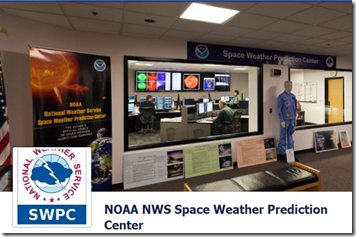
NOAA’s NSW Space Weather Prediction Center


image

Photo Credit NOAA 


# 6203


No, you won’t need an SPF 10,000 sun screen to protect yourself, but last night the sun lobbed a respectably-sized CME (coronal mass ejection) in the general direction of the earth (or at least, where the earth will be in a couple of days). 


Estimates are that we could see a strong geomagnetic storm (G3) over the next couple of days.  This is the alert from NOAA’s Space Weather Prediction Center.


012-03-07 15:18 UTC  Solar Radiation and Geomagnetic Storms Continue

The CME that erupted late on March 4 passed ACE around 0400 UTC March 7 (11:00 p.m. EST March 6). As a result, storming reaching the G2 (Moderate) level continues at this time.  Another CME, part of the recent R3 (Strong) Radio Blackout event at 0024 UTC March 7 (7:24 p.m. EST March 6) is forecast to pass ACE early morning UTC on March 8 (start of day EST March 8) . Geomagnetic storm periods reaching the G3 (Strong) level are likely from that CME.  Finally, a Solar Radiation Storm is also in progress and levels are currently above the S3 (Strong) threshold.  Region 1429 remains potent and subsequent activity is certainly possible.  Updates here as conditions warrant.


As we progress into 2012 and towards the expected solar maximum in 2013, we can expect to see an increase in the intensity, and frequency of these solar storms.


And for the hardcore solar geek, the Space Weather Prediction Center is the place where you’ll want to get the latest updates.


But NOAA’s SPC also has a very nice FACEBOOK page, which is probably a bit more user friendly for the general public, that they describe as:


This page is an experimental service provided by NWS to explore the use of Facebook to extend the reach of NWS information. Facebook posts do not always reflect the most current information. For current official info, visit: http://www.swpc.noaa.gov/


This page has short reports of space weather events and some spectacular photos, and graphics. 


Well worth taking a look.


image


Several times over the past two years I’ve written about the concerns that  FEMA and NASA, along with a host of other agencies and governments, have voiced about potential damage an unusually severe solar storm might cause to our high-tech infrastructure.


A few of those blogs include:


A Flare For The Dramatic
Solar Storms, CMEs & FEMA
A Carrington Event


While sounding a bit like science-fiction, in truth large and potentially disruptive solar storms do occur on rare occasions – usually at the time of a solar maximum.


NASA, while admitting that a serious solar storm could happen practically anytime, also cautions that the next big one could be many decades away. It is a genuine threat, they say, but the timing is impossible to predict. 


In 2009 the National Academy of Sciences produced a 134 page report on the potential damage that another major solar flare could cause in Severe Space Weather Events—Understanding Societal and Economic Impacts.


You can read it for free online at the above link. 


Last night’s CME doesn’t come close to being in the same league as the Carrington Event of 1859, or even some of the larger solar flares we saw back in the early part of the last decade.


But a CME someday in the future could have a serious impact on the earth’s technology. Which is why NASA and NOAA have invested so heavily in the study, and monitoring, of our sun.


Since solar flares and CMEs are likely to be in the news a lot over the next couple of years, you’ll probably want to make a point of visiting these NOAA sites often.

Thursday, August 18, 2011

NASA Briefing Later Today On Space Weather


image

An M2 (medium) Class solar flare, with CME and an S1 (minor) Class Radiation storm recorded by NASA on June 7th, 2011.


# 5763


A hundred years ago space weather made little difference to the inhabitants of the earth beyond producing spectacular auroral light shows in the high latitudes.


Humans were (and still are) well insulated from bursts of solar energy by the earths atmosphere and magnetic field, and our technology was primitive enough to be pretty much immune to the electromagnetic pulses (EMPs) generated by solar storms.


But over the last 50 years we’ve become increasingly dependent on high technology, and many of their components – including satellites, power generators, and radio communications – are vulnerable to unusually large EMPs.


With our sun now beginning to awaken from its solar minimum, and sun spot activity and CME’s (Coronal Mass Ejections) expected to increase over the next couple of years, concerns over the vulnerability of our modern technological infrastructure are rising again.


As I wrote in Solar Storms, CMEs & FEMA, the United States takes this threat seriously. While massive solar storms are rare, they can and do occur.  And if one is pointed towards the earth, it has the potential to damage our electronic infrastructure.


In early 2010  FEMA  held a major table-top exercise in anticipation of the upcoming solar maximum, and according to a tweet from FEMA Director Craig Fugate yesterday, they now include a solar weather update in their daily briefings.


A 30 page PDF file is available for download from the FEMA library on this exercise which envisioned a `near worst-case scenario’.

Managing Critical Disasters in the Transatlantic Domain - The Case of a Geomagnetic Storm

Resource Record Cover Image Thumbnail - summary_geomag_cvr_web.jpg


While sounding a bit like science-fiction, and being used (and abused) by prophesy/ Mayan 2012/ End-of-the-World fringe websites, the truth is large and potentially disruptive solar storms do occur on rare occasions – usually at the time of a solar maximum.


NASA, while admitting that a serious solar storm could happen practically anytime, also cautions that the next big one could be many decades away. It is a genuine threat, they say, but the timing is impossible to predict.


In 2009 the National Academy of Sciences produced a 134 page report on the potential damage that another major solar flare could cause in Severe Space Weather Events—Understanding Societal and Economic Impacts.


You can read it for free online at the above link.


Since the Internet is filled with less-than-credible information about the threat of solar storms, I like to highlight information from reputable sources whenever I can.


Later today NASA will hold a televised news conference on our awakening sun and the tracking of space weather events, which may be viewed online via NASA-TV at 2pm EST today.  


Details come from the following media advisory:


MEDIA ADVISORY : M11-170

NASA Hosts News Briefing About Tracking Space Weather Events

WASHINGTON -- NASA will host a news briefing at 2 p.m. EDT, Thursday, Aug. 18, to discuss new details about the structure of solar storms and the impact they have on Earth. The new information comes from NASA's Solar Terrestrial Relations Observatory, or STEREO, spacecraft and other NASA probes.


The briefing will take place in NASA Headquarters' James E. Webb Auditorium, located at 300 E St. SW in Washington, and will air live on NASA Television and the agency's website.

The briefing panelists are:


-- Madhulika Guhathakurta, STEREO program scientist, NASA Headquarters
-- Craig DeForest, staff scientist, Southwest Research Institute, Boulder, Colo.
-- David Webb, research physicist, Institute for Scientific Research, Boston College
-- Alysha Reinard, research scientist, National Oceanic and Atmospheric Administration and the University of Colorado, Boulder


Reporters unable to attend may ask questions from participating NASA centers or by telephone. To participate by phone, reporters must contact Steve Cole at 202-358-0918 or stephen.e.cole@nasa.gov by 11 a.m. on Thursday.


STEREO is part of NASA's Solar Terrestrial Probes Program in the agency's Science Mission Directorate in Washington. The program seeks to understand the fundamental physical processes of the space environment from the sun to Earth and other planets.


For more information about NASA's STEREO mission, visit:

http://www.nasa.gov/stereo


For NASA TV streaming video, downlink and scheduling information, visit:

http://www.nasa.gov/ntv

- end -


For more on Solar storms, including the granddaddy of them all – the 1859 Carrington Event, you may wish to revisit these earlier blog posts.


NASA: Getting Ready For The Next Big Solar Storm
 
NASA Braces For Solar Disruptions
 
A Carrington Event

Tuesday, March 22, 2011

Japan: Post Quake Power Losses


# 5428


From NASA’s  Earth Observatory a high altitude composite night time photograph showing the widespread loss of electricity across northern Japan in the wake of March 11th's Tohoku earthquake.


image


This picture shows the loss of electricity as of March 12th by merging images taken in 2010 with the new satellite images.


Yellow indicates lights that were working in 2010 and after the quake.


Red indicates areas of power outages after the March 11th quake.


For more details visit NASA’s Electricity Losses in Northeastern Japan.


Eleven days after the 9.0 quake TEPCO is now reporting that electricity in their service region has been largely restored. 


Electricity shortages and rolling blackouts, however, continue across much of Japan.

Saturday, August 28, 2010

Recent Media Reports On Solar Maximum


image


# 4843


Twice over the past few months I’ve written about the concerns that  FEMA and NASA, along with a host of other agencies and governments, have voiced about potential damage a severe solar storm might cause to our high-tech infrastructure.


NASA Braces For Solar Disruptions
A Carrington Event


While sounding a bit like science-fiction, in truth large and potentially disruptive solar storms do occur on rare occasions – usually at the time of a solar maximum.


The next solar maximum is due in 2012-2013, and some scientists have suggested this could be a particularly active cycle. 


Some have gone so far as to suggest we could see a flare as big as 1859’s `Carrington Event’ (described here), or the somewhat lesser event of 1921. 


Both were strong enough, that were they to happen today, would likely cause serious damage to parts of our electrical infrastructure.


NASA, while admitting that a serious solar storm could happen practically anytime, also cautions that the next big one could be many decades away. It is a genuine threat, they say, but the timing is impossible to predict. 


In 2009 the National Academy of Sciences produced a 134 page report on the potential damage that another major solar flare could cause in Severe Space Weather Events—Understanding Societal and Economic Impacts.


You can read it for free online at the above link. 


Last year Space.com produced a spectacular 18 minute video entitled Attack of the Sun, which may be viewed on YouTube.


Which brings us to some slightly frantic news reports that appeared this week – inspired by an article that appears in Australasian Science by David Reneke called Huge Solar Storms to Impact Earth.


Typical is the report from news.com.au that proclaims:


Sun storm to hit with 'force of 100m bombs'


Admittedly, these sorts of disaster headlines sound a bit like a `Scarrington’ event to me, but the point is to draw the reader’s attention to the story, and here I suppose the headline succeeds admirably.


The body of the article is a bit more grounded, and provides an entertaining and interesting overview of the concerns being voiced by some astronomers about the upcoming solar max.


As you might imagine, this threat has been picked up and greatly amplified by a number of prophesy/ Mayan 2012/ End-of-the-World websites, which tends to dilute it’s legitimacy in many circles.


But astronomers know that our sun is a variable star, and it goes through many major, and minor cycles. The best documented of these is the 11-year/22-year sunspot cycle.


Roughly every 11 years (it runs anywhere from 9 to 14 years), the sun experiences a magnetic pole shift at the time of solar maximum – a period of high sunspot and solar flare activity.


Every 22 years, the cycle completes, and the poles return to their `original’ position.


Our sun has, since 2006, been in a solar minimum or quiescent phase.   Very few sunspots and solar flares.


The next solar maximum was predicted to occur in 2012, but the sun’s sunspot activity remains low, and so now NASA is looking more towards 2013. 


This from science.nasa.gov.


As the Sun Awakens, NASA Keeps a Wary Eye on Space Weather


June 4, 2010: Earth and space are about to come into contact in a way that's new to human history. To make preparations, authorities in Washington DC are holding a meeting: The Space Weather Enterprise Forum at the National Press Club on June 8th.


Many technologies of the 21st century are vulnerable to solar storms. [more]


Solar flares the size of 1859’s  `Carrington Event’ don’t happen very often, and in order to affect earth, the flare or CME (coronal mass ejection) must be pointed towards our planet (or where the earth will be when it arrives 2-3 days later).


Still, in 1989 a geomagnetic storm fried several large power transformers in Quebec, causing a province-wide blackout.


And in 2003, a number of satellites were severely damaged by an extremely powerful CME which also caused some power outages in Europe.


Over the past couple of decades we’ve become increasingly dependant upon computers, the Internet, cell phones, electronic devices, and of course . . . the electrical grid.


Systems that are considered vulnerable to unusually severe geomagnetic storms.


While imbued with a certain degree of hyperbole, the media reports this week aren’t without scientific merit, although the immediacy of the threat is far less certain.


As I’ve stated before, another `Carrington Event’ may not happen in our lifetime, or it could happen within the next few years.


No one knows.


Since National Preparedness Month (NPM10)  is just a week away, it is a good time to remind my readers that:


If you are well prepared for an earthquake, a hurricane, or a pandemic . . . you are automatically in a better position to weather the disruptions caused any disaster . . . including something as rare as a catastrophic a solar storm.


Preparing is easy.  Worrying is hard.


Some resources to get you started on the road to `all threats’ preparedness include:


   FEMA http://www.fema.gov/index.shtm

READY.GOV http://www.ready.gov/

AMERICAN RED CROSS http://www.redcross.org/

Monday, July 26, 2010

NASA Braces For Solar Disruptions


image


# 4757


A little over a month ago I wrote a blog called A Carrington Event, about concerns that NASA and FEMA, and many facets of our government have over potential large scale disruptions due to solar storms.


Since we know huge solar flares have affected the earth in the recent past, it is a fair assumption that one or more will affect us again sometime in the future.


This isn’t science fiction.   Although no one knows when the next major solar flare will head in our direction.


The largest storm observed since the invention of the modern astronomy was in 1859 – now known as the Carrington Event.   Another tremendous flare lashed out at our planet in 1921.


Both of these events occurred before we developed an infrastructure highly dependent upon sensitive (and highly vulnerable) electronics.


Smaller, but disruptive solar storms have caused serious power outages and communications disruptions in recent decades.


In 2009 the National Academy of Sciences produced a 134 page report on the potential damage that another major solar flare could cause in Severe Space Weather Events—Understanding Societal and Economic Impacts.


You can read it for free online at the above link. 


Last year Space.com produced a spectacular 18 minute video entitled Attack of the Sun, which may be viewed on YouTube.


As you can see, this isn’t some esoteric plot device for a cheesy direct-to-DVD Sci-Fi movie, or prophesy driven 2012 drivel: space weather is a serious threat than can, and does, affect life on earth.


This report from Nextgov (Hat Tip FEMA Director Craig Fugate on Twitter).


NASA braces for solar storms that could bring critical systems to a halt

By Aliya Sternstein 07/23/2010

A House committee on Thursday approved a three-year authorization bill for NASA that includes a plan for issuing warnings about impending space storms that could knock out navigation systems, power and smart phones.


Because of technology's increasing reliance on satellites, many of the gadgets and systems Americans use on a daily basis are vulnerable to so-called space weather, according to NASA officials. The phenomenon refers to environmental conditions on the sun that can influence the performance and reliability of Earth-based and extraterrestrial digital systems.


The House Science and Technology Committee's legislation, H.R. 5781, which authorizes funding and missions for NASA, includes a long-term strategy for a sustainable space weather program. The White House, through the director of the Office of Science and Technology Policy, would have to define individual agency responsibilities for carrying out the line of attack.


According to NASA, the nation faces increasing uncertainty as Earth approaches the next peak of solar activity in 2013. The sun's magnetic field could produce turbulent solar wind, or charged particles streaming at high velocities. Other risks include solar flares, which are sudden eruptions of magnetic energy, as well as coronal mass ejections, emissions of plasma from the sun that disturb magnetic fields on Earth.


Just a few of the devices and services that could go down during bad space weather include credit card transactions, air travel networks, the transmission of geothermal and wind power, most mapping applications, and telemedicine systems that send patient images from hospitals to physicians.

(continue . . . )


As I pointed out last month, I wouldn’t advise anyone to lie awake at night worrying about solar storms.  But it is another good reason to take general preparedness seriously.


And if you are well prepared for an earthquake, a hurricane, or a pandemic . . . you are automatically in a better position to weather the disruptions caused by a solar storm.


Some resources to get you started on the road to `all threats’ preparedness include:


FEMA http://www.fema.gov/index.shtm

READY.GOV http://www.ready.gov/

AMERICAN RED CROSS http://www.redcross.org/


And a few of my (many) preparedness essays include:


An Appropriate Level Of Preparedness
Inside My Bug Out Bag
Red Cross Unveils `Do More Than Cross Your Fingers’ Campaign
The Gift Of Preparedness


You can search this blog for more preparedness information by clicking this link.

Friday, July 09, 2010

Getting A GRIP On Hurricanes


# 4709


In this case, GRIP stands for the Genesis and Rapid Intensification Processes field experiment NASA is conducting to try to understand how tropical storms form and develop into major hurricanes.


While tremendous strides have been made over the past several decades in prediction the path of these storms, far less progress has been made in predicting future intensity.


image


This was driven home in 2004 when Hurricane Charley – after crossing the Dry Tortugas with winds of 110 mph (a strong Cat 2), suddenly and unexpectedly intensified into a strong Category 4 storm (150 mph) over a period of just a couple of hours.


The only saving grace was that the eye of this storm was very small, and so the swath of destruction was limited.   Small solace to those in the path, however.


In October of 2005 Hurricane Wilma spun up from a tropical storm to a CAT 5 monster in just over 24 hours. 


Luckily it had lost much of its punch before slamming into the Everglades near Cape Romano, but still managed to cause 20 billion dollars of damage across Miami and much of South Florida.


Thousands of residents were without electrical power for 2 weeks or longer, which highlights the need for anyone who lives in hurricane country to be prepared for more than just a day or two.


image

Wilma’s path


NASA, which most people think of as simply a space exploration agency, it is also heavily involved in researching earth science, including:


  • the global atmosphere;
  • the global oceans including sea ice;
  • land surfaces including snow and ice;
  • ecosystems; and
  • interactions among the atmosphere, oceans, land and ecosystems, including humans.


And understanding how hurricanes form and intensify are part of their job (see NASA’s  Hurricane Page).


Although 2009 was a relatively quiet year for Atlantic Hurricanes, NASA/NOAA have produced an almost hypnotic 4-minute video (available on the NASAexplorer Youtube  channel) showing last year’s tropical cyclone genesis.


This year, all of the forecasts (outlooks, really) are for a much more active season.   If that prediction comes true, the 2010 video ought to be a real eye-opener.


This summer NASA will undertake an ambitious mission to monitor the development of tropical systems using unmanned Northrop Grumman Global Hawks.  


The hope is to better understand how, and why storms experience rapid intensification in order to improve forecasting.  


As a bit of a science geek, I found this report on that mission from NASA to be fascinating.


NASA's GRIP to Take Unprecedented Look Inside Hurricanes

07.07.10


NASA's Global Hawk 
unmanned drone, based at Dryden Flight Research Center in California, 
will provide unprecedented, sustained observations of the formation and 
strengthening of tropical cyclones during this summer's GRIP campaign.

NASA's Global Hawk unmanned drone, based at Dryden Flight Research Center in California, will provide unprecedented, sustained observations of the formation and strengthening of tropical cyclones during this summer's GRIP campaign. Until now, manned flights have only been able to capture two to fours of data over a storm at a time. The Global Hawk will be able to make up to 20 consecutive hours of measurements. Credit: NASA/Dryden/Carla Thomas


The spinning, counterclockwise drama plays out across TV screens all summer long. Satellite images show a tropical depression forming off the coast of Africa, and the people at home invariably ask the same question as the forecasters and the scientists: Will it or won't it become a hurricane?


This August and September, NASA is leading an aircraft campaign that will provide a sustained and unprecedented look at the inner workings of hurricane formation and intensification. The Genesis and Rapid Intensification Processes (GRIP) experiment will take place from Aug. 15 to Sept. 30 and employ three NASA aircraft flying over the Gulf of Mexico, Atlantic Ocean and Caribbean Sea to try to answer some of the basic but still lingering questions about how and why hurricanes form and strengthen.


NASA has flown over hurricanes before to gather data on precipitation, winds, convection, temperature and other factors that are known cyclone ingredients. The logistical demands of doing so have only allowed for two to four hours of data collection at a time, a snapshot of a storm that could spin for days. But for the first time, scientists will fly an unmanned drone, outfitted with 3-D radar, a microwave radiometer and other instruments over tropical systems for up to 20 consecutive hours.

(Continue . . .)


May was National Hurricane Preparedness week, and during that month this blog devoted considerable time to the subject.  A few of my blogs on the subject included:


A Hurricane Reality Check
National Hurricane Preparedness Week: Day 6
NOAA 2010 Atlantic Hurricane Outlook
The Worst That Could Happen
Hurricanes and Inland Flooding
Why I’ll Be Gone With The Wind
Storm Surge Monday
The Crossroads Of The Atlantic Storm Season
You Don’t Have To Live On The Coast