Showing posts with label evacuation. Show all posts

Sunday, November 02, 2014

French MOH Statement On UN Employee Evacuated From Sierra Leone With Ebola

image


# 9278


As of Friday’s WHO Ebola Response Situation Report:


A total of 523 health-care workers (HCWs) are known to have been infected with EVD up to the end of 29 October: 82 in Guinea; 299 in Liberia; 11 in Nigeria; 127 in Sierra Leone; one in Spain; and three in the United States of America (two were infected in the USA and one in Guinea). A total of 269 HCWs have died.


While a number of these infections are believed to have been acquired from community contact – or in settings where the HCW did not know they were dealing with a possible Ebola case – this illustrates just how dangerous working in the Ebola hot zone can be for healthcare workers. 


Overnight the French Ministry of Health has confirmed that they have accepted for treatment an unidentified UN worker from Sierra Leone with the Ebola virus.  This is the second such evacuation to France since the outbreak began, the first being a French nurse who was successfully treated in September.


(Machine translation)

France hosts a confirmed Ebola cases after medical evacuation

November 2, 2014

The French authorities have agreed to respond positively to the request of the World Health Organization (WHO) and welcome in France a person employed by an agency of the United Nations and victim of Ebola virus.

This person, who works in Sierra Leone in the fight against Ebola has been medicalized and secure a medical evacuation by special plane. The entire circuit support was secured from the off Freetown and the plane ride to the hospital in isolation in high-security room dedicated to the Army Instruction Bégin (St. Hospital mended), where she receives medical attention.

There are no other confirmed cases of Ebola in the area.

Marisol Touraine, Minister of Social Affairs, Health and Women's Rights, said that France is fully committed to the fight against the terrible epidemic of Ebola strikes the West Africa and takes its international commitments taken medical care for humanitarian workers mobilized by non-governmental organizations and UN agencies to fight the virus in affected countries.

Wednesday, September 24, 2014

NPM14: When You’ve Got To `Get Out Of Dodge’ In A Hurry

bob 001a

My Bug-out-bag, Canteen, & Toiletry kit

Note: This is day 24  of National Preparedness Month.  Follow this year’s campaign on Twitter by searching for the #NatlPrep & NPM14 hash tag.

This month, as part of NPM12, I’ll be rerunning some edited and updated older preparedness essays, along with some new ones.


# 9007


There is probably no tougher decision to be made in the face of a disaster than having to evacuate from your home. Home is familiar, home is comfortable, and home is where your processions are.


So quite understandably, no one wants to leave home during an emergency if they can possibly avoid it. In fact, it can be such a traumatic decision that some people will risk everything to avoid evacuating.


But the following photo taken in Crystal Beach after Hurricane Ike in 2008 proves that staying home in the face of a flood, a hurricane, or other natural disaster can have deadly consequences.

image

Being able to leave in a hurry when an evacuation has been ordered means having a plan, a destination, and an emergency `to go’ kit or `BOB’ already equipped, and standing by.


In the vernacular, a `bug-out bag'  or `BOB’  (or sometimes GOOD bag for `Get Out Of Dodge’) a bag of emergency supplies, ideally kept at the ready, that one can grab on the way out the door during an emergency.


Every hurricane season I go through my personal bug out bag, and replace flashlight and radio batteries from last year, and swap out older emergency rations for newer ones.


A BOB isn't supposed to be a survival kit, but rather, is supposed to provide the essentials one might need during the first 72 hours of a forced, and sometimes unexpected, evacuation.


It should contain food, water, any essential prescription medicines, copies of important papers (ID's, insurance, important Phone #s), a first aid kit, portable radio, flashlight, extra batteries, and ideally blankets and extra clothes.


While having to evacuate your home may seem like an unlikely event, every years hundreds of thousands of Americans are forced to do so.  Rivers spill their banks, dams break, brush fires rage out of control, even sudden industrial accidents can force evacuations.


And unlike with a hurricane, you won’t always have advance warning.


Ready.gov has the following advice on how to prepare for an evacuation.


Evacuating Yourself and Your Family

image

There may be conditions under which you will decide to get away or there may be situations when you are ordered to leave. Follow these guidelines for evacuation:

  • Plan places where your family will meet, both within and outside of your immediate neighborhood. Use the Family Emergency Plan to decide these locations before a disaster.
  • If you have a car, keep a full tank of gas in it if an evacuation seems likely. Keep a half tank of gas in it at all times in case of an unexpected need to evacuate. Gas stations may be closed during emergencies and unable to pump gas during power outages. Plan to take one car per family to reduce congestion and delay.
  • Become familiar with alternate routes and other means of transportation out of your area. Choose several destinations in different directions so you have options in an emergency.
  • Leave early enough to avoid being trapped by severe weather.
  • Follow recommended evacuation routes. Do not take shortcuts; they may be blocked.
  • Be alert for road hazards such as washed-out roads or bridges and downed power lines. Do not drive into flooded areas.
  • If you do not have a car, plan how you will leave if you have to. Make arrangements with family, friends or your local government.
  • Take your emergency supply kit unless you have reason to believe it has been contaminated.
  • Listen to a battery-powered radio and follow local evacuation instructions.
  • Take your pets with you, but understand that only service animals may be permitted in public shelters. Plan how you will care for your pets in an emergency.

    Since I live in a hurricane evacuation zone, I have an emergency plan, a pre-arranged place to go, and my evac  kit (see Inside My New Bug Out Bag) packed and ready to go.


    Of course, you’d be hard pressed to put everything for a family of four into one bag.  So each family member should have their own BOB.

    Some items, like the radio, lights, and first aid kit needn’t be duplicated in each bag. 


    I keep my BOB within arm’s reach of my first aid kit, and would hopefully be able to grab both, even in an emergency. 

    image


    On top of this, I keep a spare first aid kit in my car, along with an `overnight bag’, and I have a third duffle bag packed with extra supplies, that I would hopefully be able to throw in the car as well.


    But if I had to, I could easily go 72 hours on just my bug-out bag alone.


    I do these things to give me peace of mind and confidence that I’m ready to deal with just about any emergency that comes my way.


    The truth is, preparing is easy.

    It’s worrying that is hard.

    Friday, August 01, 2014

    State Dept. On Ebola Medical Evacuation & CDC Infection Control Guidance

    image


    # 8904


    With two American Missionaries infected with Ebola expected to arrive in the United States as soon as this weekend (see State Department statement below) – and the possibility that infected international travelers might find their way to our shores – it is not altogether surprising that the CDC today has issued Infection Prevention and Control Recommendations for health care facilities treating suspected or confirmed Ebola cases.


    First, the statement from the U.S. Department of State.


    Citizens From West Africa

    Medical Evacuations of Two U.S. Citizens From West Africa

    Press Statement

    Marie Harf
    Deputy Department Spokesperson, Office of the Spokesperson

    Washington, DC

    August 1, 2014


    The State Department, together with the Centers for Disease Control and Prevention (CDC), is facilitating a medical evacuation for two U.S. citizens who have been infected by Ebola in West Africa. The safety and security of U.S. citizens is our paramount concern. Every precaution is being taken to move the patients safely and securely, to provide critical care en route on a non-commercial aircraft, and to maintain strict isolation upon arrival in the United States.

    These evacuations will take place over the coming days. CDC protocols and equipment are used for these kinds of medical evacuations so that they are carried out safely, thereby protecting the patient and the American public, as has been done with similar medical evacuations in the past.

    Upon arriving in the United States, the patients will be taken to medical facilities with appropriate isolation and treatment capabilities.

    Because of privacy considerations, we will not be able to confirm the names or other specific details of these particular cases.

    For matters relating to public health precautions in the United States, we would refer to the CDC, which has the overall lead role on those issues within the U.S. Government.


    The CDC’s Infection control guidance (h/t @Influenza_bio for tweeting the link) is too lengthy to try to post in it’s entirety, so I’ll just show an excerpt, and ask those with need for the details to follow the link to the CDC website.


    Infection Prevention and Control Recommendations for Hospitalized Patients with Known or Suspected Ebola Hemorrhagic Fever in U.S. Hospitals

    Standard, contact, and droplet precautions are recommended for management of hospitalized patients with known or suspected Ebola hemorrhagic fever (Ebola HF), also referred to as Ebola Viral Disease (EVD) (See Table below). Note that this guidance outlines only those measures that are specific for Ebola HF; additional infection control measures might be warranted if an Ebola HF patient has other conditions or illnesses for which other measures are indicated (e.g., tuberculosis, multi-drug resistant organisms, etc.).

    Though these recommendations focus on the hospital setting, the recommendations for personal protective equipment (PPE) and environmental infection control measures are applicable to any healthcare setting. In this guidance healthcare personnel (HCP) refers all persons, paid and unpaid, working in healthcare settings who have the potential for exposure to patients and/or to infectious materials, including body substances, contaminated medical supplies and equipment, contaminated environmental surfaces, or contaminated air. HCP include, but are not limited to, physicians, nurses, nursing assistants, therapists, technicians, emergency medical service personnel, dental personnel, pharmacists, laboratory personnel, autopsy personnel, students and trainees, contractual personnel, home healthcare personnel, and persons not directly involved in patient care (e.g., clerical, dietary, house-keeping, laundry, security, maintenance, billing, chaplains, and volunteers) but potentially exposed to infectious agents that can be transmitted to and from HCP and patients. This guidance is not intended to apply to persons outside of healthcare settings.

    As information becomes available, these recommendations will be re-evaluated and updated as needed. These recommendations are based upon available information (as of July 30, 2014) and the following considerations:

    • High rate of morbidity and mortality among infected patients
    • Risk of human-to-human transmission
    • Lack of FDA-approved vaccine and therapeutics

    (Continue . . . )

    Follow the above link for specific information on Patient Isolation, PPEs, Aerosol Generating Procedures, Environmental Infection control, monitoring potentially exposed personnel . . . and more.


    Saturday, September 21, 2013

    NPM13: When Evacuation Is The Better Part Of Valor


    image

    Colorado Floods 2013 – Credit http://www.nationalservice.gov


    Note: This is day 21 of National Preparedness Month.  Follow this year’s campaign on Twitter by searching for the #NPM or #NPM13 hash tag.

    This month, as part of NPM13, I’ll be rerunning some updated  preparedness essays (like this one) , along with some new ones.


    # 7798


    The floods this past week in Colorado are just the latest example of when events can quickly force thousands of people from their homes, often with little or no warning.  According to the Colorado Office of Emergency Management, as of yesterday nearly 6,000 people were under mandatory evacuation, over 16,000 homes had been damaged, and more than 1,800 have been destroyed. 


    Last month, in NIFC Raises Wildfire Preparedness Level To 5 (Maximum), we looked at the mandatory evacuation of over 1,800 homes due to the 160-square-mile Beaver Creek Fire in Idaho.  And just two days ago, explosions and a massive fire at a chemical factory in Oklahoma City forced residents living nearby to abruptly leave their homes in the middle of the night.


    The first choice for most people in any disaster it to try to shelter-in-place in their own homes. Home is familiar, home is comfortable, and home is where your processions are. So quite understandably, no one wants to leave home during an emergency if they can possibly avoid it. In fact, it can be such a traumatic decision that some people will risk everything to avoid evacuating.


    But the following photo taken in Crystal Beach after Hurricane Ike in 2008 proves that staying home in the face of a flood, a hurricane, or other natural disaster can have deadly consequences.

    image

    Being able to leave in a hurry when an evacuation has been ordered means having a plan, a destination, and an emergency `to go’ kit or `BOB’ already equipped, and standing by.


    In the vernacular, a `bug-out bag'  or `BOB’ is a bag of emergency supplies, ideally kept at the ready, that one can grab on the way out the door during an emergency.

    bob 001a

    My Bug-out-bag, Canteen, & Toiletry kit

    Every hurricane season I go through my personal bug out bag, and replace flashlight and radio batteries from last year, and swap out older emergency rations for newer ones.


    A BOB isn't supposed to be a survival kit, but rather, is supposed to provide the essentials one might need during the first 72 hours of a forced, and sometimes unexpected, evacuation.


    It should contain food, water, any essential prescription medicines, copies of important papers (ID's, insurance, important Phone #s), a first aid kit, portable radio, flashlight, extra batteries, and ideally blankets and extra clothes.


    While having to evacuate your home may seem like an unlikely event, every years hundreds of thousands of Americans are forced to do so.  Rivers spill their banks, dams break, brush fires rage out of control, even sudden industrial accidents can force evacuations.


    And unlike with a hurricane, you won’t always have advance warning.


    Ready.gov has the following advice on how to prepare for an evacuation.

    Evacuating Yourself and Your Family

    image

    There may be conditions under which you will decide to get away or there may be situations when you are ordered to leave. Follow these guidelines for evacuation:

    • Plan places where your family will meet, both within and outside of your immediate neighborhood. Use the Family Emergency Plan to decide these locations before a disaster.
    • If you have a car, keep a full tank of gas in it if an evacuation seems likely. Keep a half tank of gas in it at all times in case of an unexpected need to evacuate. Gas stations may be closed during emergencies and unable to pump gas during power outages. Plan to take one car per family to reduce congestion and delay.
    • Become familiar with alternate routes and other means of transportation out of your area. Choose several destinations in different directions so you have options in an emergency.
    • Leave early enough to avoid being trapped by severe weather.
    • Follow recommended evacuation routes. Do not take shortcuts; they may be blocked.
    • Be alert for road hazards such as washed-out roads or bridges and downed power lines. Do not drive into flooded areas.
    • If you do not have a car, plan how you will leave if you have to. Make arrangements with family, friends or your local government.
    • Take your emergency supply kit unless you have reason to believe it has been contaminated.
    • Listen to a battery-powered radio and follow local evacuation instructions.
    • Take your pets with you, but understand that only service animals may be permitted in public shelters. Plan how you will care for your pets in an emergency.

      Since I live in a hurricane evacuation zone, I have an emergency plan, a pre-arranged place to go, and my evac  kit (see Inside My New Bug Out Bag) packed and ready to go.

      Of course, you’d be hard pressed to put everything for a family of four into one bag.  So each family member should have their own BOB.

      Some items, like the radio, lights, and first aid kit needn’t be duplicated in each bag. 

      I keep my BOB within arm’s reach of my first aid kit, and would hopefully be able to grab both, even in an emergency. 

      image

      On top of this, I keep a spare first aid kit in my car, along with an `overnight bag’, and I have a third duffle bag packed with extra supplies, that I would hopefully be able to throw in the car as well.


      But if I had to, I could easily go 72 hours on just my bug-out bag alone.


      o these things to give me peace of mind and confidence that I’m ready to deal with just about any emergency that comes my way.


      The truth is, preparing is easy.


      It’s worrying that is hard.

      Thursday, September 20, 2012

      NPM12: When Evacuation Is The Better Part Of Valor


      bob 001a

      My Bug-out-bag, Canteen, & Toiletry kit

      Note: This is day 20  of National Preparedness Month.  Follow this year’s campaign on Twitter by searching for the #NPM  & NPM12 hash tag.


      This month, as part of NPM12, I’ll be rerunning some edited and updated older preparedness essays, along with some new ones.


      # 6566


      There is probably no tougher decision to be made in the face of a disaster than having to evacuate from your home.


      Home is familiar, home is comfortable, and home is where your processions are.


      So quite understandably, no one wants to leave home during an emergency if they can possibly avoid it. In fact, it can be such a traumatic decision that some people will risk everything to avoid evacuating.


      But the following photo taken in Crystal Beach after Hurricane Ike in 2008 proves that staying home in the face of a flood, a hurricane, or other natural disaster can have deadly consequences.

      image


      Being able to leave in a hurry when an evacuation has been ordered means having a plan, a destination, and an emergency `to go’ kit or `BOB’ already equipped, and standing by.


      In the vernacular, a `bug-out bag'  or `BOB’ is a bag of emergency supplies, ideally kept at the ready, that one can grab on the way out the door during an emergency.


      Every hurricane season I go through my personal bug out bag, and replace flashlight and radio batteries from last year, and swap out older emergency rations for newer ones.


      A BOB isn't supposed to be a survival kit, but rather, is supposed to provide the essentials one might need during the first 72 hours of a forced, and sometimes unexpected, evacuation.


      It should contain food, water, any essential prescription medicines, copies of important papers (ID's, insurance, important Phone #s), a first aid kit, portable radio, flashlight, extra batteries, and ideally blankets and extra clothes.


      While having to evacuate your home may seem like an unlikely event, every years hundreds of thousands of Americans are forced to do so.  Rivers spill their banks, dams break, brush fires rage out of control, even sudden industrial accidents can force evacuations.


      And unlike with a hurricane, you won’t always have advance warning.


      Ready.gov has the following advice on how to prepare for an evacuation.


      Evacuating Yourself and Your Family

      image

      There may be conditions under which you will decide to get away or there may be situations when you are ordered to leave. Follow these guidelines for evacuation:

      • Plan places where your family will meet, both within and outside of your immediate neighborhood. Use the Family Emergency Plan to decide these locations before a disaster.
      • If you have a car, keep a full tank of gas in it if an evacuation seems likely. Keep a half tank of gas in it at all times in case of an unexpected need to evacuate. Gas stations may be closed during emergencies and unable to pump gas during power outages. Plan to take one car per family to reduce congestion and delay.
      • Become familiar with alternate routes and other means of transportation out of your area. Choose several destinations in different directions so you have options in an emergency.
      • Leave early enough to avoid being trapped by severe weather.
      • Follow recommended evacuation routes. Do not take shortcuts; they may be blocked.
      • Be alert for road hazards such as washed-out roads or bridges and downed power lines. Do not drive into flooded areas.
      • If you do not have a car, plan how you will leave if you have to. Make arrangements with family, friends or your local government.
      • Take your emergency supply kit unless you have reason to believe it has been contaminated.
      • Listen to a battery-powered radio and follow local evacuation instructions.
      • Take your pets with you, but understand that only service animals may be permitted in public shelters. Plan how you will care for your pets in an emergency.


      Since I live in a hurricane evacuation zone, I have an emergency plan, a pre-arranged place to go, and my evac  kit (see Inside My New Bug Out Bag) packed and ready to go.


      Of course, you’d be hard pressed to put everything for a family of four into one bag.  So each family member should have their own BOB.


      Some items, like the radio, lights, and first aid kit needn’t be duplicated in each bag. 


      I keep my BOB within arm’s reach of my first aid kit, and would hopefully be able to grab both, even in an emergency. 


      image


      On top of this, I keep a spare first aid kit in my car, along with an `overnight bag’, and I have a third duffle bag packed with extra supplies, that I would hopefully be able to throw in the car as well.


      But if I had to, I could easily go 72 hours on just my bug-out bag alone.


      I do these things to give me peace of mind and confidence that I’m ready to deal with just about any emergency that comes my way.


      The truth is, preparing is easy.


      It’s worrying that is hard.

      Tuesday, August 28, 2012

      The Limits Of Intensity Forecasting

      image  Source NHC


      # 6521


      The 8am EST advisory from the National Hurricane Center finds Isaac close to hurricane strength this morning as he slogs towards the northern Gulf coast at 7 miles per hour. Isaac will be pushing substantial storm surge (6-12 feet) towards the coast, along with high winds, rain, and the potential for tornadoes.  


      Hurricane or not, Isaac remains a serious threat and is deserving of respect. 


      Two days ago forecasters had already accurately predicted a Louisiana/Mississippi landfall - but they also expected Isaac to a strong CAT 2 storm by now. At least one model (HWRF) suggested a low CAT 3 intensity.


      So what happened?


      While forecast path prediction has come a long ways in the past 30 years, comparatively little progress has been made in intensity predictions.  


      The number of atmospheric, oceanic, and land influences on budding tropical systems make it very difficult – with today’s technology – to accurately predict intensity changes 24 to 48 hours out.


      We’ve often seen storms fail to reach their predicted potential, while others have rapidly intensified beyond any reasonable expectations.


      Unexpectedly, Hurricane Charlie jumped from a CAT 2 storm to a CAT 4 storm in a matter of a couple of hours just before slamming into Southwest Florida in 2004.

      image


      This vexing subject was the topic of a presentation last year at the National Hurricane Conference.


      image


      It’s a fascinating 22-page document, but the upshot is, there’s not much hope that intensity forecasting is going to catch up with the recent gains in track forecasting anytime soon.


      image


      All of this uncertainty over storm intensity makes life very difficult for emergency managers.  They must decide – 48 hours in advance of a storm – whether to call for evacuations.


      And the stakes are very high.


      Evacuations are expensive, horribly inconvenient, and have the potential to claim more lives than the storm itself. During the evacuation of the Texas Gulf coast in advance of Hurricane Rita in 2005, more than 90 people died. 


      And storms that failed to live up to their billing only serve to convince people not to evacuate the next time a storm threatens.


      Be glad it isn’t your call.


      In time, intensity forecasting will hopefully improve.  But tropical storms and hurricanes are complex and dynamic systems, and will probably always have the ability to throw us a curve.


      All of which highlights the importance of individual, family, and community preparedness.  We must always be prepared for the unexpected.


      National Preparedness Month is just a few days away, and the folks at FEMA, and READY.GOV would like to encourage you to learn how to make a planbuild a kit, and be informed.

      image


      And all next month I’ll be featuring preparedness articles in my blog.

      Monday, September 26, 2011

      NPM11: When You Have To `Get Out Of Dodge’ In A Hurry


      Note: This is day 26 of National Preparedness Month.  Follow this year’s campaign on Twitter by searching for the #NPM11 hash tag.

      image

      This month, as part of NPM11, I’ll be rerunning some edited and updated older preparedness essays, along with some new ones.


      # 5865


      There is probably no harder decision to be made in the face of a disaster than having to decide whether to evacuate from your home. Home is familiar, and home is where your processions are.


      Quite understandably, no one wants to leave home during an emergency if they can avoid it.


      In fact, it can be such a traumatic decision that some people will risk everything to avoid evacuating. But as the following photo taken in Crystal Beach after Hurricane Ike, staying home in the face of a flood, a hurricane, or other natural disaster can have deadly consequences.


      Being able to leave in a hurry means having an emergency `to go’ kit or `BOB’ already equipped, and standing by.


      In the vernacular, a `bug-out bag'  or `BOB’ is a bag of emergency supplies, ideally kept at the ready, that one can grab on the way out the door during an emergency.


      Some people call it a GOOD bag (Get Out Of Dodge).


      Every hurricane season I go through my personal bug out bag, and replace flashlight and radio batteries from last year, and swap out older emergency rations for newer ones.


      A BOB isn't supposed to be a survival kit, but rather, is supposed to provide the essentials one might need during the first 72 hours of a forced, and sometimes unexpected, evacuation.


      It should contain food, water, any essential prescription medicines, copies of important papers (ID's, insurance, important Phone #s), a first aid kit, portable radio, flashlight, extra batteries, and ideally blankets and extra clothes.


      While having to evacuate your home may seem like an unlikely event, every years hundreds of thousands of Americans are forced to do so.  Rivers spill their banks, dams break, brush fires rage out of control, even sudden industrial accidents can force evacuations. 


      Unlike with a hurricane, you won’t always have advance warning.


      Ready.gov has the following advice on how to prepare for an evacuation order.


      Evacuating

      There may be conditions under which you will decide to get away, or there may be situations when you are ordered to leave. Plan how you will assemble your family and anticipate where you will go. Choose several destinations in different directions so you have options in an emergency.

      Create an evacuation plan:
      • Plan places where your family will meet, both within and outside of your immediate neighborhood.
      • If you have a car, keep a half tank of gas in it at all times in case you need to evacuate.
      • Become familiar with alternate routes and other means of transportation out of your area.
      • If you do not have a car, plan how you will leave if you have to.
      • Take your emergency supply kit unless you have reason to believe it has been contaminated.
      • Lock the door behind you.

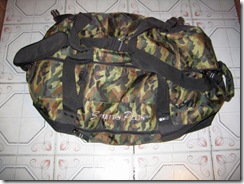
      Although everyone’s needs will differ, I’ve a brief tour of my Bug Out Bag below:

      You should consult the Ready.gov website for specific recommendations about what you should include in your kit.

      Everything I’ve got fits into a single duffle bag.


      I keep mine stocked (and checked for freshness every 6 months), and easily accessible in my home.  If I had to leave on a moment’s notice, at least I’d be leaving with more than the clothes on my back.
       

      Picture 007s


      You’ll notice in the pictures below just about everything is kept in plastic bags. 

      Picture 001s

      First comes the electronics.  


      While I would obviously want to grab my cellphone (and my beloved iPod) on the way out the door, some basics that stay in the bag are an LED Lantern, a battery operated radio, extra batteries, a small pocket knife, and a hand-crank flashlight.


      Picture 002s

      Next in line is 72 hours of food


      I’ve a couple of MREs, a couple of `pouch meals’ that can be eaten warm or cold, some soup mixes, some instant oatmeal, and (don’t forget) something to eat and drink out of, and some plastic utensils.
       

      Picture 009


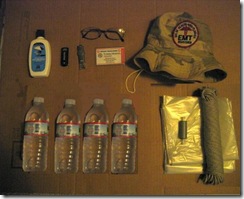
      Next come some basic `survival’ items.  


      Water (I usually carry 4 or 5 pints), hat, spare glasses, sun block, essential computer backups on flash drives, a copy of my medical history, and some plastic sheeting, duct tape, and some light rope.


      With those last three items, I have the makings of an emergency shelter if need be.

      Picture 003s

      Next comes a combination toiletry kit (toothbrush, paste, floss, toilet paper, small garbage bags)/mini first aid kit.  I’ve also got some aspirin, and 3 prescriptions I’d hate to be caught without in an emergency.


      Tucked away inside this kit I also have some quarters, some folding money, and copies of my driver’s license, a list of emergency phone numbers, and copies of some other important papers.


      I also threw in a pair of reef-runners.   Light mesh shoes that are good for walking in water.  They dry out quickly.   Admittedly, they are a bit bulky, but this is Hurricane country, and dry shoes could be a godsend in a crisis.


      Picture 005s


      And lastly, I’ve some dry clothes and a fleece blanket.  Everything, of course, bagged to keep dry.


      There you have it.  Total weight, about 22 lbs.


      Everything I need to stay warm, dry, nourished, and reasonably comfortable for 72 hours.  Plus the added benefit of having two sources of light, an emergency radio, a little cash, a mini first aid kit, and some basic toiletries.


      Things that would take me precious minutes to gather up during an emergency.  Time I simply might not have.


      Of course, you’d be hard pressed to put everything for a family of four into one bag.  So each family member should have their own BOB.  


      Some items, like the radio, lights, and first aid kit needn’t be duplicated in each bag. 


      I keep my BOB within arm’s reach of my first aid kit, and would hopefully be able to grab both, even in an emergency.   Frankly, I’d feel naked without it.


      image


      Over the years, having a well stocked first aid kit has come in very handy.  It is amazing the peace of mind that comes from being ready for an emergency.


      I do these things because preparing is easy.


      It’s worrying that is hard.


      Note:  For international readers who might be unfamiliar with the Americanism of `get out of dodge’, it comes from the old western radio & TV series Gunsmoke, where the Marshall would warn the bad guys to leave or else . . .


      Today, it is often used to mean getting away from any dangerous situation.


      Friday, March 25, 2011

      Fukushima: Voluntary Evacuation Urged in 20km - 30km Radius Zone


      # 5443


      image

      Voluntary evacuation urged in the red shaded zone.

      Graphic NHK World News 


      Chief Cabinet Secretary Yukio Edano told reporters today that residents living between 20km and 30km of the damaged Fukushima reactor should consider voluntary evacuation at this time to avoid further hardship.


      Citing severe living conditions brought on - in part - due to harsh disruptions of essential services and breaks in the local supply/distribution chain, he urged those who have remained in the `stay indoors’ zone for the past two weeks to consider leaving.


      He also stated that depending upon radiation levels, the government could extend the mandatory evacuation zone in the coming days.


      NHK World News has an article and a video report on this story at:


      Edano: Voluntary evacuation from 20-30 km advised

      Friday, March 25, 2011 13:17 +0900 (JST)

      Wednesday, March 16, 2011

      NRC Offers Americans In Japan Evacuation Recommendations


      # 5408


      I’ve been looking for the official statement for a couple of hours, but Sharon Sanders at FluTrackers beat me to it.   Here is the statement by the United States’ NRC (Nuclear Regulatory Commission) on prudent evacuation advice for Americans in the vicinity of Japan’s damaged reactors.


      You’ll note that their evacuation recommendations (50 km) are considerably more aggressive than the one issued (20 km) by Japanese officials.


      image

      NRC PROVIDES PROTECTIVE ACTION RECOMMENDATIONS BASED ON U.S. GUIDELINES


      Under the guidelines for public safety that would be used in the United States under similar circumstances, the NRC believes it is appropriate for U.S. residents within 50 miles of the Fukushima reactors to evacuate.


      Among other things, in the United States protective actions recommendations are implemented when projected doses could exceed 1 rem to the body or 5 rem to the thyroid. A rem is a measure of radiation dose. The average American is exposed to approximately 620 millirems, or 0.62 rem, of radiation each year from natural and manmade sources.


      In making protective action recommendations, the NRC takes into account a variety of factors that include weather, wind direction and speed, and the status of the problem at the reactors.


      Attached are the results of two sets of computer calculations used to support the NRC recommendations.


      In response to nuclear emergencies, the NRC works with other U.S. agencies to monitor radioactive releases and predict their path. All the available information continues to indicate Hawaii, Alaska, the U.S. Territories and the U.S. West Coast are not expected to experience any harmful levels of radioactivity.

      Sunday, June 06, 2010

      Of Pandemics, Hurricanes and An Abundance Of Caution


      # 4626


      As a paramedic I frequently took precautions for my patients that quite often, I knew were probably unnecessary. 


      Victims of car accidents nearly always got a cervical collar, and most were strapped onto a backboard, despite their often vehement complaints. Why?   Because of the slight possibility that they might have a spinal injury that could be worsened by movement during transport.


      Patients with chest pain were ferried from where ever we found them by gurney to the ambulance . . . even if they insisted they were okay to walk.   Why?   Because the exertion of walking might bring on a fatal arrhythmia. 


      Most of the time, these (and a hundred other) precautionary actions were unnecessary.  Most people in car wrecks don’t have neck or back fractures, and many heart attack victims wait hours before calling an ambulance and could probably easily make the walk out to the ambulance.


      But you do these things to protect the 1 in 100 where these steps would make a real difference.   


      When you are responsible for the health and safety of a patient you are expected to do everything reasonably possible to protect them.


      Call it the `mindset’ of a paramedic (or anyone else charged with the safety and protection of others)


      Even if, in retrospect, some of those efforts might seem `overkill’.

      Nearly every year, some area of the United States’ coastline is threatened by a hurricane and some form of evacuation is ordered by local emergency management officials.


      Those who live in low-lying or flood prone areas often have 24 hours or less to get to safety, a process that for many is invariably difficult, expensive, and inconvenient.


      And the vast majority of these folks will return after the storm has passed to find their home intact. Discovering that they could have safely stayed home and ridden out the storm.


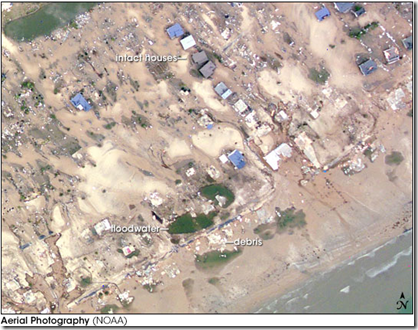
      But of course, sometimes we end up with scenes like these, proving the absolute wisdom of evacuating before the storm.


      Remnants of Crystal Beach, TX  After Ike in 2008

      image

      Hurricane Andrew (1992)


      Because of early warnings and an emphasis on evacuation of damage prone areas, hurricanes in the United States have become mostly a killer of property . . . not people.


      Katrina, which claimed more than 1800 lives in 2005, was an exception.  And that was primarily because New Orleans sits below sea level and so many people failed (for a variety of reasons) to get out of the area in time.


      Emergency planners must make the decision about whether to order an evacuation 36 to 48 hours in advance of a the storm. They know that the storm may lose intensity before making landfall or that it may veer away at the last minute.


      They also know that the costs and burden of evacuation on the affected communities will be high. And sometimes evacuations can end up costing lives, as happened during the exodus for Hurricane Rita in 2005.


      It’s a tough position to be in.  Particularly when you can’t possibly know how things will turn out.


      And it isn’t so different from the position that the World Health Organization found itself in a little more than a year ago, when they were faced with an emerging novel influenza virus that was quickly spreading around the globe.


      Although not as deadly as some influenza pandemic strains of the past, the concern was (and remains) that the virus could pick up virulence, or antiviral resistance, and pose a bigger threat down the line.


      And so the WHO, the CDC, and most of the public health agencies around the world went on the offensive.  They geared up to deal – not so much with the pandemic at hand but with the pandemic it might become.


      Today newspaper editorials, bloggers, and pundits are attacking the WHO, and other public health organizations, for overreacting to the pandemic threat.   They, of course, have the advantage of a year of hindsight.


      Even those pundits who maintained from the beginning that this virus wasn’t worthy of global concern, did so from the safety of the sidelines. 


      It’s not as if they were going to be held responsible for an inadequate response should the pandemic turn ugly in the fall.


      Those who insist that a pandemic has to be a scourge like 1918 forget that for most of the world, the 1968 pandemic was almost a non-event. And the 1957 pandemic – while a bit more severe – was hardly cataclysmic in nature.


      History has shown that pandemics, like hurricanes, often don’t live up to the hype.   But knowing that doesn’t give emergency planners the luxury of ignoring their potential for disaster.


      Could the WHO have done a better job communicating the risks of novel H1N1 to the world? 


      You bet. 


      Although I have serious doubts that the press would have delivered the message to the public much differently, even if they had. This was a big story, and it was milked by some aspects of the media for all it was worth.


      More than a year ago, I predicted that no matter how the pandemic turned out, this was a no-win situation for public health officials.  I regret to see that I was correct.


      Before We Ride Down And Shoot The Survivors
      The No-Win Situation
      Hubris And The Flu
       

      This year, we may see sections of our coastline threatened by a hurricane, and evacuations ordered.   With luck, the storms will turn out to be less than feared, and a lot of people will return to find their homes unscathed.


      And no doubt, some of those people who evacuated will curse the emergency managers who `panicked’ and ordered them to leave their homes.


      Paramedics will continue to backboard and place C-Collars on anyone who might have a spinal injury, despite the protests of the patient.  And patients with chest pain will be placed on gurneys, even if they think they can walk to the ambulance.


      Those whose job it is to protect the public are expected to take these measures when lives are at stake. It is their duty to assume the worst, and act with an abundance of caution.


      And the same holds true for the WHO’s declaration of a pandemic, and gearing up to deal with it.  Even if the threat doesn’t end up being as great as initially feared.


      They have the duty to prepare for the worst.  


      They shouldn’t be excoriated when things turn out less dire than they planned for.


             *            *              *               *              *     

      Note:   On the subject of conflicts of interest by advisors to the WHO, I’m holding any judgment in abeyance until the facts are in.


      I’m not surprised in the least that leading experts in vaccines and antivirals would have ties to the pharmaceutical industry, and simply having such ties doesn’t make them guilty of malfeasance.


      Unfortunately, many see political or economic opportunity in lodging these accusations, even without proof of wrongdoing, and the press is only too happy to print them.


      I will need to see a lot more than blanket accusations before I’ll buy into any of these stories.