Showing posts with label NPM. Show all posts

Sunday, September 30, 2012

NPM12: Because We Don’t Know What Tomorrow Will Bring

image


Note: Today marks  the final day of National Preparedness Month, but that in no way signals the end of your need to prepare. Preparedness is a year-round job. 


Over the past 30 days I’ve posted more than a dozen preparedness blogs, so today I thought I’d explain how I became a `prepper’.


Follow this year’s campaign on Twitter by searching for the #NPM or #NPM12 hash tag.


# 6597


I confess that I didn’t really start to think seriously about preparedness until 1984, when I bought my first sailboat and began to outfit it for extended coastal cruising.


I knew there would be times when my wife and I would be absolutely on our own – often miles from shore or in some remote region of the Ten Thousands Islands - well beyond the puny range of our VHF radio.


Suddenly, I was faced with playing the `What if?’ game.


  • What if one of us got hurt?
  • What if we were dismasted or driven hard aground?
  • What if the outboard motor or radio died?
  • What if we sank!


What if . . . what if . . . what if . . .  the possibilities for disaster were endless and daunting, and then there were the less emergent considerations. 


How much food and water could we carry?  How much fuel?   How would we generate electricity for anchor, navigation, and interior lights . . . and for the radio?


As the only thing smaller than our 23-foot Grampian sailboat was the budget we had for outfitting her, it took nearly a year to get her ready for the cruise. Twelve months, and $7,500 dollars later (and that included the price of the 12 year old boat!), we headed south.


image
Cheryl at the Helm of Halcyon


I’m happy to report that while we did see our share of storms, gear failures, minor injuries, and accidental groundings we managed to enjoy the better part of a year cruising without any major mishaps.


But it wouldn’t have had a happy ending without proper planning.


During the mid-1990’s I moved from the water to the land, and tried my hand at taming 24 acres of Missouri backwoods. Once again, living miles from the nearest town and occasionally cut off for a week or more by snow and ice storms, made preparedness and self-sufficiency paramount.


The view from our 4000sf garden


I confess - I’m not really much of a backwoodsman - and while I learned many skills during that time, I finally was able to return to Florida in 2005 (the statute of limitations had expired).


So you see, I come by my preparedness streak honestly.


Even though I no longer live aboard a boat, or in the backwoods, I still believe in being prepared. 


Not for the end of the world - as seems to be the popular perception of preppers - but for the very real and all-to-common disasters and emergencies that happen all the time.


Thirty days ago, on the first day of National Preparedness Month, I highlighted a very effective graphic from  Ready.gov that shows the `day before disaster’ for all 50 states.


The date when it was still not too late to prepare.

Click through to the interactive map, to see each state’s date with destiny.


image

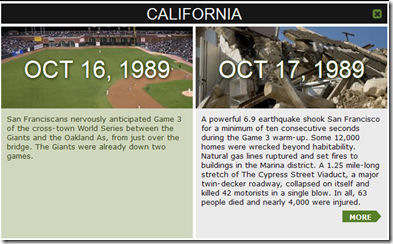
If you click on California, for example, you’ll get:
 

image

You get the idea. 


The takeaway point is, you never know whether today is the day before your disaster . . .


The thing that keeps emergency planners up at night is the knowledge that during a disaster, far too many people will be unprepared to fend for themselves until emergency help can arrive.


Which is why the Federal government wants all of us to be prepared for emergencies, as they know that during a `normal’ disaster (of which dozens occur every year) citizens may be on their own for up to 72 hours


In an extreme disaster (like we saw with Katrina in 2005), some people may end up having to fend for themselves for a week or longer.


image


Based on the  events in Japan (or after Hurricane Katrina in New Orleans, or the earthquake in Haiti) 3 days of supplies many not be enough for a truly worst case scenario.


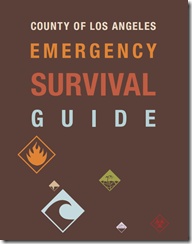
The County of Los Angeles Emergency Survival Guide calls for having 3 to 10 days worth of food and water.


Personally, I believe that 2-weeks of supplies isn’t an unreasonable goal, particularly if you live in earthquake or hurricane country.


The L.A. guide may be downloaded here (6.5 Mbyte PDF).
 

image


The bottom line is everyone should have a disaster plan. Everyone should have a good first aid kit, a `bug-out bag’, and sufficient emergency supplies to last a bare minimum of 72 hours.


For more on  disaster preparedness, I would invite you to visit:


NPM12: Disaster Buddies
When 72 Hours Isn’t Enough
NPM12: The Gift Of Preparedness
An Appropriate Level Of Preparedness

Thursday, September 27, 2012

NPM12: One For The Home, And One More For The Road

Note: This is day 27 of National Preparedness Month.  Follow this year’s campaign on Twitter by searching for the #NPM or #NPM12 hash tag.


This month, as part of NPM12, I’ll be rerunning some updated  preparedness essays (like this one) , along with some new ones.


kit2

Inside my primary first aid kit.  Notice the masks and goggles, along with two flashlights (one hands free). 


# 6589

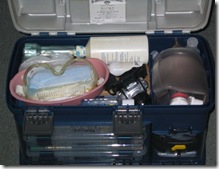
As a former EMT/Paramedic, I confess to feeling a bit naked without a decent first aid kit within easy reach.  And this is why I maintain two, well equipped, medical kits; one for my home, and one for the trunk of my car.


I’ll admit that owning two ambu-bags borders on the excessive, but I certainly feel better knowing they are there.


Well equipped first aid kits are a necessity in every home, and should also be found in the trunk of every car. While you can purchase a ready-made kit (the quality of which varies depending on price), I’ve always preferred to create my own.


I undoubtedly have a more elaborate kit than most, but perhaps a look inside my auto first aid bag will inspire some of my readers to make one of their own.


The `bag’ is an old style Laptop computer case, with a handle and a shoulder strap.  I like these, because they have numerous compartments, are soft, and are reasonably waterproof.


auto kit 009


On the `trauma’ side of the bag, I’ve got `Kling’ roll bandages, an ACE bandage, a couple of cravat `Triangle’ bandage (sling & swath), sterile 4x4 gauze pads, paper tape, Band-Aids, antibiotic cream and several absorbent feminine pads (they make excellent trauma dressings). 


auto kit 003


On the opposite side, I’ve got an `ambu’ bag-mask resuscitator along with a selection of adult and child airways, a foam C-Collar, a B/P cuff, stethoscope, flashlight, and some ammonia caps – hidden away where you can’t see them are bandage shears, tweezers, and a magnifying glass, along with a spare pair of reading glasses.


auto kit 002


There is also a penlight, a felt tipped pen, and a note pad.


Under the front `cover’ flap, I keep some basic OTC medicines, including aspirin, acetaminophen, some hand antiseptic, and a bulb syringe (can be used for minor suctioning).


auto kit 004


Under the flap on the other side, I’ve got surgical & N95 masks, exam gloves, and a `space’ blanket.


auto kit 005


Of course, having a kit isn’t enough.  You need to know how to use it.


And for that, you need first aid training.  If you haven’t already taken a course, contact your local Red Cross chapter, and find out what is available in your area.   And don’t forget the CPR training (or recertification!) as well.


Whether you buy a ready-made kit, or make your own, now is a good time to make sure you are fully equipped to deal with a medical emergency.


For more information I would invite you to visit:


FEMA http://www.fema.gov/index.shtm

READY.GOV http://www.ready.gov/

AMERICAN RED CROSS http://www.redcross.org/

Monday, September 24, 2012

NPM12: Those Who Forget Their History . . .

image


Note: This is day 24 of National Preparedness Month.  Follow this year’s campaign on Twitter by searching for the #NPM or #NPM12 hash tag.


This month, as part of NPM12, I’ll be rerunning some updated  preparedness essays (like this one) , along with some new ones.


# 6577


. . . .  are condemned to wait longer in triage.


Not where you thought I was going, is it?  But this is an important aspect of personal preparedness.


Knowing, and having immediately available, a  medical history on every member of your family should be part of everyone’s emergency plan.

As a former paramedic - one who has struggled to take thousands of medical histories in the back of a moving vehicle, or at the scene of a medical emergency -  I know how difficult getting an accurate and complete medical history can be.


As you might imagine, when someone is unconscious, or unable to respond to questions, getting a medical history becomes more problematic.


You have to rely on relatives, friends, neighbors . . .and sometimes even snooping in their medicine cabinet.


Often, people don’t even know what medicines they are taking, or why.


If I had a nickel for every time a patient denied taking meds, but under the pressure of additional questioning, admitted to taking `a red one, a blue one and two white ones in the morning . .  and 3 white ones at night’well, I’d have a lot of nickels.


Since I act as a medical advocate for several relatives, I maintain a pretty elaborate medical history on each of them.   When one of them falls ill, a copy goes with them to the doctor or the emergency room.


I never see my doctor without bringing him an updated history.  Sure, he knows me.  But he sees hundreds of patients, and me only every few months.  There is no way he can remember the details of my medical history.


So I provide him with a short, 1 page synopsis that he can scan in about 30 seconds, to make his life, and mine, easier (see A History Lesson to learn how).


Since you can’t always know, in advance, when you might need medical care it is important to carry with you some kind of medical history at all times.  It can tell doctors important information about your history, medications, and allergies when you can’t.


Many hospitals and pharmacies provide – either free, or for a very nominal sum – folding wallet medical history forms with a plastic sleeve to protect them.


I’ve scanned the one offered by one of our local hospitals below. It is rudimentary, but covers the basics.


medhx1

medhx2


In a medical emergency, minutes can make the difference between life and death.  And even in less urgent cases, having all of this information can go a long ways towards speeding your treatment.


You should make it a point, this week, to get medical history forms for every member of your family – regardless of their age – and fill them out.


Except for small children, everyone should find a way to carry it with them at all times.


This is not a one-time, make it and forget, prep.  You need to update it every time you add or change your medications, or your medical history changes.    It only takes a few minutes now.


But it could save a lot of time later.

Saturday, September 22, 2012

NPM12: The Ethics Of Preparedness

image


Note: This is day 22 of National Preparedness Month.  Follow this year’s campaign on Twitter by searching for the #NPM or #NPM12 hash tag.


This month, as part of NPM12, I’ll be rerunning some updated  preparedness essays (like this one) , along with some new ones.


# 6570


As a long-time committed prepper, I admit I come away from viewing cable shows like Doomsday Preppers on the National Geographic Channel and Doomsday Bunkers on the Discovery Channel with a certain degree of unease.


The vivid doomsday scenarios and over-the-top preparations may make for entertaining TV, but they are hardly representative of the mainstream preparedness movement.


When FEMA, Ready.gov, and the American Red Cross encourage us to prepare for emergencies, they aren’t asking us to dig a bunker, or stockpile 20 years worth of freeze dried foods.


They are hoping for a more reasoned response (see NPM12: Everyday Preppers).


But even if we are talking about a week or two worth of emergency supplies, there are some who view the idea that preparing – when others with limited financial means cannot - is somehow unfair, or even unethical.


A noble and egalitarian sounding idea, I suppose.


But the reality is that when more people are prepared before a crisis, fewer people will be competing for finite and sometimes slow-to-arrive emergency assistance in the days following a disaster.


And when you as an individual, family, or business are prepared, you are in a better position to offer help to friends, neighbors, relatives, or your community.


Which makes prepping not only ethical, but extremely practical as well.


And it isn’t just me saying that.


In October, 2008 I wrote a blog which highlighted the John's Hopkins Study entitled Ethics and Severe Pandemic Influenza: Maintaining Essential Functions through a Fair and Considered Response.


It included the following snippet from the summary provided on  the Johns Hopkins Berman Institute of Bioethics website.


. . .  individuals and families who can afford it should do their best to prepare for any disaster. The paper notes, the more initiative the general public exercises in stockpiling several weeks' worth of food, water, paper goods, batteries medicines, and other needed supplies, the less vulnerable they will be to a break in the supply chain.


It is important for leaders to communicate to the middle class and the wealthy that it is their responsibility to prepare for self-sufficiency in order to free up scarce supplies and allow first responders to direct their attention towards those too poor or vulnerable to prepare themselves.

While this may not have been the main thrust of this paper's message, it is a powerful component. One that bloggers such as myself have been trying to promote for several years.


As long as our supply chains are intact, grocery store shelves are full and capable of being restocked, and no major shortages exist it is not hoarding, selfish, or unethical to be stockpiling a reasonable amount of emergency supplies for you, your family, and others you might be able to assist during a disaster.


During a crisis, relief agencies will have their hands full trying to help those who were unable to prepare, or who lost their preps due to a disaster.


By being prepared in advance, you take some of that burden off these agencies, which will allow them to concentrate their efforts on helping those less able to help themselves.


And by being prepared, you are in a better position to help others as well.


And that’s a win-win situation. For you, your family, and your whole community.


While 72 hours is considered the minimum amount of  time for which you and your family should be prepared, there is nothing that says you shouldn’t strive to do better than that.


A week or more of emergency supplies (along with an emergency NWS radio, first aid kit, and a family disaster plan) is a laudable, and easily obtainable, goal. 


Over the past decade, personal and community preparedness has become a national goal.


For more information, visit:

FEMA http://www.fema.gov/index.shtm

READY.GOV http://www.ready.gov/


It’s really the ethical thing to do.

Thursday, September 20, 2012

NPM12: When Evacuation Is The Better Part Of Valor


bob 001a

My Bug-out-bag, Canteen, & Toiletry kit

Note: This is day 20  of National Preparedness Month.  Follow this year’s campaign on Twitter by searching for the #NPM  & NPM12 hash tag.


This month, as part of NPM12, I’ll be rerunning some edited and updated older preparedness essays, along with some new ones.


# 6566


There is probably no tougher decision to be made in the face of a disaster than having to evacuate from your home.


Home is familiar, home is comfortable, and home is where your processions are.


So quite understandably, no one wants to leave home during an emergency if they can possibly avoid it. In fact, it can be such a traumatic decision that some people will risk everything to avoid evacuating.


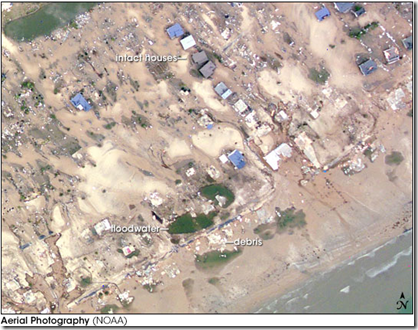
But the following photo taken in Crystal Beach after Hurricane Ike in 2008 proves that staying home in the face of a flood, a hurricane, or other natural disaster can have deadly consequences.

image


Being able to leave in a hurry when an evacuation has been ordered means having a plan, a destination, and an emergency `to go’ kit or `BOB’ already equipped, and standing by.


In the vernacular, a `bug-out bag'  or `BOB’ is a bag of emergency supplies, ideally kept at the ready, that one can grab on the way out the door during an emergency.


Every hurricane season I go through my personal bug out bag, and replace flashlight and radio batteries from last year, and swap out older emergency rations for newer ones.


A BOB isn't supposed to be a survival kit, but rather, is supposed to provide the essentials one might need during the first 72 hours of a forced, and sometimes unexpected, evacuation.


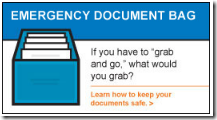
It should contain food, water, any essential prescription medicines, copies of important papers (ID's, insurance, important Phone #s), a first aid kit, portable radio, flashlight, extra batteries, and ideally blankets and extra clothes.


While having to evacuate your home may seem like an unlikely event, every years hundreds of thousands of Americans are forced to do so.  Rivers spill their banks, dams break, brush fires rage out of control, even sudden industrial accidents can force evacuations.


And unlike with a hurricane, you won’t always have advance warning.


Ready.gov has the following advice on how to prepare for an evacuation.


Evacuating Yourself and Your Family

image

There may be conditions under which you will decide to get away or there may be situations when you are ordered to leave. Follow these guidelines for evacuation:

  • Plan places where your family will meet, both within and outside of your immediate neighborhood. Use the Family Emergency Plan to decide these locations before a disaster.
  • If you have a car, keep a full tank of gas in it if an evacuation seems likely. Keep a half tank of gas in it at all times in case of an unexpected need to evacuate. Gas stations may be closed during emergencies and unable to pump gas during power outages. Plan to take one car per family to reduce congestion and delay.
  • Become familiar with alternate routes and other means of transportation out of your area. Choose several destinations in different directions so you have options in an emergency.
  • Leave early enough to avoid being trapped by severe weather.
  • Follow recommended evacuation routes. Do not take shortcuts; they may be blocked.
  • Be alert for road hazards such as washed-out roads or bridges and downed power lines. Do not drive into flooded areas.
  • If you do not have a car, plan how you will leave if you have to. Make arrangements with family, friends or your local government.
  • Take your emergency supply kit unless you have reason to believe it has been contaminated.
  • Listen to a battery-powered radio and follow local evacuation instructions.
  • Take your pets with you, but understand that only service animals may be permitted in public shelters. Plan how you will care for your pets in an emergency.


Since I live in a hurricane evacuation zone, I have an emergency plan, a pre-arranged place to go, and my evac  kit (see Inside My New Bug Out Bag) packed and ready to go.


Of course, you’d be hard pressed to put everything for a family of four into one bag.  So each family member should have their own BOB.


Some items, like the radio, lights, and first aid kit needn’t be duplicated in each bag. 


I keep my BOB within arm’s reach of my first aid kit, and would hopefully be able to grab both, even in an emergency. 


image


On top of this, I keep a spare first aid kit in my car, along with an `overnight bag’, and I have a third duffle bag packed with extra supplies, that I would hopefully be able to throw in the car as well.


But if I had to, I could easily go 72 hours on just my bug-out bag alone.


I do these things to give me peace of mind and confidence that I’m ready to deal with just about any emergency that comes my way.


The truth is, preparing is easy.


It’s worrying that is hard.

Monday, September 17, 2012

NPM12: Giving Preparedness A Shot In The Arm

image


Photo Credit PHIL


# 6559


Note: This is day 17  of National Preparedness Month.  Follow this year’s campaign on Twitter by searching for the #NPM  & NPM12 hash tag.


This month, as part of NPM12, I’ll be rerunning some edited and updated older preparedness essays, along with some new ones.


While you might not have thought about it, getting your seasonal flu shot each year should be part of your overall preparedness plan. During a disaster or prolonged emergency you are likely to be tired, stressed, and your immune systems could be weakened.

The last thing you need during a crisis is to be sick with the flu on top of it.


This morning, as I dutifully filled out my weekly `Flu Near You’ Survey (which takes only a couple of seconds each week) I noticed a recent rise in ILI (influenza like illness) reports in my state of Florida.


image

Flu Near You Chart for Florida 9/17/12


Whether this spike is an anomaly, of the first blush of this fall’s flu season, is too soon to tell.  But it did serve to remind me that mid September isn’t too early to get my seasonal flu shot.


Which is exactly what I did this morning. 


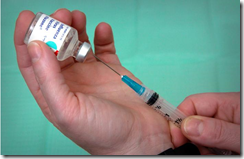
I went to my local CVS pharmacy, filled out a short form, and a couple of minutes later got a completely painless (nice job, Carol) shot from the Pharmacist.


According to the CDC, more than 72 million doses of this year’s flu vaccine have already been distributed, so finding a shot should be a piece of cake.


image


Due to the continual antigenic drift of flu viruses, flu vaccine formulations are frequently adjusted. After 3 years with essentially no changes in the flu vaccine, this new formulation makes changes to both the H3N2 and B virus strains.


The H1N1 component remains essentially unchanged, with the A/California/7/2009 (H1N1)pdm09-like  still included.

  • The old A/Perth/16/2009 (H3N2)-like virus now gives way to the A/Victoria/361/2011 (H3N2)-like virus.
  • And the Victoria lineage B/Brisbane/60/2008-like virus will be replaced by a Yamagata strain; the B/Wisconsin/1/2010-like virus. 


Vaccines have excellent safety records.


Yes, taking any medicine – including a vaccine – entails some (usually miniscule) degree of risk. But those risks pale when compared to the dangers of catching the diseases they are designed to prevent.


Influenza sickens millions, and kills tens of thousands of people, every year in this country. 


And while the vaccine can’t promise 100% protection, it – along with practicing good flu hygiene (washing hands, covering coughs, & staying home if sick) – remains your best strategy for avoiding the flu this winter.


For more on flu vaccine effectiveness you may wish to revisit CID Study: Effectiveness Of 2010-11 Flu Vaccine.


Not unexpectedly, this study found the protective effects of the flu shot were substantially reduced in the elderly.  This is a topic we’ve addressed before (see Study: Flu Vaccines And The Elderly).


Last year, NFID - the National Foundation for Infectious Diseases - convened a group of experts to address the issues of influenza and the elderly. From that panel a 5-page brief has emerged, called: Understanding the Challenges and Opportunities in Protecting Older Adults from Influenza.

image


While the elderly generally see less protection from the flu vaccine, they state that older individuals may still mount a robust immune response. Even if the vaccine doesn’t always prevent infection in the elderly, studies suggest that the vaccine may blunt the seriousness of the illness in those over 65.


For those over 65, the option of taking the new high dose flu vaccine is now available (see MMWR On High Dose Flu Vaccine For Seniors), although we don’t have a lot of data yet on how much more effective it is among that cohort.


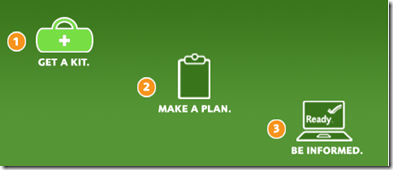
Ready.gov urges all Americans to follow these 3 steps to better preparedness:

image

GET A KIT

MAKE A PLAN

BE INFORMED


But if you want to be truly prepared, I would recommend you consider adding an important 4th step.


Get a shot

Sunday, September 16, 2012

NPM12: Disaster Buddies

image

Note: This is day 16 of National Preparedness Month.  Follow this year’s campaign on Twitter by searching for the #NPM and #NPM12 hash tags.


This month, as part of NPM12, I’ll be rerunning some edited and updated older preparedness essays, along with some new ones.


# 6557


One of the ironies of our increasingly connected world is that our closest friends need not live anywhere near us.  Facebook, Twitter, email, and texting have allowed us to interact at a distance as never before.


And during a disaster, that can be both a problem, and a blessing.


The blessing is that since many disasters are local, if you are hit by a tornado, or an earthquake, or a flood . . . having friends outside the impact area could be a lifesaver.


The downside, of course, is that increasing distance makes getting direct assistance from a friend during an emergency more difficult.


In 2007 I began to promote the idea of each of us having, and being, `Flu Buddies’.  I fleshed out the idea in a 2008 blog called Lifelines In A Pandemic.  


A `Flu Buddy’ is simply someone you can call if you get sick, who will then check on you every day, make sure you have the medicines you need (including fetching Tamiflu if appropriate), help care for you if needed, and who can call for medical help if your condition deteriorates.


Those people who care for others, like single parents, also need to consider who will take care of their dependents if they are sick.


Nearly 1 person in 10 in the United States lives alone.   That’s roughly 27 million people who are particularly vulnerable during an epidemic.


I returned to this theme often during the 2009 pandemic, including Pandemic Solutions: Flu BuddiesUK: Call To Appoint Swine `Flu Friends’ and Canada Urges People To Find `Flu Buddies’.


After the pandemic receded I reworked the idea into a more generic `Disaster Buddy’ concept in a blog called  In An Emergency, Who Has Your Back?.


While we tend to think of disasters as large scale events, it doesn’t require a pandemic, earthquake, or hurricane to put you in perilous straits.


A house fire, car accident, sudden illness, or some other more limited emergency can overwhelm as well, and having a pre-existing support system makes a lot of sense.


And the best way I know is by arranging to have (and to be) a `Disaster Buddy’.


A `Disaster Buddy’ is simply someone you have prearranged that you can call on during a crisis, and who in turn, can call on you if they need help.


It only works if it is reciprocal.


Frankly, having (and being) a `Disaster Buddy’ to friends, neighbors, and relatives should be part of everyone’s family disaster plan. 


No one likes to impose on a friend, of course.


But if you’ve already established a `disaster buddy’ relationship  – one that is fair and reciprocal – it shouldn’t be considered an imposition.


In the parlance of paramedics, cops, firefighters and the military . . .  you have their back, and in return, they have yours.”


It is a simple concept, but one that needs to be talked out in advance, not simply assumed.


While some people invest in a stockpile of freeze dried food, or buy the latest survival  gadgets, and think themselves prepared   . . .  having friends you can really depend on in an emergency is the greatest prep of all.


It is also worth mentioning that there has never been a better time to volunteer to help with the American Red Cross, The Medical Reserve Corps, CERT, or your Neighborhood watch.


We are truly only prepared as our friends, families, and surrounding community are.  There are roles to play for everyone, including civic organizations, schools, and church. 


Now - before a disaster occurs - is the time to sit down and talk to your friends, family, and neighbors about how you will help one another during a personal or community wide crisis.


For more potentially life saving preparedness information, I invite you to visit:


FEMA http://www.fema.gov/index.shtm

READY.GOV http://www.ready.gov/

AMERICAN RED CROSS http://www.redcross.org/

Thursday, September 13, 2012

NPM12: The Gift Of Preparedness

image


Note: This is day 13 of National Preparedness Month.  Follow this year’s campaign on Twitter by searching for the #NPM or #NPM12 hash tag.

This month, as part of NPM12, I’ll be rerunning some updated  preparedness essays (like this one) , along with some new ones.


# 6552


Almost 5 years, and roughly 5,600 blogs ago (Nov. 1, 2007 to be precise) I posted an essay called Hickory Farms Will Hate Me For This, where I suggested that instead of buying ugly neckties, holiday-themed sweaters, or an assortment of unidentifiable cheeses for the people on your holiday gift-giving list - that you give them preparedness items instead.


This epiphany came to me one fall day a few years back when I was rummaging through a local warehouse closeout store and found a bin of `shake’ LED flashlights on sale for .77 cents each. You know the type, you shake for a few seconds and it powers the flashlight for several minutes.

image


I bought 40 of them on the spot, and that Christmas they ended up as `stocking stuffers’ for all of my friends. 


Since then, whenever possible, I give preparedness items as gifts.  And every year I update that original blog with some of the new preparedness gifts I’ve found or purchased.


The great thing is, many of these items can often be had for just a few dollars, yet they can be lifesaving (or at least important to have) in an emergency.


While I’m not endorsing any specific product or manufacturer, below you’ll find examples of some of the preparedness items I’ve either bought for myself, or for family and friends over the past few years.


A couple of years ago I ran across a deal on LED headlamps, and bought about 20 of them for $2 apiece.  The following year, I found LED Cap lights (they clip to the bill of a baseball style cap) for $3 each, which I confess I like even better.


image


Hands free light can be a real plus in a crisis.  These too ended up in a number of people's Christmas and birthday packs.


During the year I keep my eye out for bargains such as these, and stock up when I find things on sale.Several years ago I picked up a number of LED lanterns for $3 apiece at a closeout store. They are particularly nice, and run about 40 hours on a set of AA batteries.


image


But last year, I found a newer item; a combination LED lantern/flashlight that sells for about $5, and it is rapidly become my new favorite.  Lightweight, versatile, and cheap.  A hard combination to beat.


image


This year, I’m seeing a lot more variety in LED lanterns and flashlights, providing a lot more bang for the buck. Not only do LEDs run a long time on a set of batteries, unlike gas lanterns, they don’t pose a fire safety hazard.


Every home should have a battery operated radio, yet many do not. A few years ago I bought my daughter a combination windup-battery-solar AM/FM/SW radio for under $40, and she uses it every day.

image


Last year, I found a combination AM/FM Weather ALERT radio at a discount store for under $20. Again, every home and business should have an emergency alert radio.


NOAA Radio


A pair of the FRS radios, like the ones I highlighted in this blog, would make an excellent gift for many families, and can be had for less than $25.


image


For Christmas a couple of years back I put together some first aid kits, and distributed them to a number of friends and relatives. You can either put one together yourself, or purchase one already assembled.


image


Living as I do in hurricane country, I’m always aware of the need to store water for emergencies. One of the items I’ve purchased for friends (and myself) are those collapsible 5-gal water carriers. For only about $5, you can store 5 gallons of water, and when not in use they fold up for storage. 


image


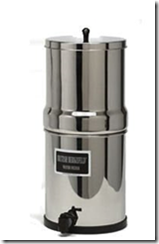
Although a bit pricier, I’ve also purchased emergency water filter/purification systems for several friends over the years. Here you’ll find a number of options ranging from purification tablets (chlorine or iodine based) for under $10, to high capacity filtration systems like the one below for about $200.

image


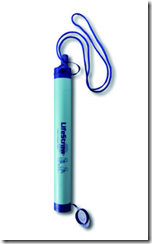
In between you’ll find a lot of filtration options in the $20 -$60 range, but I’m particularly pleased this year to see the LifeStraw ® is now available in the United States and Canada; at just 2 ounces, this personal water filter will reportedly filter 1000 liters down to .2 microns. 


Not bad for around $20.


image


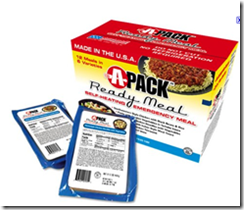
Even MREs can make an excellent gift, and a couple of years back I found cases of them heavily discounted at my local Costco warehouse. 


image


Battery chargers, or an inverter to turn any 12 volt battery into a 120 volt electrical source make wonderful gifts as well. 


chargers


Three summers ago, on a particularly hot Florida afternoon, we had a power outage that lasted more than 6 hours.  I wrote about it in Sweltering In Place.

While I was already set up with a 12 volt fan, my Sister and Father weren’t so lucky. . . . they ended up driving across town to sit in an air-conditioned restaurant for several hours.


The next day, I went out and bought them each a battery operated personal cooling fan, one that will run for nearly 24 hours on 4 D-Cells.


I paid about $12 each for them.

personal Fan


Something as simple, and as utilitarian, as a multifunction `Swiss’ army knife or a `Multi-tool’ makes a great preparedness gift.


swiss knife

image


Another inexpensive gift idea: For under $10 you can buy a box of exam gloves, and a box of facemasks.


image


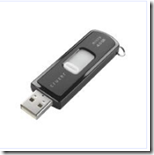
Joel over at Preparedness and Response came up with what I consider to be an excellent preparedness idea several years ago, giving USB flash drives to family and friends and instructions on how to back up their important papers and documents.
 

image

Inexpensive USB Drives start under $10.


He explains it in  his essay Helping others prepare (Personal Preparedness), where he gives his rationale for going with the durable mil-spec and encrypted, but fairly pricey IronKey brand.


My thanks to Joel for a terrific idea.


And lastly, I've put together CD's of preparedness videos, along with copies of online manuals and preparedness guides.  For the cost of a blank CD or DVD, and a little bit of my time, I've at least put this valuable information into my friend's hands.
 

I may just copy all of this info on to the USB drives I’m giving out this year instead of on CDs.


These are all useful, indeed, potentially lifesaving items, that most people simply don't think about needing until it is too late.


Giving them as gifts, instead of more traditional items,  not only helps prepare the people you love and care about for an emergency, it opens the door for conversations about pandemic preparedness.


We need to cultivate a culture of preparedness in this country, and around the world.


We can start doing that, one gift at a time.


And one last reminder for the upcoming Holiday Season.


This year, when we think about ways to give back to our community, remember that more people will be relying on community food banks than in years past.


In addition to anything else you might do, this is a good time to go through your pantry and donate foodstuffs that are approaching (but not exceeding) their `use by' date.

Thursday, September 06, 2012

NPM12: Everyday Preppers


Note: This is day 6 of National Preparedness Month.  Follow this year’s campaign on Twitter by searching for the #NPM or #NPM12 hash tag.


This month, as part of NPM12, I’ll be rerunning some updated  preparedness essays (like this one) , along with some new ones.


# 6538


After watching Doomsday Preppers on the National Geographic Channel and Doomsday Bunkers on the Discovery Channel many people may come away thinking that all preppers are crazed fanatics gearing up for the impending apocalypse. 


Which apocalypse you ask? 


Why, take your pick.  There appear to be scores of improbable nightmare scenarios fueling an `end of days’ fever these days, ranging from an all-out nuclear war to an asteroid strike to the fulfillment of the so-called `Mayan Prophesies’.


But for the vast majority of us who embrace the preparedness lifestyle - it is the far more common localized disaster that spurs us on:


. .. hurricanes, tornadoes, ice storms, blizzards, earthquakes, floods . . . along with even more limited emergencies like house fires, car accidents, or personal accident and injury.


Of course, if you want decent cable TV ratings, you don’t profile those who maintain a 14 day supply of necessities in their pantry, volunteer for CERT, have a well thought out family emergency plan, or take pride in keeping a well stocked first aid kit.


No . . .  you focus on families with elaborate secret underground bunkers, a 20 year supply of freeze-dried foods, weapons capable of taking down Godzilla with one well-placed shot, and a firm belief that the end is nigh.


It is TV, after all.


While we collectively wait for doomsday (and I’m perfectly content to wait a long, long time for mine) we are nonetheless faced with an ongoing parade of lesser - but no less burdensome to those affected – localized disasters.


They happen with surprising regularity - and unlike an abrupt 30 degree shift of the earth’s crust or the eruption of the Yellowstone Super Volcano - are something being prepared for is actually likely to help.


A severe storm can knock out electrical power and phone service for days, sometimes weeks. Public services (including 911) can be severely disrupted, and something as routine as obtaining food and potable water for your family may be difficult for several days.


There are many legitimate disaster threats out there, which is why FEMA, READY.GOV, and many other agencies actively promote personal, family, and business preparedness.


To that end the Federal government has produced copious toolkits, brochures, pamphlets, and even mobile apps designed to help citizens prepare . . . for just about anything.


One such toolkit is FEMA’s Are You Ready? An In-depth Guide to Citizen Preparedness (IS-22) – which, at 204 pages – ranks as one of the most comprehensive guides to public preparedness available.
image


FEMA describes this guide as:


An In-depth Guide to Citizen Preparedness

Are You Ready? An In-depth Guide to Citizen Preparedness (IS-22) is FEMA’s most comprehensive source on individual, family and community preparedness. The guide has been revised, updated and enhanced in August 2004 to provide the public with the most current and up-to-date disaster preparedness information available.


Are You Ready? provides a step-by-step approach to disaster preparedness by walking the reader through how to get informed about local emergency plans, how to identify hazards that affect their local area and how to develop and maintain an emergency communications plan and disaster supplies kit. Other topics covered include evacuation, emergency public shelters, animals in disaster and information specific to people with access and functional needs.


Are You Ready? also provides in-depth information on specific hazards including what to do before, during and after each hazard type. The following hazards are covered: Floods, Tornadoes, Hurricanes, Thunderstorms and Lightning, Winter Storms and Extreme Cold, Extreme Heat, Earthquakes, Volcanoes, Landslide and Debris Flows (Mudslide), Tsunamis, Fires, Wildfires, Hazardous Materials Incidents, Household Chemical Emergencies, Nuclear Power Plant and Terrorism (including Explosion, Biological, Chemical, Nuclear and Radiological hazards).

(Continue . . . )


Disasters happen.


And while they don’t often occur on a national or international scale (an assumption with which residents of Haiti, Pakistan, and Japan might just take exception), they can be devastating to large segments of our population.


Admittedly, a lot of the preparations highlighted by these `survivalist’ genre TV shows seem to be more than a little screwy, even to this lifelong prepper . . .


But having no plan . . . well that’s just plain nuts.

Monday, September 03, 2012

An Increasingly Complex Flu Field


Influenza Timeline 2012

(Click to enlarge)


# 6534


Up until 1977  it was considered normal that only one strain of influenza A circulated at a time.


When a new pandemic strain appeared (as it did in 1918, 1957, and 1968), the existing seasonal strain – for reasons that weren’t well understood – would vanish, and in time the new pandemic virus would settle in as the seasonal flu.


But in 1977 something unprecedented happened.


The H1N1 flu virus – which had been replaced by the pandemic H2N2 virus in 1957 (only to be replaced by the H3N2 strain 11 years later) - suddenly reappeared after 20 years absence.


The theory is that it escaped from a Russian or Chinese lab’s freezer, as it was almost unchanged from a strain not seen since the early 1950s. 


It was dubbed the `Russian flu’, and for a while, slammed Emergency rooms and Flu wards in a big way.


Most adults had some immunity left over from their exposures before 1957, and so kids under 20 were the hardest hit.  But unlike in 1918, 1957, and 1968 – this new flu didn’t depose the old flu.


Instead we ended up with two major Influenza A strains bumping shoulders and jockeying for position.  Some years H3N2 would dominate, and other years it would be H1N1.


Further complicating matters we also have Influenza B viruses, which while generally regarded as less serious than influenza A, have divided into two distinct lineages (Yamagata & Victoria.


And they too compete each year for dominance.


Which leaves us with (currently) four major flu strains to contend with; 

  • A/H1N109
  • A/H3N2
  • B/Victoria
  • B/Yamagata


These viruses constantly change and evolve over time, and we often have several clades of each strain at any given time. The most recent ECDC: Influenza Virus Characterization found 5 genetically distinct H3N2 strains in circulation across Europe.


The recent emergence of a new – antigenically different H3N2 strain, along with the recent dominance of the Yamagata influenza B virus, has prompted a major change in this year’s flu vaccine.


  • The H1N1 component remains essentially unchanged, with the A/California/7/2009 (H1N1)pdm09-like  still recommended.
  • But the old A/Perth/16/2009 (H3N2)-like virus now gives way to the A/Victoria/361/2011 (H3N2)-like virus.
  • And the Victoria lineage B/Brisbane/60/2008-like virus will be replaced by a Yamagata strain; the B/Wisconsin/1/2010-like virus. 


Which makes getting the flu vaccine this fall doubly important, as it is likely that community immunity to both of these strains is low.


Beyond these four, keeping researchers up late at night is the fact that there are no fewer than six influenza viruses that – while not well adapted to humans  – keep trying to nudge their way into the human host pool.


Most people by now are aware of the concerns over the H5N1 `bird flu’, but less well known are the H7 avian strains, which have managed to jump to humans several times over the past decade.


  • In 2003 an outbreak of H7N7 at a poultry farm in the Netherlands went on to infect at least 89 people. Most of the victims were only mildly affected, but one person died.
  • In 2004 two people in British Columbia tested positive for H7N3 (see Health Canada Report) during an outbreak that resulted in the culling of 19 million birds.
  • In 2006 and 2007 there were a small number of human infections in Great Britain caused by H7N3 (n=1)  and H7N2 (n=4), again producing mild symptoms.


H9N2 is another avian strain that has, on rare occasions, infected humans and is believed to have some pandemic potential. Over the past dozen years a small handful of cases have been identified – mostly in Hong Kong (see CIDRAP Avian Influenza (Bird Flu): Implications for Human Disease).


  • In January of 2010, in H9N2: The Other Bird Flu Threat, I wrote about the World Health Organization  recommending the creation of a candidate vaccine virus for H9N2.


And since 2005 the CDC has been reporting a growing number of swine flu variants that have managed – on rare occasions – to jump to humans.


The three main flu strains circulating in pigs are:

  • H1N1
  • H1N2
  • H3N2

When one of these swine viruses jumps to a human host, it is then called a `variant’ virus. 


Up until last year, it was the trH1N1 swine virus (now called H1N1v) that had been most commonly reported. The numbers were very low – rarely more than 2 or 3 infections each year.


Over the past year, the focus has shifted to the H3N2v virus, which emerged in the summer of 2011. After a quiet winter and spring, this summer it has infected several hundred people in the Midwest – most (but not all) appear to have contracted it directly from exposure to pigs.


And as an added surprise, on Friday of last week we learned of 1 confirmed and 2 suspected cases of a variant flu strain that had only been reported twice during the previous 7 years, in Minnesota Reports Swine H1N2v Flu.


image

Next week this chart will likely need updating.


There are other flu strains out there, of course.


Earlier this year, concerns were raised over an H3N8 flu virus that had killed seals off the coast of New England, and which conceivably could infect other mammals as well (see mBio: A Mammalian Adapted H3N8 In Seals).


And given the propensity for flu viruses to reassort (swap gene segments), the possibility of seeing an entirely new flu strain emerge can’t be ignored.


Nature’s laboratory is open 24/7, and unlike human researchers suffers neither from bureaucratic rules or budgetary constraints.


That said, history has shown that pandemic events only happen rarely; just three times during the last century (albeit with a couple of close-but-no-cigar events thrown in to keep us on our toes)


Even with all of these potential threats on the viral horizon we could easily see average flu season.


So far, none of these novel viruses has demonstrated the ability to transmit among humans in a sustained and efficient manner while producing significant illness.


And if we get lucky, they never will. 


But as schools open, and cooler weather arrives, the conditions conducive for the spread of influenza improve. And that holds true whether we are talking seasonal flu, or one of these upstart strains.


Today is day three of National Preparedness Month, and while most people think of emergency preparedness as something you do for hurricanes and earthquakes, flu epidemics are also worth planning for as well.


Preparedness should include practicing good flu hygiene (hand washing-sanitizing, covering cough & sneezes, staying home if sick) all year round, and getting the flu shot early each year.


No one can predict with certainty the kind of flu year we will see, and I certainly have no special insight into the matter. The CDC states it pretty succinctly:


What sort of flu season is expected this year?

Flu seasons are unpredictable. The CDC and WHO closely monitor flu cases to identify new viruses or potential epidemics or pandemics.


The CDC and the WHO obviously take pandemics and epidemics very seriously, which is reason enough for us to take a more in-depth look at pandemic preparedness later this month as National Preparedness Month continues.

Sunday, September 02, 2012

NPM12: Surviving Disaster – Texas Style

image


# 6532


September is National Preparedness Month, and along with thousands of others across the country, AFD blog is part of this year’s NPM coalition. All this month, in addition to my regular infectious disease blogging, I’ll be running preparedness articles as well. 


Some will be new, like today’s entry, and some will be reposts (often updated) of earlier preparedness essays.


Today, from Texasprepares.org (part of the Texas Department of State Health Services) we’ve a series of preparedness videos (available in both English and En EspaƱol) that highlight how Texans – who are hardly strangers to natural disasters – prepare for and cope with emergencies.


The 7 videos are:


Introduction from Dr. David Lakey, Commissioner – 1:20
Surviving Hurricanes: Grab it and Go – 9:50
A Community Rebuilds: Recovering from Wildfires – 9:46
Back to Business: Planning for Disasters – 7:35
Ready for Anything: Preparing for the Next Flood – 8:02
Winds of Destruction: A County's Lessons – 8:45
Facing Disasters: A Plan for Work and Home – 8:17


You can click the image below to watch the videos, or follow the link below it to the download page, where you can access, and download, all of their videos.


image


Surviving Disaster: How Texans Prepare - Download and Accessible Videos


Beyond the videos, you’ll find plenty of emergency preparedness resources on the Texasprepares.org page, including:


image

image

image


You needn’t be one of the 25 million residents of Texas to find these videos, and resources useful. But you can also find emergency preparedness resources at the FEMA and Ready.gov websites.


Regardless of where you go, today would be an excellent day to to take a hard look at your family’s emergency plans, and begin taking steps to improve them.