Showing posts with label neurological. Show all posts

Thursday, October 09, 2014

COCA Call Transcript & Audio On Neurological Illness In Children Now Online

image


#9172


The transcripts & audio from last week’s very important COCA Call on recent cases of  Neurologic Illness with Limb Weakness in Children that has appeared coincident to the recent EV-D68 outbreaks around the nation are now available online. 


If you are a clinician – and you haven’t heard this hour-long presentation – now is your opportunity.


I blogged the latest information from the CDC this morning on these cases in CDC Update On Investigation Into Acute Neurological Illness Of Unknown Etiology In Kids.


Neurologic Illness with Limb Weakness in Children 

Presenter(s)

Daniel Feikin, MD
Chief
Epidemiology Branch
Division of Viral Diseases
National Center for Immunization and Respiratory Diseases - CDC

Steve Oberste, PhD
Chief
Polio and Picornavirus Laboratory Branch
Division of Viral Diseases
National Center for Immunization and Respiratory Diseases – CDC

Overview

CDC is working closely with partners in Colorado and other state and local health departments to investigate an acute neurologic illness of unknown etiology occurring in children. Characterized by focal limb weakness and abnormalities of the spinal cord gray matter on MRI, a cluster of these illnesses was first reported from Colorado in September, 2014. These neurological findings are coincident with an increase of respiratory illnesses among children. During this COCA Call, clinicians will learn about the latest situation, surveillance, and CDC clinical guidance for testing, patient evaluation and case reporting.

Call Materials

CDC Update On Investigation Into Acute Neurological Illness Of Unknown Etiology In Kids

image

Credit CDC


# 9167


The audio and transcript from last Friday’s CDC COCA Call on  Neurologic Illness with Limb Weakness in Children have yet to be uploaded to the COCA site, but we do have a brief update on the ongoing investigation into recent reports of neurological illness and limb weakness which began around August 1st of this year (see Unexplained Paralysis Hospitalizes Children).


Almost two weeks ago the CDC released a HAN: Acute Neurologic Illness with Focal Limb Weakness of Unknown Etiology in Children, alerting doctors around the country to be aware of this trend, and providing information on reporting cases.


Although the CDC has only identified 17 cases from 12 states thus far, anecdotal reports from doctors around the country suggest the number of unusual presentations of limb weakness or paralysis to be much higher.  It will take time for the CDC to fully investigate all of these cases.


As this increase in cases has been coincident with the recent outbreak of EV-D68 (see Enterovirus D-68 (HEV-D68) Update) and at least some of these paralysis cases have tested positive for this emerging enterovirus, investigators are looking at a possible link between the two, although the etiology of this syndrome has yet to be established.


Investigation of Acute Neurologic Illness with Focal Limb Weakness of Unknown Etiology in Children, Fall 2014

The Centers for Disease Control and Prevention (CDC) is working closely with the Colorado Department of Public Health and Environment (CDPHE) and Children’s Hospital Colorado to investigate a cluster of pediatric patients hospitalized with acute neurologic illness of undetermined etiology characterized by focal limb weakness and abnormalities of the spinal cord gray matter on MRI.

On September 26, CDC issued a request to all states to look for and report other similar neurologic illnesses. We are receiving reports and will update this website with new available data every Wednesday.

Update

As of October 8, CDC has verified reports of 17 cases in 12 states that meet our case definition below. We are working with healthcare professionals and state and local officials to investigate all of these cases.

We are also in the process of verifying dozens of additional reports. These investigations take time and are in the early stages. Therefore, the number of cases will likely increase as we update these numbers weekly on Wednesday, but the increase will not necessarily reflect changes in occurrence of cases in real time.

Case Definition

Persons who meet the case definition should be reported to state and local health departments.

To be considered a case, a patient must meet ALL 4 of the following criteria:

  1. Patient ≤21 years of age,
  2. Acute onset of focal limb weakness,
  3. On or after August 1, 2014, AND
  4. An MRI showing a spinal cord lesion largely restricted to gray matter

            (Continue . . .)

Saturday, September 27, 2014

CDC HAN: Acute Neurologic Illness with Focal Limb Weakness of Unknown Etiology in Children

image


# 9117


There are a fair number of possible causes for a cluster of acute neurological illness in children, ranging from vector-borne encephalopathies like West Nile Virus, to a variety of polio and non-polio enteroviruses. In recent years, EV-71 has been linked to a number of clusters of AFP (acute flaccid paralysis) around the globe, particularly in Asia, Australia, and the Pacific (see Australia: Acute Flaccid Paralysis & EV71).


A month ago, when the EV-D68 virus was first identified in a cluster of sick kids in the Midwest (see Kansas City Outbreak Identified As HEV 68), I mentioned that this rarely reported non-polio enterovirus had been detected in two of five children who developed a rare polio-like syndrome last winter (see Acute Flaccid Paralysis Cases In California) .


While this may have simply been an incidental finding, due to the history of other non-polio enteroviruses to cause neurological illness, EV-D68 infection was considered at least plausible cause for these illnesses. The CDC has frequently stated that  `EV-D68 causes primarily respiratory illness, although the full spectrum of disease remains unclear.’

image

The EV-D68 virus has now spread to more than 40 states, and has likely sickened tens of thousands of children, but until now we’d not heard any credible reports of EV-D68 infected children developing neurological symptoms. Testing for the virus, however, is both difficult and time consuming – and the battery of tests required to rule out other causes of neurological illness can take considerable time – and so there are often lags in reporting.


Given the recent surge in enterovirus infections across the nation, and their history of occasionally producing neurological illness, it is not altogether surprising that health authorities in Denver, Colorado have now reported a cluster of children presenting with acute neurological symptoms following recent respiratory infections.


To date, four of nine have tested positive for the EV-D68 virus. 


With the caveat that the etiology remains unknown, the CDC is anxious to identify other recent cases or clusters, and to nail down the cause (or causes) of these illnesses. 


Last night the CDC issued the following HAN (Health Alert Network)  Advisory to clinicians, with instructions on reporting and recommendations for testing. 


Acute Neurologic Illness with Focal Limb Weakness of Unknown Etiology in Children

Summary

The Centers for Disease Control and Prevention (CDC) is working closely with the Colorado Department of Public Health and Environment (CDPHE) and Children’s Hospital Colorado to investigate a cluster of nine pediatric patients hospitalized with acute neurologic illness of undetermined etiology. The illness is characterized by focal limb weakness and abnormalities of the spinal cord gray matter on MRI. These illnesses have occurred since August 1, 2014 coincident with an increase of respiratory illnesses among children in Colorado. The purpose of this HAN Advisory is to provide awareness of this neurologic syndrome under investigation with the aim of determining if children with similar clinical and radiographic findings are being cared for in other geographic areas. Guidance about reporting cases to state and local health departments and CDC is provided. Please disseminate this information to infectious disease specialists, intensive care physicians, pediatricians, neurologists, radiologists/neuroradiologists, infection preventionists, and primary care providers, as well as to emergency departments and microbiology laboratories.

Background

The CDPHE, Children’s Hospital Colorado, and CDC are investigating nine cases of acute neurologic illness among pediatric patients. The cases were identified during August 9–September 17, 2014 among children aged 1–18 years (median age 10 years). Most of the children were from the Denver metropolitan area. All were hospitalized. Common features included acute focal limb weakness and specific findings on magnetic resonance imaging (MRI) of the spinal cord consisting of non-enhancing lesions largely restricted to the gray matter. In most cases, these lesions spanned more than one level of the spinal cord. Some also had acute cranial nerve dysfunction with correlating non-enhancing brainstem lesions on MRI. None of the children experienced altered mental status or seizures. None had any cortical, subcortical, basal ganglia, or thalamic lesions on MRI. Most children reported a febrile respiratory illness in the two weeks preceding development of neurologic symptoms. In most cases, cerebrospinal fluid (CSF) analyses demonstrated mild-moderate pleocytosis (increased cell count in the CSF) consistent with an inflammatory or infectious process. CSF testing to date has been negative for West Nile virus and enteroviruses, including poliovirus. Nasopharyngeal specimens were positive for rhinovirus/enterovirus in six out of eight patients that were tested. Of the six positive specimens, four were typed as EV-D68, and the other two are pending typing results. Testing of other specimens is still in process. Eight out of nine children have been confirmed to be up to date on polio vaccinations. Epidemiologic and laboratory investigations of these cases are ongoing.

The United States is currently experiencing a nationwide outbreak of EV-D68 associated with severe respiratory disease. The possible linkage of this cluster of neurologic disease to this large EV-D68 outbreak is part of the current investigation. CDC is seeking information about other similar neurologic illnesses in all states, especially cases clustered in time and place. CDC has particular interest in characterizing the epidemiology and etiology of such cases.

Recommendations

  • Patients who meet the following case definition should be reported to state and local health departments:

    Patients ≤21 years of age with

    1. Acute onset of focal limb weakness occurring on or after August 1, 2014;

    AND

    1. An MRI showing a spinal cord lesion largely restricted to gray matter.
  • State and local health departments should report patients meeting the case definition to CDC using a brief patient summary form (www.cdc.gov/non-polio-enterovirus/investigation/). State health departments should send completed summary forms to CDC by email at limbweakness@cdc.gov.
  • Providers treating patients meeting the above case definition should consult with their local and state health department for laboratory testing of stool, respiratory, and cerebrospinal fluid specimens for enteroviruses, West Nile virus, and other known infectious etiologies.
  • Health departments may contact CDC for further laboratory and epidemiologic support by phone through the CDC Emergency Operations Center (770-488-7100), or by email at limbweakness@cdc.gov. Confirmation of the presence of EV-D68 currently requires typing by molecular sequencing.

Thursday, November 21, 2013

CMJ: Varied Clinical Presentations Of H7N9

image


# 7997


While we’ve only seen a limited number H7N9 infections in China, as studies are published we are learning more about the different ways this virus manifests in patients, with some  experiencing relatively mild illness, while others progress to ARDS and even death.


Last month in PLoS One: Epidemiological & Clinical Description Of 6 H7N9 Cases – Shanghai we looked at the course of illness among a half dozen patients treated at Fifth People’s Hospital of Shanghai, as well as a study on Hematological & Biochemical Abnormalities In H7N9 Patients in the Journal of Medical Virology.


Today, a pair of reports from the Chinese Medical Journal (CMJ) that discuss four unusual H7N9 presentations (h/t @Ironorehopper), including both cardiovascular and neurological complications.


First stop, a brief letter describing a non-typical presentation in an 87 year-old man, who initially (April 4th) complained of loss of appetite and strength but no fever, cough, or expectoration.  Chest x-rays on the 6th indicated some lung inflammation, but due to his symptoms a bacterial, not a viral cause, was suspected.  He admitted to the hospital and was placed on antibiotics (cefuroxime).


Five days into his illness, he developed dyspnea (shortness of breath) and an elevated temperature, and on April 10th deteriorated further. Influenza was finally suspected, and he was started on oseltamivir and levofloxacin, and a decision to test for H7N9 was made. 


Despite ICU treatment, and a transfer to specialized hospital, the patient died on April 21st.


The authors write:

This case history serves to remind us that we need timely use of antiviral treatment, even for the patients whose clinical manifestations are not typical but whose lung inflammation may be developing rapidly. Careful clinical observation needs to be carried out so that appropriate treatment can begin as early as possible and progression culminating in death is minimized


The entire letter may be read at:


Chinese Medical Journal 2013;126(22):4399-4399
A case with non-typical clinical course of H7N9 avian influenza

ZHENG Yu-fang, CAO Ye, LU Yun-fei, XI Xiu-hong, QIAN Zhi-ping, Lowrie Douglas, LIU Xi-nian, WANG Yan-bin, ZHANG Qi, LU Shui-hua and LU Hong-zhou


A second, more detailed report also appears in the Chinese Medical Journal, that looks at three H7N9 cases, and the variability in their clinical presentation – including neurological and cardiovascular manifestations.


The authors write:

In this report, the initial clinical manifestations of three confirmed cases are summarized. Two of the patients were in critical condition. In addition, two of the patients experienced changes in mental status, one of which was believed to be the first published case with Brugada syndrome associated with H7N9 infection in China. We suggest that this H7N9 virus causes various signs and symptoms in the early stages of infection.


We’ve seen reports of neurological complications with influenza in the past (see Neurologic Manifestations of Pandemic (H1N1) 2009 Virus Infection), but the bulk of these cases have involved children or adolescents. And we’ve also seen studies that suggest that influenza can induce cardiogenic changes as well (see  Another Study Links Heart Attacks & Influenza). 


So while these H7N9 cases are the first to be documented in China with these complications, their existence is not without precedence.


Follow the link below to read the complete case histories of all three patients (age range 39 to 69), two of whom survived.  For those unfamiliar with Brugada syndrome, is a relatively recently (1992) recognized condition that is characterized by an abnormal EKG that signifies an increased risk of sudden cardiac arrest.


Chinese Medical Journal 2013;126(21):4194-4196
Clinical variability in onset of influenza A (H7N9) infection

WANG Shu-ying, REN Shu-hua, HUANG Mei-xian, YU Dao-jun, SHEN Qiang, ZHAO Hong-feng, LÜ Qiao-hong and QIAN Shen-xian

(EXCERPT)

Based on these case reports, patients with H7N9 influenza virus infection from symptom onset to laboratory confirmation showed variable findings in clinical manifestation. Patients with H7N9 infection present variable symptoms: fever, cough, phlegm production, hemoptysis, chest tightness, diarrhea, and disturbance of consciousness. Detection of the nucleic acids of H7N9 virus in the throat swab specimens may show negative results in the early stage. Clinicians should remain vigilant to the possibility of H7N9 infection associated with neurological and cardiovascular complications, because the novel virus may unmask some underlying diseases. Documentation of


Four cases out of a pool of just over 130 doesn’t really tell us a lot about the incidence of these atypical findings, but it does serve to remind us that a severe influenza infection can impact our physiology in many ways, and can exacerbate many previously existent (even if not previously diagnosed) conditions.

Tuesday, February 05, 2013

PLoS One: Influenza-Associated Encephalopathy


image

6-fold spike in encephalopathy during 2009 Pandemic Credit PLoS One


# 6908


While not viewed as having been a particularly severe pandemic, the 2009 H1N1 virus nonetheless caused serious, and sometimes fatal illness in a small percentage of patients.


And it did so in some pretty remarkable ways.


Seasonal influenza is primarily seen as a `harvester’ of the aged and infirmed, robbing its victims of the last few months or years of life, and only rarely does it seriously impact young adults and children.


Yet, in  Study: Years Of Life Lost Due To 2009 Pandemic, we saw the mean age of death from the 2009 H1N1 virus to be half that of seasonal flu, or 37.4 years. 


Severe lung injury, not normally seen with seasonal influenza, was also reported in a very small number of patients as well. We saw scattered reports during the summer and fall of 2009 (see Pathology Of Fatal H1N1 Lung Infections), but it wasn’t until December that the NIH: Post Mortem Studies Of H1N1 showed:


New York Autopsies Show 2009 H1N1 Influenza Virus Damages Entire Airway

In fatal cases of 2009 H1N1 influenza, the virus can damage cells throughout the respiratory airway, much like the viruses that caused the 1918 and 1957 influenza pandemics, report researchers from the National Institutes of Health (NIH) and the New York City Office of Chief Medical Examiner.

(Continue . . .)


It was also widely reported (see Pregnancy & Flu: A Bad Combination) during the 2009 pandemic that pregnant women were up to 6 times more likely to be hospitalized with influenza than were non-pregnant women.


While many of these complications made headlines, somewhat less well publicized was the neurological impact this virus had on young children.


Barely 90 days after the novel H1N1 virus emerged, the CDC’s MMWR reported on 4 pediatric patients with the novel H1N1 virus who presented with neurological symptoms including unexplained seizures and altered mental status:


Neurologic Complications Associated with Novel Influenza A (H1N1) Virus Infection in Children --- Dallas, Texas, May 2009


Additional reports came in, particularly from Japan, indicating an unusual number cases of Influenza-related encephalopathy (IAE) among children (see Japan: Influenza Related Encephalopathy).


Encephalopathy isn’t a distinct disease, but rather refers to a syndrome of diffuse brain dysfunctions, which may be associated with a variety of causes (including viral, bacterial, trauma, prions, and toxic chemicals).

The overriding hallmark of encephalopathy is an altered mental state, although depending and severity of encephalopathy, common neurological symptoms such as progressive memory loss and changes in cognitive ability,  personality changes, inability to concentrate, lethargy, seizures and loss of consciousness may be seen.


Over the past 15 years Influenza has been increasingly recognized as a rare cause of encephalopathy. For reasons not really known, is reported most often among children and adolescents in Japan and Taiwan.


In January of 2010, the CDC’s EID Journal carried a report called Neurologic Manifestations of Pandemic (H1N1) 2009 Virus Infection and in September, the Annals of Neurology carried a study called Heightened Neurologic Complications in Children with Pandemic H1N1 Influenza that found:

The study looked at 303 children hospitalized with the pandemic H1N1 virus, of which 18 developed neurological symptoms.


They compared these cases to records of 234 children admitted to the hospital in previous years due to seasonal influenza.


The most common neurological complications exhibited with novel H1N1 were seizures (12 patients or 67%), with seven exhibiting status epilepticus, a potentially life-threatening condition involving continuous or recurrent seizures that can last for a half hour or longer.


The mean age of children admitted with neurological symptoms from H1N1 was more than twice the age (6.5 years) than usually seen with seasonal flu (2.4 years).


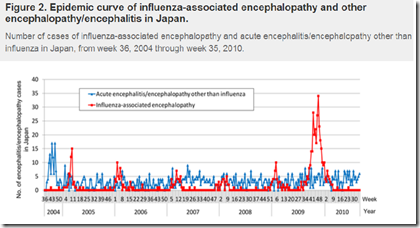
All of which serves as prelude to a research article that recently appeared in PloS One, that examined the rate of influenza-related encephalopathy in Japan across 6 flu seasons, including the 2009 pandemic.


National Surveillance of Influenza-Associated Encephalopathy in Japan over Six Years, before and during the 2009–2010 Influenza Pandemic

Yoshiaki Gu mail, Tomoe Shimada, Yoshinori Yasui, Yuki Tada, Mitsuo Kaku, Nobuhiko Okabe


Abstract (reparagraphed)

Influenza-associated encephalopathy (IAE) is a serious complication of influenza and is reported most frequently in Japan. This paper presents an assessment of the epidemiological characteristics of influenza A (H1N1) 2009-associated encephalopathy in comparison to seasonal IAE, based on Japanese national surveillance data of influenza-like illness (ILI) and IAE during flu seasons from 2004–2005 through 2009–2010.


In each season before the pandemic, 34–55 IAE cases (mean 47.8; 95% confidence interval: 36.1–59.4) were reported, and these cases increased drastically to 331 during the 2009 pandemic (6.9-fold the previous seasons).


Of the 331 IAE cases, 322 cases were reported as influenza A (H1N1) 2009-associated encephalopathy. The peaks of IAE were consistent with the peaks of the influenza epidemics and pandemics.


A total of 570 cases of IAE (seasonal A, 170; seasonal B, 50; influenza A (H1N1) 2009, 322; unknown, 28) were reported over six seasons. The case fatality rate (CFR) ranged from 4.8 to 18.2% before the pandemic seasons and 3.6% in the 2009 pandemic season. The CFR of pandemic-IAE was 3.7%, which is lower than that of influenza A−/B-associated encephalopathy (12.9%, p<0.001; 14.0%, p = 0.002; respectively).


The median age of IAE was 7 years during the pandemic, which is higher than that of influenza A−/B-associated encephalopathy (4, p<0.001; 4.5, p = 0.006; respectively).


However, the number of pandemic-IAE cases per estimated ILI outpatients peaked in the 0–4-year age group and data both before and during the pandemic season showed a U-shape pattern. This suggests that the high incidence of influenza infection in the 0–4 year age group may lead to a high incidence of IAE in the same age group in a future influenza season.


Further studies should include epidemiologic case definitions and clinical details of IAE to gain a more accurate understanding of the epidemiologic status of IAE.


This is a detailed, and interesting, analysis that finds that in addition to a 6 fold increase in cases during the pandemic, that (like the Annals of Neurology Study mentioned above) the median age of reported encephalopathy was twice that normally seen during other flu seasons.


The CFR (Case Fatality Ratio) of encephalopathy cases during the pandemic dropped, however, which the authors ascribe to `improved quality of diagnosis and treatment’.


Some of the 6-fold increase in IAE cases during the 2009 pandemic can probably be linked to increased public awareness and medical surveillance.  Cases of mild IAE might have been transient, and not picked up by medical authorities during other flu seasons. 


But when added to the other reports we’ve seen, the 2009 H1N1 virus does appear to have had some unusual properties.  The authors conclude by writing:


In summary, national surveillance of AE in Japan revealed a steep increase in IAE cases during the 2009–2010 pandemic season. This was likely due to the large number of children infected with influenza during the pandemic, but social attention and information bias might have affected epidemiology data. Results of the present study revealed a relatively low CFR despite a large number of reported IAE cases during the pandemic. One of the characteristic findings was the age distribution of the reported IAE cases. Further studies should include strict epidemiologic case definitions, clinical details including medication history, and epidemiological information of IAE for a more accurate understanding of the epidemiologic status of IAE.


Nearly 4 years since the emergence of the 2009 H1N1 pandemic, A/H1N109pdm is probably the most studied flu virus in history. While it did not end up being a particularly deadly pandemic virus, it has consistently yielded surprises.


  • This was the first seasonal flu shown to infect both dogs and cats (see EID Journal: Pandemic H1N1 Infection In Cats) and showed up in such diverse animal hosts as turkeys and ferrets.
  • Novel H1N1 also appears to differ from seasonal flu in how it is transmitted, at least according to researchers in Hong Kong who discovered that the novel H1N1 virus – unlike seasonal flu – easily infects and replicates in the conjunctival tissues of the eye  (see I Only Have Eyes For Flu).
  • And rather than completely supplanting the existing seasonal influenza A strains as we saw in the 1918, 1957 and 1968 pandemics, the 2009 pandemic virus now co-circulates with H3N2 (it did replace seasonal H1N1).


While some of these studies may seem a bit esoteric and limited in scope or impact, the knowledge we gain from them can hopefully prove an advantage to us the next time the world faces an emerging viral threat.

Wednesday, August 29, 2012

Study: Kids, Underlying Conditions, And The 2009 Pandemic Flu

image

Credit CDC FluView


# 6522


The chart above illustrates the sharp rise in pediatric deaths from flu-related complications during the 2009-2010 H1N1 pandemic seasons in the United States.  As grim as this charts is, it probably doesn’t fully represent the burden the 2009 pandemic placed on the pediatric community.


In another chart, again from the CDC, we get an estimate of deaths related to the 2009 pandemic, broken down by age groups through April of 2010.


image


While just over 300 pediatric deaths were recorded during this time period, the CDC estimates that 4 times (n=1280) that many children likely died from flu-related illness in the United States.


Globally, the number was undoubtedly many times higher than that (see Lancet: Estimating Global 2009 Pandemic Mortality).


All of which serves as prelude to a new study that appears today in the journal  Pediatrics, that looks at 336 documented pH1N1-associated deaths, and finds a high number of kids with underlying neurologic conditions.


Two-thirds of all deaths in children under the age of 17 occurred in kids with at least 1 underlying medical condition (n=227), and just under half of all cases (n=146) involved neurological disorders, such as cerebral palsy, epilepsy, or intellectual disability.


Neurologic Disorders Among Pediatric Deaths Associated With the 2009 Pandemic Influenza

Lenee Blanton, MPHa,Georgina Peacock, MD, MPH, FAAPb, Chad Cox, MD, MPHa, Michael Jhung, MD, MPHa, Lyn Finelli, DrPHa, and Cynthia Moore, MD, PhDb

ABSTRACT (Excerpts)

RESULTS: Of 336 pH1N1-associated pediatric deaths with information on underlying conditions, 227 (68%) children had at least 1 underlying condition that conferred an increased risk of complications of influenza. Neurologic disorders were most frequently reported (146 of 227 [64%]), and, of those disorders, neurodevelopmental disorders such as cerebral palsy and intellectual disability were most common.

CONCLUSIONS: Neurologic disorders were reported in nearly two-thirds of pH1N1-associated pediatric deaths with an underlying medical condition. Because of the potential for severe outcomes, children with underlying neurologic disorders should receive influenza vaccine and be treated early and aggressively if they develop influenza-like illness.


According to a statement released last night by the CDC:


Of the children with neurologic disorders for whom information on vaccination status was available, only 21 (23 percent) had received the seasonal influenza vaccine and 2 (3 percent) were fully vaccinated for 2009 H1N1.


With September just around the corner, the annual push for flu vaccinations is upon us, and today’s study will hopefully help inspire parents to get all kids – regardless of underlying conditions - vaccinated against influenza.


While the effectiveness of flu vaccines vary from year-to-year, and indeed, from one person to the next, they remain the single most important preventative step you can take to avoid getting the flu each year.


Despite the hyperbolic anti-vaccine rhetoric often found on the Internet, the truth is, serious adverse reactions to the vaccine are exceedingly rare (see the CDC’s  Influenza Vaccine Safety).


With two new strains of seasonal flu expected to be in circulation this winter (Yamagata B, and the Victoria H3N2) – ones that will be covered by this year’s vaccine – getting the flu shot this year is doubly important.


CDC recommends that just about everyone aged 6 months and older get an annual influenza vaccination, and stresses their importance for those who are at greater risk of serious complications.


For more on vaccine safety and effectiveness, the CDC maintains extensive web pages, and resources, on seasonal flu vaccines, including:


What You Should Know for the 2012-2013 Influenza Season


Preventing Seasonal Flu With Vaccination


Children, the Flu, and the Flu Vaccine

Saturday, July 21, 2012

Revisiting The Influenza-Parkinson’s Link


image

Influenza Virons – Credit CDC PHIL


# 6443


We’ve a new study, conducted by the University of British Columbia, that finds a linkage between a past history of severe bouts of influenza and the likelihood of developing Parkinson’s disease later in life.


In fact, according to their research, a severe bout of influenza doubles a person’s chances of developing the neurological condition.


If all of this sounds vaguely familiar, it may be because we explored the idea of a Parkinson’s-Influenza link back in 2009 (see More On The Influenza-Parkinson’s Link).


Interestingly, the UBC researchers found that those who caught red measles as a child were 35% less likely to develop the disabling disease.   


The article appears in the journal Movement Disorders, and the abstract may be read at:


Association of Parkinson's disease with infections and occupational exposure to possible vectors

M. Anne Harris PhD, Joseph K. Tsui MB, Stephen A. Marion MD, Hui Shen PhD, Kay Teschke PhD


While the study is behind a pay wall, we’ve a short press release from the University of British Columbia  with some of the details.  After which I will return with more.


Severe flu increases risk of Parkinson's: UBC research

Severe influenza doubles the odds that a person will develop Parkinson's disease later in life, according to University of British Columbia researchers.


However, the opposite is true for people who contracted a typical case of red measles as children – they are 35 per cent less likely to develop Parkinson's, a nervous system disorder marked by slowness of movement, shaking, stiffness, and in the later stages, loss of balance.


The findings by researchers at UBC's School of Population and Public Health and the Pacific Parkinson's Research Centre, published online this month in the journal Movement Disorders, are based on interviews with 403 Parkinson's patients and 405 healthy people in British Columbia, Canada.

(Continue . . .)


Were this all the evidence – medical and occupational histories of a fewer than 1,000 people – then this might not be a terribly convincing study. But we’ve plenty of other research that suggest that some strains of influenza may be neurotropic - capable of infecting and damaging brain cells.


In 2009 a study appearing in PNAS found that the H5N1 virus was highly neurotropic in lab mice, and in the words of the authors `could initiate CNS disorders of protein aggregation including Parkinson's and Alzheimer's diseases’.

Highly pathogenic H5N1 influenza virus can enter the central nervous system and induce neuroinflammation and neurodegeneration

Haeman Jang, David Boltz, Katharine Sturm-Ramirez, Kennie R. Shepherd, Yun Jiao, Robert Webster and Richard J. Smeyne


Providing more analysis of this study, we’ve an article published on the  St. Jude Children’s Research Hospital website, again from 2009.


Avian influenza strain primes brain for Parkinson’s disease

At least one strain of the H5N1 avian influenza virus leaves survivors at significantly increased risk for Parkinson’s disease and possibly other neurological problems later in life, according to new research from St. Jude Children’s Research Hospital.

<SNIP>

This avian flu strain does not directly cause Parkinson’s disease, but it does make you more susceptible,” said Richard Smeyne, Ph.D., associate member in St. Jude Developmental Neurobiology. Smeyne is the paper’s senior author.


“Around age 40, people start to get a decline in brain cells. Most people die before they lose enough neurons to get Parkinson’s. But we believe this H5N1 infection changes the curve. It makes the brain more sensitive to another hit, possibly involving other environmental toxins,” Smeyne explained.


Smeyne noted the work involved a single strain of the H5N1 flu virus, the A/Vietnam/1203/04 strain. The threat posed by other viruses, including the current H1N1 pandemic flu virus, is still being studied.

(Continue . . . )


In 2011 a study by Boise State biology professor Troy Rohn  appeared in PLOS ONE , which unexpectedly found immunohistochemical evidence of prior influenza A infection in the post-mortem brain tissues of 12 Parkinson’s patients they tested.


Immunolocalization of Influenza A Virus and Markers of Inflammation in the Human Parkinson's Disease Brain

Troy T. Rohn*, Lindsey W. Catlin


We’ve seen other (albeit largely anecdotal) evidence to support an  influenza-neurological disorder link, and not just with Parkinson’s Disease.


During the 1918 pandemic, and the decade that followed, more than a million people around the world were afflicted by a mysterious neurological disorder called Encephalitis Lethargica (EL), which some researchers believe may have been precipitated by the influenza virus.  


Other forms of neurological symptoms were also reported in the years (and decades) following the 1918 pandemic, leading some researchers to question whether or not it might be a part of some long-term sequelae of the virus.


Other scientists have linked EL with a post-streptococcal immune response, or believe it was an autoimmune response, and dismiss the link with the 1918 pandemic.  


The cause remains a mystery.


Last year a study appeared in the Annals of Neurology, that suggests a link between contracting an upper respiratory infection and developing narcolepsy (cite Narcolepsy Onset is Seasonal and Increased Following the H1N1 Pandemic in China).


What these researchers found was, that in China, among a largely unvaccinated population, the incidence of Narcolepsy increased dramatically in the spring after the winter flu season.


This increase was most pronounced following the emergence of the H1N1 swine flu virus in 2009.


Those results are reminiscent of another study we saw in 2010 (see Lancet: The Influenza - Guillain Barré Syndrome Connection) that suggested the risks of developing GBS – another type of autoimmune disease - were far greater following a bout of the flu, than from receiving the flu vaccine.


While conclusive proof of a link between severe influenza A infection and the later development of neurological disorders has not yet been produced, the anecdotal evidence continues to mount.


All of which should provide additional motivation to get that seasonal flu shot every year, since the evidence suggests that it may be protecting you against something far worse than simply spending a miserable week in bed.

Thursday, October 13, 2011

BMJ: Another Pandemrix Study To Ponder


 image

Photo Credit CDC 


# 5897


Whenever there is a hint or a suggestion that a vaccine might have caused some sort of serious side effect, it invariably becomes big news. 


Even when the reports are preliminary, and the evidence less than rock solid, these stories often end up on the front pages of newspapers and quickly become fodder for the anti-vaccination brigade.


When more reassuring vaccine studies come out, they rarely get that kind of media play, since it isn’t the sort of thing that sells newspapers. 


Case in point:


A little over a year ago GSK’s Pandemrix vaccine was associated with a perceived increase in narcolepsy among children and adolescents in Finland. For early coverage of this story, you may wish to revisit Finland Suspends Use of Pandemrix Vaccine and EMA To Review Pandemrix Vaccine, both of which I wrote in August of 2010.


Despite some conflicting and incomplete data the European Medicines Agency issued a statement last July recommending:


In persons under 20 years of age Pandemrix to be used only in the absence of seasonal trivalent influenza vaccines, following link to very rare cases of narcolepsy in young people.


Finland also convened a Narcolepsy Task Force (see Finland: Task Force Report On Pandemrix-Narcolepsy Link) that confirmed an association – as yet unexplained  – between receipt of the vaccine and an increase in narcolepsy in children between the ages of 4 and 19.


Complicating matters, more than a dozen countries reported an increase in narcolepsy during the 2009 pandemic, even those where the adjuvanted vaccine was not used.


You can find details on one such study in Stanford Study Finds Influenza – Narcolepsy Connection  that linked narcolepsy not to the vaccine . . . but to infection by influenza virus itself.


Confused yet?


Alas, science isn’t always neat and tidy.  Good studies take time, and we don’t always get consistent results.


Today, we’ve another study that appears in the BMJ that is a bit more reassuring on the safety of the Pandemrix vaccine, but fails to answer the question of narcolepsy. 


It is called:


Neurological and autoimmune disorders after vaccination against pandemic influenza A (H1N1) with a monovalent adjuvanted vaccine: population based cohort study in Stockholm, Sweden

OPEN ACCESS

Carola Bardage, epidemiologist, Ingemar Persson, professor of pharmacoepidemiology and senior expert, Åke Örtqvist, county medical officer and associate professor, Ulf Bergman, professor of pharmaco-epidemiology and clinical pharmacologist, Jonas F Ludvigsson, paediatrician and epidemiologist, Fredrik Granath, senior biostatistician


This was a population based cohort study conducted in Stockholm, Sweden during the 2009 pandemic where 1,024,019  people were vaccinated with the Pandemrix vaccine and 921,005 remained unvaccinated.


Using the detailed healthcare registers for Stockholm County Council, researchers tracked all admissions to hospitals and visits to specialists for autoimmune or neurological diagnoses.


The conditions flagged in this study included:


  • Guillain-Barré syndrome
  • Bell’s palsy
  • multiple sclerosis
  • polyneuropathy
  • anaesthesia or hypoaesthesia
  • paraesthesia
  • narcolepsy
  • rheumatoid arthritis
  • inflammatory bowel disease (ulcerative colitis, Crohn’s disease)
  • type 1 diabetes


This study further divided this cohort into those who received the vaccine within the first 45 days of its availability, and those who received it later. Those in high risk groups, with comorbid conditions, were more likely to be vaccinated during the first 6 weeks of the vaccination campaign. 


The results (which are far more detailed in the open access report) indicated:


Conclusions

Results for the safety of Pandemrix over 8-10 months of follow-up were reassuring —notably, no change in the risk for Guillain-Barré syndrome, multiple sclerosis, type 1 diabetes, or rheumatoid arthritis.


Relative risks were significantly increased for Bell’s palsy, paraesthesia, and inflammatory bowel disease after vaccination, predominantly in the early phase of the vaccination campaign.


Small numbers of children and adolescents with narcolepsy precluded any meaningful conclusions.


The report summary states:


What is already known on this topic
  • Studies are lacking on adverse events (except for narcolepsy) with any of the three vaccines used in the European Union against H1N1 during the pandemic period

  • Available data are limited to case series or highly selected populations with short follow-up or no control group

What this study adds
  • Excess risks for Bell’s palsy, paraesthesia, and inflammatory bowel disease after H1N1 vaccination with adjuvanted Pandemrix in Sweden were small but significant among more than one million vaccinated, but only in high risk groups targeted for early vaccination and who were likely to have earlier comorbidity

  • The risk of Guillain-Barré syndrome, multiple sclerosis, type 1 diabetes, and rheumatoid arthritis remained unchanged

  • Small numbers of children and adolescents with narcolepsy precluded any meaningful conclusions


While the low number of children and adolescents with narcolepsy may have precluded making any firm conclusions, their scarcity is nonetheless a bit reassuring.


The authors suggest that the small, but statistically significant increase in Bell’s palsy, paraesthesia, and inflammatory bowel disease among the early recipients of the vaccine may be partly, or perhaps entirely, explained by the higher number of high risk patients in that cohort.


We are still left with the mystery of what caused the increase in narcolepsy reported in Finland, of course. And there will no doubt be additional studies that will look at the safety of the Pandemrix vaccine in other regions.


But for now, as the authors state,  the news is `reassuring’.


For previous reports on the safety of (adjuvanted and unadjuvanted) flu vaccines, you may wish to revisit.


IOM Report On Vaccine Safety Concerns


BMJ: No Substantial Link Between Flu Vaccines And Guillain-Barre Syndrome


Lancet: Immunogenicity and safety Of Adjuvanted Flu Vaccines


NEJM: Study On China’s H1N1 Vaccine Safety


Harvard Study Reaffirms Safety Of Flu Vaccine


Monday, September 20, 2010

Study: Pediatric Neurological Complications With H1N1


# 4915


Despite being relatively mild for the vast majority of those it infected, the novel H1N1 virus – at least in a small percentage of victims – showed unusual, and sometimes severe, symptoms.


The most obvious difference between the pandemic virus and seasonal influenzas of the past has been the age shift in infections, hospitalizations, and deaths.


Unlike seasonal influenza, novel H1N1 has taken its biggest toll on those under the age of 65.


While the total number of flu-related fatalities appears to be less than normally seen with seasonal flu, In terms of years of life lost, novel H1N1 was anything but benign (see Study: Years Of Life Lost Due To 2009 Pandemic).


But the difference between pandemic H1N1 and seasonal flu go beyond this profound age shift. The symptomology of this virus differed for many people as well.


A brief review, before we get to today’s study.


Researchers in Hong Kong discovered that the H1N1 virus – unlike seasonal flu – easily infects and replicates in the conjunctival tissues of the eye  (see I Only Have Eyes For Flu).


Another difference observed with novel H1N1 has been its unusually high rate of gastro-intestinal symptoms. Diarrhea and vomiting have both been commonly reported with H1N1 pandemic influenza as evidenced by this report from Maggie Fox of Reuters.

 
US flu study confirms H1N1 more serious in youth

Thu Oct 8, 2009 10:41pm BST

* 45 percent of those hospitalized were under 18

* Diarrhea, vomiting in 42 percent of children with H1N1

* Quick drug treatment may save lives


And in December of last year, we saw a report from the NIH on autopsies performed on H1N1 victims in New York that showed unusual levels of lung damage.


 Virus Damages Entire Airway

Monday, Dec. 7, 2009

In fatal cases of 2009 H1N1 influenza, the virus can damage cells throughout the respiratory airway, much like the viruses that caused the 1918 and 1957 influenza pandemics, report researchers from the National Institutes of Health (NIH) and the New York City Office of Chief Medical Examiner.


Beyond the gastro-intestinal and pulmonary symptoms, we’ve also seen a number of neurological complications, particularly (but not exclusively) in children.


The first hint of this came last summer when the CDC’s MMWR (July 23rd issue) reported on 4 pediatric patients with the novel H1N1 virus who presented with neurological symptoms including unexplained seizures and altered mental status.


Neurologic Complications Associated with Novel Influenza A (H1N1) Virus Infection in Children --- Dallas, Texas, May 2009

. . .  On May 28, 2009, the Dallas County Department of Health and Human Services (DCHHS) notified CDC of four children with neurologic complications associated with novel influenza A (H1N1) virus infection admitted to hospitals in Dallas County, Texas, during May 18--28.


In November, in a blog entitled Japan: Influenza Related Encephalopathy we looked at a report in the Yomiuri Shimbun on 132 flu patients with neurological complications during the opening four months of the pandemic.


All of which serves as prelude to today’s study by researchers at the University of Utah which is to be published later today in the Annals of Neurology  (link not available yet).  


Heightened Neurologic Complications in Children with Pandemic H1N1 Influenza

Jeffrey J. Ekstrand, Amy Herbener, Julia Rawlings, Beth Turney, Krow Ampofo, E. Kent Korgenski, Joshua L. Bonkowsky. Annals of Neurology; Published Online: September 20, 2010 (DOI:10.1002/ana.22184)


Since the link has not appeared, what we do have is the press release on this study:


Higher incidence of seizures seen in children with H1N1 virus compared to seasonal flu

Vaccination important to combat flu-related neurological complications


This was a retrospective study, where researchers identified 303 children hospitalized with the pandemic H1N1 virus, 18 of which developed neurological symptoms.  


They compared these cases to records of 234 children admitted to the hospital in previous years due to seasonal influenza.


The most common neurological complications exhibited with novel H1N1 were seizures (12 patients or 67%), with seven exhibiting status epilepticus, a potentially life-threatening condition involving continuous or recurrent seizures that can last for a half hour or longer.


The mean age of children admitted with neurological symptoms from H1N1 was more than twice the age (6.5 years) than usually seen with seasonal flu (2.4 years).


And abnormal EEG (electroencephalogram) readings were more common in pandemic H1N1 cases than in seasonal influenza.


The researchers are unsure why these neurological manifestations appear more common in novel H1N1 influenza, but suggest that it may be part of an autoimmune response.


You can find more details of this study in an review published today by Medpage Today:


Seizures in Kids Linked to H1N1 Flu

By Nancy Walsh, Staff Writer, MedPage Today


While it is easy to dismiss the 2009 pandemic virus as overblown based simply on the total number of fatalities, when one looks a little deeper one discovers that the virus played by its own set of rules.


For the demographic group usually hit hardest by the flu – those in their 70s and 80s and most likely to die from the infection - novel H1N1 was almost like a year without influenza.  


But for many children, and younger adults, H1N1 proved to be a serious challenge.


This year, we’ve a double threat looming with this fall’s flu season.   The (former) pandemic H1N1 virus is likely to return, along with (potentially) the new Perth H3N2 strain.


And H3N2, if it returns, is unlikely to spare the elderly as did the pandemic virus.


The good news is both of these are covered (along with an influenza B strain) in this year’s trivalent flu vaccine. 


Three good reasons to get your flu shot early this year.