Showing posts sorted by relevance for query #NatlPrep. Sort by date Show all posts

Wednesday, September 30, 2020

#Natlprep: Whatever Future Threats May Come


Note: This is day 30 of National Preparedness Month. Follow this year’s campaign on Twitter by searching for the #NatlPrep #BeReady or #PrepMonth hashtags.

This month, as part of NPM20, I’ll be rerunning some updated preparedness essays, along with some new ones.


#15,478


Thirty-nine weeks ago, in the wee hours of the morning of December 31st, I awoke (at 2 am) and found a Skype message from Sharon Sanders of FluTrackers alerting me to several strange, and admittedly worrisome media reports from China of an unidentified respiratory outbreak in Wuhan City.

Within a few short weeks we would see this event escalate into The Most Predicted Global Crisis of the 21st Century; a severe pandemic. 

In last October's Inaugural Global Health Security Index, the United States - followed by the UK, The Netherlands, Australia, and Canada - were judged to be the best prepared to deal with a severe pandemic.  A least when graded on the curve. 

But despite two decades of warnings (see WHO: On The Inevitability Of The Next Pandemic), and several close calls (H7N9 in 2017, H1N1 in 2009, SARS in 2003, etc.), over the past 9 months the world has proved itself to be spectacularly unprepared to deal with a fast-moving, viral threat. 

Eleven years ago, in Caught With Our Masks Down, I wrote that the demand for PPEs during a serious pandemic would far exceed the available supply. At one time the HHS estimated the nation would need 30 billion masks (27 billion surgical, 5 Billion N95) to deal with a major pandemic (see Time Magazine A New Pandemic Fear: A Shortage of Surgical Masks).

The good news is we were afforded more than a decade to prepare; to procure the basic PPEs needed protect our healthcare workers, first responders, and the general public.

The bad news is, we instead spent billions on sexy, next-gen-high-tech pandemic `solutions' before first investing in the basic supplies and public health infrastructure we would need to deliver any of these solutions during a severe pandemic.

And nine months into COVID-19, healthcare workers are still scrambling for PPEs, and the public are relegated to using a smorgasbord of less effective face covers. 

As challenging as COVID-19 has been, it is far from the `worst-case' pandemic scenario.  It is a relatively low-mortality pandemic, killing something less than 1% of symptomatic cases. Among hospitalized cases, MERS-CoV has an apparent CFR of 35%,  Nipah over 40% and some strains of avian flu are even higher.  

As we now understand all too well - a pandemic isn't just a public health crisis - it can quickly become a global economic disaster, and can pose a genuine national security threat.  The full economic and societal impact of COVID-19 probably won't be known for a decade or more. 

All of this was foretold a hundred times or more, in exercises, books, and reports - including: 

  • Fifteen years ago Dr. Michael Osterholm, director of CIDRAP, presciently likened a severe pandemic to an 18-month global blizzard, where nearly everything is shut down. Many will find themselves without a paycheck, either due to their refusal to work and risk exposure, or because their jobs are simply no longer available (see Baby, it's Cold Outside).
  • In December of 2012 the U.S. National Intelligence Council released a report called "Global Trends 2030: Alternative Worlds" that tried to anticipate the global shifts that will likely occur over the next two decades (see Black Swan Events). Number one on their hit parade? A severe pandemic. 
  • In 2014, the U.S. Director of National Intelligence declared An Influenza Pandemic As A National Security Threat, writing:  No one can predict which pathogen will be the next to spread to humans, or when or where such a development will occur, but humans will continue to be vulnerable to pandemics, most of which will probably originate in animals.

And yet, despite these warnings, governments and leaders of the world kicked the can down the road each year, pledging to address the deficits in our pandemic preparedness `next year', never truly believing the next pandemic would fall on their watch.  

Sadly, we are probably no better prepared to deal with a great (8.0+) earthquake on the San Andreas, Cascadia, or New Madrid fault lines, or a `Carrington level' CME from the sun, than we are for the next severe pandemic. 

Eight years ago, the earth narrowly missed being hit by a massive CME (see NASA: The Solar Super Storm Of 2012) that could have destroyed a large portion of our electrical grid.  

Since then, scientists have discovered that these severe solar storms happen far more often than previously believed (See Destructive Solar Storms Usually Hit Earth Every 25 Years or So, Say Scientists).

The earth in general, and the United States in particular, have been in an earthquake (and volcanic eruption) `drought' for the past century (see #NatlPrep: Half Of All Americans Need An Earthquake Plan).  But all droughts end eventually (see Dr. Lucy Jones: `Imagine America Without Los Angeles’). 

While we can't predict what the next national, regional, or global crisis will be, it is a pretty safe bet that it will come sooner rather than later.  

There are a lot of things we can do as individuals (see #NatlPrep: Prolonged Grid Down Preparedness), or as business owners (see SBA's Disaster Preparedness and Recovery Plan), to prepare for the next great disaster or crisis - but what is truly needed is a commitment by governments around the globe to prioritize emergency preparedness. 

Not just talk the talk, but to walk the walk. 

Here in the United States I'd love to see a Department of National Resilience  (hopefully with a better acronym than DNR)  - with the funding, and foresight, to adequately prepare local communities to deal with whatever future threats may come. One that actively involves local officials, schools, businesses, civic groups, and individuals - not just another Federal alphabet agency filled with career bureaucrats.  

With millions of people out of work, this could even become a jobs program, benefiting both individuals and their communities.

I'm sure there are thousands of retired EMTs, firefighters, and nurses that would make excellent instructors and plenty of others who would love an opportunity to work, and to make a real difference to their community.    
 
The next big crisis is just around the corner.  

We can either meet it as a prepared society, or we can hope for the best, and take our lumps.  Again. 
 

Sunday, September 01, 2024

#NatlPrep: National Preparedness Month 2024 Kicks Off


Note: This is the first day of National Preparedness Month. Follow this year’s campaign on Twitter by searching for the #NatlPrep #BeReady or #PrepMonth hashtags.

This month, as part of NPM24, I’ll be rerunning some updated preparedness essays, along with some new ones.


#18,273

Each year September 1st marks the start of National Preparedness month here in the United States, and as I've done every year since 2007  I'll be running some new and/or updated preparedness blogs alongside this blog's usual emerging infectious disease fare. 

We're not talking about `doomsday prepping', but rather reasonable steps you can take now to make life easier, and safer, for you and your loved ones during a unexpected emergency or crisis.

Although most people believe that they are relatively immune to natural disasters, each year millions of Americans find themselves dealing with hurricanes, tornadoes, floods, fires, blizzards, derechos, power blackouts, or other serious interruption in life or essential services. 

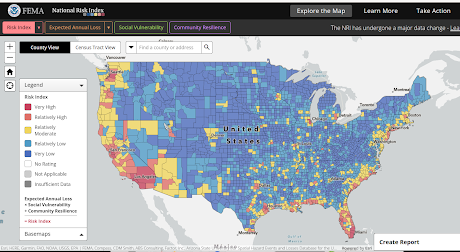
While nowhere is completely safe, FEMA's National Risk Index For Natural Disasters (see map below) shows the highest risk areas in the country.  


While it has been a relatively quiet summer, so far in 2024 the United States has seen 19 `Billion Dollar' weather/climate disaster events (15 severe storm events, 1 tropical cyclone event, 1 wildfire event, and 2 winter storm events).


Of course, hundreds of other `smaller' events don't make the list, but can be every bit as impactful on those affected.  And while we've enjoyed an `earthquake drought' in recent years, the USGS warns that  75% of Americans At Risk Of Experiencing A Damaging Earthquake. 


Each year FEMA conducts a nationwide poll on preparedness, and they released their 2023 survey last December. Even though these are self-reported assessments, and `being prepared' means different things to different people, they report some small progress over the past 12 months.

It is a mixed bag, however.  More people have assembled supplies, but fewer people report practicing emergency drills or habits.  More have learned their evacuation routes, but fewer have made a plan.  And while more have tested a family communication plan, fewer report having signed up for alerts or warnings. 

While you can't be prepared for every eventuality, the most common scenarios involve interruptions in services (power, water, internet, banking, etc.); which may last hours, days, or even weeks.

Having basic preps (food, water, first aid kit, emergency radio, etc.) can go a long way towards easing the misery.

The goal of #NatlPrep is to foster a culture of national preparedness, and to encourage everyone to plan and be prepared to deal with an event where they can go at least 72 hours without electricity, running water, local services, or access to a supermarket.

These are, of course, minimum goals.  I consider 2 weeks a far more prudent goal. 

Over the next 30 days I'll be devoting considerable blog time and space to the topic of disaster preparedness. Along the way we'll look at some threats you and your family may not have considered.

I hope you’ll take some time during the coming weeks to think about how to make your family, business, or community better prepared to deal with the next disaster, and then act on it.

And that you’ll encourage others to do the same.

Tuesday, October 09, 2018

NHC Forecasting A Landfalling CAT 3 Hurricane Tomorrow


https://www.nhc.noaa.gov/refresh/graphics_at4+shtml/093811.shtml?cone#contents


#13,579

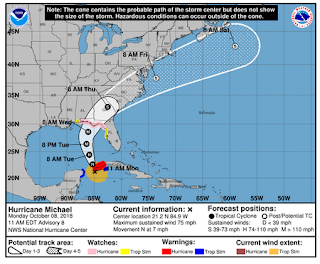
With winds now at a solid 110 MPH - Hurricane Michael is on the cusp of becoming a CAT 3 storm - and with another 24 hours of warm water to cross, is expected to intensify further before landfall. 
The forecast track has remained constant for the past few model runs, putting landfall in the panhandle tomorrow afternoon.   The forecast cone (above) does not - however - show the full extent of this storm's likely impact, or damage. 

From the 11am discussion by the National Hurricane Center. 
Michael is moving between north-northwest and north at about 10 kt. The track forecast reasoning is the same as the past several advisories, as Michael should move generally northward through early Wednesday between a ridge over the western Atlantic and a deep-layer trough over the central United States. As the trough moves eastward it will cause Michael to turn northeastward on Wednesday.
The hurricane should then continue northeastward and accelerate as it becomes embedded in the mid-latitude westerlies. The track guidance is in very good agreement through the first 36-48 hours, with some differences in forward speed thereafter. The GFS and ECMWF have trended slower after landfall, and the new NHC track has been adjusted accordingly.
FORECAST POSITIONS AND MAX WINDS

INIT  09/1500Z 25.0N  86.2W   95 KT 110 MPH
 12H  10/0000Z 26.7N  86.5W  105 KT 120 MPH
 24H  10/1200Z 28.8N  86.3W  110 KT 125 MPH
 36H  11/0000Z 30.8N  85.1W   75 KT  85 MPH...INLAND
 48H  11/1200Z 33.0N  82.5W   45 KT  50 MPH...INLAND
 72H  12/1200Z 37.5N  74.0W   50 KT  60 MPH...POST-TROP/EXTRATROP
 96H  13/1200Z 44.0N  56.0W   60 KT  70 MPH...POST-TROP/EXTRATROP
120H  14/1200Z 50.0N  38.0W   55 KT  65 MPH...POST-TROP/EXTRATROP

https://www.nhc.noaa.gov/refresh/graphics_at4+shtml/093811.shtml?key_me+ssages#contents

It would not surprise me to see hurricane conditions extend into southern Alabama and Georgia, and residents there and across much of the Florida panhandle should be prepared to deal with prolonged power outages.

Storm surge, particularly to the right (east) of where the eye comes ashore, is likely to be severe, with 9+ feet of water over the land in some places.  If you live in an evacuation zone, now is the time to leave.

Credit NHC


As always, when it comes to getting the latest information on hurricanes, your first stop should always be the National Hurricane Center in Miami, Florida. These are the real experts, and the only ones you should rely on to track and forecast the storm.
If you are on Twitter, you should also follow @FEMA, @NHC_Atlantic, @NHC_Pacific and @ReadyGov.
For some recent blogs on how to prepare for a hurricane, and deal with the aftermath, you may wish to revisit:
#Natlprep: No Time Like The Present To Prepare

#NatlPrep: For A Brighter Day (and Night).
#NatlPrep: After The Storm Passes

Monday, October 08, 2018

NHC 11am Key Messages: Hurricane Michael Now Expected To Become A Major Storm

https://www.nhc.noaa.gov/refresh/graphics_at4+shtml/094401.shtml?cone#contents


#13,575


When conditions are as favorable for tropical development as exist in the Gulf of Mexico right now - low shear, and very warm undisturbed water - tropical systems can intensify rapidly.
In just 24 hours, we've gone from expecting a Category 1 hurricane to now looking at possibly a CAT 3 (or better) storm.
 The 11am discussion now forecasts:

https://www.nhc.noaa.gov/text/refresh/MIATCDAT4+shtml/081438.shtml


Storm surge - from just south of Tampa Bay north - is likely to be a major problem, as are (potentially) 120 MPH winds, and inland flooding.  We may also see small tornadoes spin up - particularly north and east of the storm - over the next few days.

Given its size, and expected speed, Michael will likely deliver a significant blow to Florida,  Georgia, the Carolinas, and possibly to parts of the mid-Atlantic region in the latter half of this week. 

https://www.nhc.noaa.gov/refresh/graphics_at4+shtml/094401.shtml?key_messages#contents
Link

Anyone in the path of this storm should consider it the real deal, and make their preparations today and early tomorrow.
As a personal aside, even though I am just barely in the tropical storm watch area, I went out and gassed up my car this morning. While I was out, I saw people buying cases of water, batteries, and other supplies.
After the debacle of empty shelves 5 days before Irma in 2017, people in central Florida are apparently paying better attention.

As always, when it comes to getting the latest information on hurricanes, your first stop should always be the National Hurricane Center in Miami, Florida. These are the real experts, and the only ones you should rely on to track and forecast the storm.
If you are on Twitter, you should also follow @FEMA, @NHC_Atlantic, @NHC_Pacific and @ReadyGov.
For some recent blogs on how to prepare for a hurricane, and deal with the aftermath, you may wish to revisit:
#Natlprep: No Time Like The Present To Prepare

#NatlPrep: For A Brighter Day (and Night).
#NatlPrep: After The Storm Passes

Friday, September 04, 2026

#NatlPrep: 75% of Americans At Risk Of Experiencing A Damaging Earthquake


Note: This is the 4th day of National Preparedness Month. Follow this year’s campaign on Twitter by searching for the #NatlPrep #BeReady or #PrepMonth hashtags.

This month, as part of NPM26, I’ll be rerunning some updated preparedness essays, along with some new ones.

#19,323

Over the past 3 months, in addition to hundreds of mild-to-moderate earthquakes, the world has seen 3 devastating seismic events:
  • In early June, the Philippines was struck by a 7.8 quake offshore of Mindanao, killing more than 100 people, and damaging more than 100 thousand homes.
  • Two weeks later Venezuela was struck by twin quakes (7.2 and 7.5) - 39 seconds apart - killing more than 6500 people, and destroying tens of thousands of buildings. 
  • Three weeks after that (August 10th) Colombia was hit by a 7.4 quake, killing > 330 people, and causing massive infrastructure collapse. 
While we like to think that these sorts of events can't happen here in the United States, Canada, or Europe, the truth is more sobering.  

In 2006 the USGS calculated that earthquakes posed a significant risk to 75 million Americans living in 39 States. A 2015 study, published in the journal Earthquake Spectra, nearly doubled – to 143 million - the number of Americans who live or work in areas susceptible to potentially damaging ground shaking (see USGS: Nearly Half Of U.S. Population Exposed to Potentially Damaging Earthquakes).

In January of 2024 the USGS unveiled a new seismic risk map (see top of blog), which increased the percentage of the population at risk of experiencing a damaging earthquake to nearly 75% (roughly 240 million people).

While most people immediately think of California and the `big one', the New Madrid Seismic Zone (NMSZ), the Pacific Northwest (Cascadia fault), coastal South Carolina, Alaska and Hawaii, and even New York City and parts of New England are at risk of seeing significant seismic activity.

Additionally, there are nearly a dozen `very high risk' volcanoes in the continental US (4 in Washington, 4 in Oregon & 3 in California), along dozens of `lesser' threats. While earthquake damage is generally localized, volcanic eruptions can affect property and populations thousands of miles away.
Over the past 100+ years the United States (excluding Alaska & Hawaii) has experienced a `seismic drought', with relatively few big quakes or volcanic eruptions.  As a result, most people assume the next `big one' won't happen in their lifetimes. 

But all droughts end eventually.

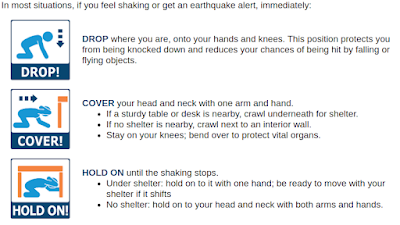
Every year since 2009 I've promoted Shakeout.org's safety campaign, and I strongly urge anyone who lives in any seismically active region to take part. 


After the shaking stops, you'll have to find ways to cope with the aftermath. 
 
While the government will send help, you could find yourself pretty much on your own for several days (or longer) and living in less than comfortable conditions for weeks (assuming your home is still habitable).

For starters - and as a bare minimum - every household should have a disaster plan, a good first aid kit (and the knowledge to use it), an emergency battery operated NWS weather radio, and emergency supplies to last a minimum of 72 hours during a disaster.

While 72 hours is an admirable start, having previously lived very near the New Madrid fault, and now living in hurricane country, I wouldn't feel comfortable stopping there.

Many agencies and organizations in the U.S. recommend that households work towards having a 10-to-14 day supply of food, water, and emergency supplies on hand, which I consider far more prudent.

Other steps to consider include setting up emergency meeting places, out-of-state contacts, and creating individual wallet information cards (see #NatlPrep : Create A Family Communications Plan).

Sunday, September 22, 2024

#Natlprep: Watching The Gulf of Mexico


Note: This is the 22nd day of National Preparedness Month. Follow this year’s campaign on Twitter by searching for the #NatlPrep #BeReady or #PrepMonth hashtags.

This month, as part of NPM24, I’ll be rerunning some updated preparedness essays, along with some new ones.


#18,310

For the past week long range forecast models (GFS, EURO, CMC, etc.) have been hinting at the development of a tropical system in the CAG (Central American Gyre), an area which is particularly active in late Spring and again in early fall.   

While nothing has formed yet, conditions appear ripe for development later this week, and overnight the National Hurricane Center (NHC) has upped the chances for development to 70%.

Northwestern Caribbean Sea and Gulf of Mexico:

A broad area of low pressure is likely to form during the next few days over the northwestern Caribbean Sea and the adjacent portions of Central America. Thereafter, gradual development of this system is expected, and a tropical depression is likely to form as the system moves slowly northward across the northwestern Caribbean Sea and Gulf of Mexico through the end of the week. Regardless of development, this system is expected to produce heavy rains over portions of Central America during the next several days.

* Formation chance through 48 hours...low...near 0 percent.
* Formation chance through 7 days...high...70 percent.

Unless and until that system forms, models can only roughly approximate where it may go, meaning that a large swath of the gulf coast - from Texas to Florida - should be monitoring this situation.  Likewise, the range of intensity at landfall in the models is equally wide.

Some models put this system approaching the Gulf coast 4 days from now, while others are looking more like a week out. Once it begins moving, however, it could move quickly. 

Since I'm potentially in the path of this storm, I'll be making some last minute preparations - including being ready to evacuate if necessary - over the next few days.  Luckily, I have a disaster buddy who will take me and the cat in.

While no one wants to evacuate, sometimes it truly is the better part of valor. Which is why Day 4 of National Hurricane Preparedness Week is all about how to develop a plan to evacuate you, your family, and your pets to a safe location.


Ready.gov has some specific advice on what to do before, during, and after an evacuation.

As traumatic as evacuation, or riding out a hurricane in your home, might be, often the toughest part comes After The Storm Passes.

Even if your home escapes major damage, your power, internet, and water may be out for days or weeks - stores, banks, and other essential services may be closed - and downed trees and flooding may make travel impossible. 

Flood waters may also contain hidden hazards, like broken glass, metal, toxic chemicals, and even life-threatening bacteria (see CDC HAN: Severe Vibrio vulnificus Infections in the United States Associated with Warming Coastal Waters).

Last week, in #NatlPrep: Prolonged Grid Down Preparedness, we looked at some steps you can take to prepare for extended power outages. It isn't too late to prepare, even if it is just making sure you have batteries for flashlights and lanterns. 

Because of all of these potential impacts, I've scheduled my fall COVID booster for tomorrow morning, will top off my gas tank when I'm out, and will spend the next few days charging all of my batteries and devices, filling water containers, and making other last minute preps. 

With a little bit of luck, this storm won't come my way.  But it is increasingly likely it will impact some part of the Gulf coast in the next week. 

While this blog, and many other internet sources (I personally follow Mark Sudduth's Hurricane Track, and Mike's Weather page), will cover this threat, your primary source for forecast information should always be the National Hurricane Center in Miami, Florida.

These are the real experts, and the only ones you should rely on to track and forecast the storm.

If you are on Twitter, you should also follow @FEMA, @NHC_Atlantic, @NHC_Pacific and @ReadyGov and of course take direction from your local Emergency Management Office.

Stay tuned, get prepared, and stay safe.

For more preparedness information I would invite you to visit:

Saturday, September 19, 2020

#NatlPrep: When Evacuation Is The Better Part of Valor


Credit Ready.gov

Note: This is day 19 of National Preparedness Month. Follow this year’s campaign on Twitter by searching for the #NatlPrep #BeReady or #PrepMonth hashtags.

This month, as part of NPM20, I’ll be rerunning some updated preparedness essays, along with some new ones.


#15,463


Although I've had a couple of close calls over the years, 2017's brush with Hurricane Irma was the first time I've actually been forced to leave my home in the face of a natural disaster. I wrote about my decision in #NatlPrep: Disaster Buddies - The Most Important Prep Of All.

It is not a pleasant prospect, but sometimes circumstances and common sense dictate that you must leave your home - and the bulk of your belongings - behind. 

Luckily, I had several prearranged places I could go. Friends, who are also disaster buddies (see In An Emergency, Who Has Your Back?), who know my couch is always available to them should they need it.

Being able to leave in a hurry when an evacuation has been ordered means having a plan, a destination, and an emergency `to go’ kit or `BOB’ already equipped, and standing by. 

bob 001a
Bug-out-bag, Canteen, & Toiletry kit

In the vernacular, a `bug-out bag' or `BOB’ (or sometimes GOOD bag for `Get Out Of Dodge’) a bag of emergency supplies, ideally kept at the ready, that one can grab on the way out the door during an emergency. Every hurricane season I go through my personal bug out bag, and replace flashlight and radio batteries from last year, and swap out older emergency rations for newer ones.

A BOB isn't supposed to be a survival kit, but rather, is supposed to provide the essentials one might need during the first 72 hours of a forced, and sometimes unexpected, evacuation.

It should contain food, water, any essential prescription medicines, copies of important papers (ID's, insurance, important Phone #s), a first aid kit, portable radio, flashlight, extra batteries, and ideally blankets and extra clothes. While having to evacuate your home may seem like an unlikely event, every years hundreds of thousands of Americans are forced to do so. 

Rivers spill their banks, dams break, brush fires rage out of control, even sudden industrial accidents can force evacuations. And unlike with a hurricane, you won’t always have advance warning. 

The bug out bag pictured above is my immediate `grab' in case of a house fire, or some other abrupt emergency. But if I've got a few minutes to get out, I've also got a couple of larger duffel bags at the ready that can be tossed into the trunk of my car, containing extra clothes, and longer term disaster supplies.   

On top of that, I always keep a first aid kit in my car (see #NatlPrep : First Aid Kits - Don't Leave Home Without One), along with a small survival kit (containing tools, `space blanket', tarp, water, etc.).   Obviously, if I've a few hour to leave, I'll load my car to the gills. 

As we've discussed previously (see Why Preparing For This Year's Hurricane Season Will Be `Different'), evacuation during our COVID-19 pandemic will require more planning and preparation than usual. 

Ready.gov has the following advice on how to prepare for an evacuation.

Plan to Evacuate
Many kinds of emergencies can cause you to have to evacuate. In some cases, you may have a day or two to prepare while other situations might call for an immediate evacuation. Planning is vital to making sure that you can evacuate quickly and safely no matter what the circumstances.
Before an Evacuation
  • Learn the types of disasters that are likely in your community and the local emergency, evacuation and shelter plans for each specific disaster.
  • Plan how you will leave and where you will go if you are advised to evacuate.
  • Check with local officials about what shelter spaces are available for this year. Coronavirus may have altered your community’s plans.
  • If you evacuate to a community shelter, follow the latest guidelines from the Centers for Disease Control and Prevention (CDC) for protecting yourself and your family from possible coronavirus: people over 2-years-old should use a cloth facial covering while at these facilities.
  • Be prepared to take cleaning items with you like masks, soap, hand sanitizer, disinfecting wipes or general household cleaning supplies to disinfect surfaces.
  • Maintain at least 6 feet of space between you and people who aren’t in your immediate family.
  • Identify several places you could go in an emergency such as a friend’s home in another town or a motel. Choose destinations in different directions so that you have options during an emergency.
  • If needed, identify a place to stay that will accept pets. Most public shelters allow only service animals.
  • Be familiar with alternate routes and other means of transportation out of your area.
  • Always follow the instructions of local officials and remember that your evacuation route may be on foot depending on the type of disaster.
  • Come up with a family/household plan to stay in touch in case you become separated; have a meeting place and update it depending on the circumstance.
  • Assemble supplies that are ready for evacuation. Prepare a “go-bag” you can carry when you evacuate on foot or public transportation and supplies for traveling longer distances if you have a car. 
  • If you have a car:
    • Keep a full tank of gas if an evacuation seems likely. Keep a half tank of gas in it at all times in case of an unexpected need to evacuate. Gas stations may be closed during emergencies and unable to pump gas during power outages. Plan to take one car per family to reduce congestion and delay.
    • Make sure you have a portable emergency kit in the car.
  • If you do not have a car, plan how you will leave if needed. Decide with family, friends or your local emergency management office to see what resources may be available.
During an Evacuation
  • Download the FEMA app for a list of open shelters during an active disaster in your local area.
  • Listen to a battery-powered radio and follow local evacuation instructions.
  • Take your emergency supply kit.
  • Leave early enough to avoid being trapped by severe weather.
  • Take your pets with you but understand that only service animals may be allowed in public shelters. Plan how you will care for your pets in an emergency now.
  • If time allows:
    • Call or email the out-of-state contact in your family communications plan. Tell them where you are going.
    • Secure your home by closing and locking doors and windows.
    • Unplug electrical equipment such as radios, televisions and small appliances. Leave freezers and refrigerators plugged in unless there is a risk of flooding. If there is damage to your home and you are instructed to do so, shut off water, gas and electricity before leaving.
    • Leave a note telling others when you left and where you are going.
    • Wear sturdy shoes and clothing that provides some protection such as long pants, long-sleeved shirts and a hat.
    • Check with neighbors who may need a ride.
  • Follow recommended evacuation routes. Do not take shortcuts, they may be blocked.
  • Be alert for road hazards such as washed-out roads or bridges and downed power lines. Do not drive into flooded areas.
After an Evacuation
If you evacuated for the storm, check with local officials both where you’re staying and back home before you travel.
  • If you are returning to disaster-affected areas, after significant events prepare for disruptions to daily activities and remember that returning home before storm debris is cleared is dangerous.
  • Let friends and family know before you leave and when you arrive.
  • Charge devices and consider getting back-up batteries in case power-outages continue.
  • Fill up your gas tank and consider downloading a fuel app to check for outages along your route.
  • Bring supplies such as water and non-perishable food for the car ride.
  • Avoid downed power or utility lines, they may be live with deadly voltage. Stay away and report them immediately to your power or utility company.
  • Only use generators outside and away from your home and NEVER run a generator inside a home or garage or connect it to your home's electrical system.

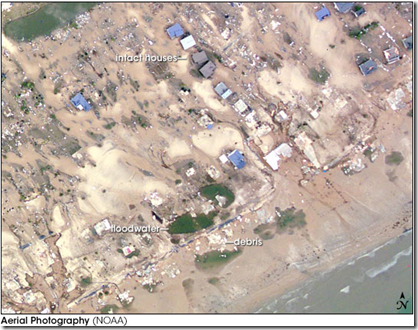
The following aerial photo was taken of Crystal Beach,Texas after Hurricane Ike in 2008. It proves that staying home in the face of a flood, a hurricane, or other natural disaster can have deadly consequences.

image

As hard as it might be, sometimes evacuation is truly the better part of valor. 

Sunday, September 12, 2021

#NatlPrep: When Evacuation Is The Better Part of Valor


Credit Ready.gov

Note: September is National Preparedness Month.  Follow this year’s campaign on Twitter by searching for the #NatlPrep #BeReady or #PrepMonth hashtags.

This month, as part of #NPM21, I’ll be rerunning some updated preparedness essays, along with some new ones.

#16,180


Although I've had a couple of close calls over the years, 2017's brush with Hurricane Irma was the first time I've actually been forced to leave my home in the face of a natural disaster. I wrote about my decision in #NatlPrep: Disaster Buddies - The Most Important Prep Of All.

It is not a pleasant prospect, but sometimes circumstances and common sense dictate that you must leave your home - and the bulk of your belongings - behind.

Luckily, I had several prearranged places I could go. Friends, who are also disaster buddies (see In An Emergency, Who Has Your Back?), who know my couch is always available to them should they need it.

Being able to leave in a hurry when an evacuation has been ordered means having a plan, a destination, and an emergency `to go’ kit or `BOB’ already equipped, and standing by.


Bug-out-bag, Canteen, & Toiletry kit

In the vernacular, a `bug-out bag' or `BOB’ (or sometimes GOOD bag for `Get Out Of Dodge’) a bag of emergency supplies, ideally kept at the ready, that one can grab on the way out the door during an emergency. Every hurricane season I go through my personal bug out bag, and replace flashlight and radio batteries from last year, and swap out older emergency rations for newer ones.

A BOB isn't supposed to be a survival kit, but rather, is supposed to provide the essentials one might need during the first 72 hours of a forced, and sometimes unexpected, evacuation.

It should contain food, water, any essential prescription medicines, copies of important papers (ID's, insurance, important Phone #s), a first aid kit, portable radio, flashlight, extra batteries, and ideally blankets and extra clothes. While having to evacuate your home may seem like an unlikely event, every years hundreds of thousands of Americans are forced to do so.

Rivers spill their banks, dams break, brush fires rage out of control, even sudden industrial accidents can force evacuations. And unlike with a hurricane, you won’t always have advance warning.

The bug out bag pictured above is my immediate `grab' in case of a house fire, or some other abrupt emergency. But if I've got a few minutes to get out, I've also got a couple of larger duffel bags at the ready that can be tossed into the trunk of my car, containing extra clothes, and longer term disaster supplies.

On top of that, I always keep a first aid kit in my car (see #NatlPrep : First Aid Kits - Don't Leave Home Without One), along with a small survival kit (containing tools, `space blanket', tarp, water, etc.). Obviously, if I've a few hour to leave, I'll load my car to the gills.

As we've discussed previously (see Why Preparing For This Year's Hurricane Season Will Be `Different'), evacuation during our ongoing COVID-19 pandemic will require more planning and preparation than usual.
 
Ready.gov has the following advice on how to prepare for an evacuation.


Plan to Evacuate

Many kinds of emergencies can cause you to have to evacuate. In some cases, you may have a day or two to prepare while other situations might call for an immediate evacuation. Planning is vital to making sure that you can evacuate quickly and safely no matter what the circumstances.

Before an Evacuation

  • Learn the types of disasters that are likely in your community and the local emergency, evacuation and shelter plans for each specific disaster.
  • Plan how you will leave and where you will go if you are advised to evacuate.
  • Check with local officials about what shelter spaces are available for this year. Coronavirus may have altered your community’s plans.
  • If you evacuate to a community shelter, follow the latest guidelines from the Centers for Disease Control and Prevention (CDC) for protecting yourself and your family from possible coronavirus: people over 2-years-old should use a cloth facial covering while at these facilities.
  • Be prepared to take cleaning items with you like masks, soap, hand sanitizer, disinfecting wipes or general household cleaning supplies to disinfect surfaces.
  • Maintain at least 6 feet of space between you and people who aren’t in your immediate family.
  • Identify several places you could go in an emergency such as a friend’s home in another town or a motel. Choose destinations in different directions so that you have options during an emergency.
  • If needed, identify a place to stay that will accept pets. Most public shelters allow only service animals.
  • Be familiar with alternate routes and other means of transportation out of your area.
  • Always follow the instructions of local officials and remember that your evacuation route may be on foot depending on the type of disaster.
  • Come up with a family/household plan to stay in touch in case you become separated; have a meeting place and update it depending on the circumstance.
  • Assemble supplies that are ready for evacuation. Prepare a “go-bag” you can carry when you evacuate on foot or public transportation and supplies for traveling longer distances if you have a car.
  • If you have a car:
    • Keep a full tank of gas if an evacuation seems likely. Keep a half tank of gas in it at all times in case of an unexpected need to evacuate. Gas stations may be closed during emergencies and unable to pump gas during power outages. Plan to take one car per family to reduce congestion and delay.
    • Make sure you have a portable emergency kit in the car.
  • If you do not have a car, plan how you will leave if needed. Decide with family, friends or your local emergency management office to see what resources may be available.
During an Evacuation
If time allows:
  • Call or email the out-of-state contact in your family communications plan. Tell them where you are going.
  • Secure your home by closing and locking doors and windows.
  • Unplug electrical equipment such as radios, televisions and small appliances. Leave freezers and refrigerators plugged in unless there is a risk of flooding. If there is damage to your home and you are instructed to do so, shut off water, gas and electricity before leaving.
  • Leave a note telling others when you left and where you are going.
  • Wear sturdy shoes and clothing that provides some protection such as long pants, long-sleeved shirts and a hat.
  • Check with neighbors who may need a ride.
  • Follow recommended evacuation routes. Do not take shortcuts, they may be blocked.
  • Be alert for road hazards such as washed-out roads or bridges and downed power lines. Do not drive into flooded areas.
After an Evacuation
  • If you evacuated for the storm, check with local officials both where you’re staying and back home before you travel.
  • If you are returning to disaster-affected areas, after significant events prepare for disruptions to daily activities and remember that returning home before storm debris is cleared is dangerous.
  • Let friends and family know before you leave and when you arrive.
  • Charge devices and consider getting back-up batteries in case power-outages continue.
  • Fill up your gas tank and consider downloading a fuel app to check for outages along your route.
  • Bring supplies such as water and non-perishable food for the car ride.
  • Avoid downed power or utility lines, they may be live with deadly voltage. Stay away and report them immediately to your power or utility company.
  • Only use generators outside and away from your home and NEVER run a generator inside a home or garage or connect it to your home's electrical system.
The following aerial photo was taken of Crystal Beach,Texas after Hurricane Ike in 2008. It proves that staying home in the face of a flood, a hurricane, or other natural disaster can have deadly consequences.


As hard as it might be, sometimes evacuation really is the better part of valor.

Tuesday, September 10, 2024

#Natlprep: Personal Pandemic Preparedness

Credit CDC
 

Note: This is the 10th day of National Preparedness Month. Follow this year’s campaign on Twitter by searching for the #NatlPrep #BeReady or #PrepMonth hashtags.

This month, as part of NPM24, I’ll be rerunning some updated preparedness essays, along with some new ones.

#18,288

In the months prior to the 2019 outbreak of a novel coronavirus in Wuhan China - which would spark the deadliest pandemic in 100 years - our `threats board' was pretty quiet.  Avian flu - in Asia (H7N9) and in Europe (H5N8) - had both markedly receded, and a lot of our attention was focused on agricultural diseases (e.g. African Swine Fever), not zoonotic threats. 

Despite this lull, there was still a lot of emphasis on pandemic preparedness in 2019, including. 

  • In August of 2019, in WHO: Survey Of Pandemic Preparedness In Member States, we saw the dismal results of a two-year survey of global pandemic preparedness, where just over half (n=104, or 54%) of member states responded. And of those, just 92 stated they had a national pandemic plan. Nearly half (48%) of those plans were created prior to the 2009 pandemic, and have not been updated since. 
  • In September, we looked at a WHO/World Bank GPMB Pandemic Report : `A World At Risk, which warned that `. . . an outbreak equivalent to the 1918 influenza pandemic could kill an estimated 50 to 80 million people, spreading around the world in less than 36 hours and wiping out nearly five percent of the global economy.'
Recap Video
The CDC had - over the previous decade - published dozens of personal pandemic preparedness documents, including the following 16-page Household Pandemic Planning guide, which emphasized the use of NPIs - or Non-Pharmaceutical Interventions - during a pandemic.


Sadly, many of the older CDC pandemic guidance documents now have broken links, have been `retired', and can only be found in the https://stacks.cdc.gov/ archive. While Ready.gov provides a rudimentary pandemic preparedness section, the robust guidance that was once available to the public is now very hard to find. 

For whatever reason - now that the number of pandemic threats has arguably grown - we seem less inclined to talk about pandemic preparedness. 
 
Admittedly, we could be years away from the next pandemic. HPAI H5 could fizzle, and COVID's impact could continue to diminish over time.  But, even so, COVID taught us how easily we can be blindsided by an emerging virus that isn't even on our radar. 

We don't tell people who live on the coast, or those who live in earthquake zones, not to prepare just because statistically, there's a good chance they won't get hit this year.  And we shouldn't treat personal pandemic preparedness any differently. 

While you and I can't do much about the readiness of our local, state, or federal government - much less that of other countries - we can take steps to prepare our homes, our businesses and our communities.

And most of those preparations would be equally useful in any other emergency/disaster situation.  Simple things, like:
  • Having enough food and water stockpiled for 10 to 14 days
A `Flu Buddy’ is simply someone you can call if you get sick, who will then check on you every day (by phone, social media, or in person), make sure you have the food and medicines you need (including fetching prescriptions if appropriate), help care for you if needed, and who can call for medical help if your condition deteriorates.
Those people who care for others, like single parents, also need to consider who will take care of their dependents if they are sick.
Most of these preparations would serve you and your family well in any emergency, but during a pandemic could be lifesaving.  While the following quote is nearly 20 years old, it is just as true today as it was in 2006:
“Everything you say in advance of a pandemic seems alarmist.  Anything you’ve done after it starts is inadequate." - Michael Leavitt,  Former Secretary of HHS