Thursday, March 06, 2014

Saudi MOH Announces MERS-CoV Case

image


# 8355


**** Correction ****  I initially posted this as a fatal case (speed reading while multi-tasking, mea culpa).  Turns out this case is asymptomatic, and a likely contact of a previous case.


For the second time in 24 hours (see yesterdays’ Saudi MOH Announces 2 New MERS-CoV Cases (1 Fatal)) we’ve an announcement from the Saudi MOH on MERS-CoV, this time reporting the death of an 86-year-old citizen from Riyadh.


Useful epidemiological information – such as exposure history, date of symptom onset (or even death) – are, as usual, absent from these MOH announcements.


Health: recording cases of one virus (Corona) new in the Riyadh region

05.05.1435

In the context of the work of epidemiological investigation and ongoing follow-up carried out by the Ministry of Health for the virus, "Corona" that causes Acquired Middle East respiratory MERS CoV, Ministry announces the registration of the case of HIV infection to the citizen in Riyadh at the age of 86 years, Mkhalt of confirmed cases and has no symptoms.


Although the rate of reporting of MERS cases has declined since the first of the year, this is the 10th case reported out of KSA – and fifth fatality – of 2014.

CHP CDW Report On Antiviral Resistant Influenza In Hong Kong

image

Photo Credit – Wikipedia


# 8354


Last January, we looked at a Eurosurveillance journal reports (see Community Cluster Of Antiviral Resistant pH1N1 in Japan) that detailed a recent (between November and December 2013) cluster of resistant pH1N1 (with the H275Y mutation) in Sapporo, Japan.  Six genetically similar viruses were detected, although none of the patients had known contact with each other, which suggests a resistant strain may be starting to spread in that region.


The most common cause of  Neuraminidase Inhibitor (NAI) antiviral drugs (like oseltamivir aka Tamiflu ®) is the H275Y mutation - where a single amino acid substitution (histidine (H) to tyrosine (Y)) occurs at the neuraminidase position 275 (Note: some scientists use 'N2 numbering' (H274Y)).


Up until 2006 we only saw a smattering of oseltamivir resistant seasonal H1N1 cases, almost always attributed to `spontaneous mutations’  within a patient already receiving the drug.  While of concern to the patient being treated, it appeared to be poorly transmissible, and less than 1% of cases exhibited resistance.


But in 2008 the profile of antiviral resistant seasonal flu changed, and by the spring roughly 25% of European samples tested showed the H275Y mutation (see Increased Tamiflu Resistance In Seasonal Influenza).


By the end of 2008, nearly all of the samples tested in the United States were resistant to oseltamivir and the CDC was forced to issue major new guidance for the use of antivirals (see CIDRAP article With H1N1 resistance, CDC changes advice on flu drugs).


One benefit of the arrival of the H1N1 pandemic strain the following spring was that it effectively removed this resistant strain from circulation.  Despite some scattered clusters of resistance reported in Asia and Australia (see NEJM: Oseltamivir Resistant H1N1 in Australia), nearly 99% of the  pH1N1 viruses tested around the globe have remained sensitive to NA inhibiting drugs. 


The latest FluView report (week 8) indicated that of 3733 viruses tested this flu season in the United States, only 28 (0.8%) showed signs of NA Inhibitor resistance.

image


Today, Hong Kong’s CHP has a report in their Communicable Diseases Watch  (CDW) that indicates a slightly higher (but still < 2%) incidence rate of Oseltamivir resistance detected over the past several years, but reassuring finds that the overwhelming majority of viruses tested still remain sensitive to the drug, and reports no signs of community transmission.


Human Infections with Oseltamivir-resistant Influenza A(H1N1)pdm09 Virus in Hong Kong


Reported by Dr Henry YH Mou, Medical and Health Officer, Respiratory Disease Office, Surveillance and
Epidemiology Branch, CHP.


(EXCERPT)

From May 2009 to February 2014, more than 2,700 influenza A(H1N1)pdm09 viruses were tested for oseltamivir resistance in Hong Kong. Among them, a total of 46 reports (<2% of tested samples) of oseltamivir-resistant influenza A(H1N1)pdm09 virus were detected. The cases affected 26 males and 20 females with a male to female ratio of 1.3:1. Their ages ranged from 5 months to 85 years (median: 16 years). Most of them (87%) were known to acquire the infection locally. No epidemiological linkage was identified among the cases. The annual number of cases detected ranged from 1 to 17 during the period between 2009 and 2013. The monthly number of cases ranged from 0 to 6.

Fifteen cases (33%) had known exposure to a full course of oseltamivir before the collection of specimens. Among the 44 cases with information available, 26 cases (59%) enjoyed good past health. The remaining 18 cases had one or more underlying medical conditions such as hypertension, diabetes, chronic lung diseases, malignant conditions, etc. There was one fatal case affecting a 52 years old female who had multiple chronic medical conditions including hypertension, diabetes and depression. It was also noted that five cases were known to have conditions that resulted in immunosuppressed or immunocompromised state. Viral replication may persist in such patients for prolonged periods of time despite antiviral treatment and this can create a favourable environment for selection of drug-resistant strain.

Molecular tests showed the presence of nucleotide mutation resulting in H275Y amino acid substitution in the neuraminidase protein (N1) of all the oseltamivir-resistant viruses isolated. All were found to be sensitive to another neuraminidase inhibitor zanamivir.


So far, the vast majority of influenza A(H1N1)pdm09 viruses tested in Hong Kong remained sensitive to oseltamivir. Cases of oseltamivir-resistant viruses were sporadic and infrequently found and there is no evidence of onward transmission of oseltamivir-resistant influenza A(H1N1)pdm09 viruses in Hong Kong. Zanamivir remains a treatment option in patients with severe or deteriorating illness caused by oseltamivir-resistant virus. The CHP will continue to monitor the global and local situation of oseltamivir-resistant influenza viruses and remain vigilant for any further changes in influenza viruses that may have public health significance.

(Continue . . .)

While surveillance for antiviral resistance continues to be reassuring, scientists remember the remarkable speed by which seasonal influenza went from being almost 100% sensitive to being nearly 100% resistant.


So, as the report says, continued vigilance is required. 

ECDC: Risk Assessment On Measles Outbreak Aboard Cruise Ship

image

 Remarkable effectiveness of the US Measles vaccination campaign – Source CDC


# 8353


Although most people think of measles as a relatively mild, `childhood disease’, statistics from the  World Health Organization show otherwise.


Key facts

  • Measles is one of the leading causes of death among young children even though a safe and cost-effective vaccine is available.
  • In 2012, there were 122 000 measles deaths globally – about 330 deaths every day or 14 deaths every hour.
  • Measles vaccination resulted in a 78% drop in measles deaths between 2000 and 2012 worldwide.
  • In 2012, about 84% of the world's children received one dose of measles vaccine by their first birthday through routine health services – up from 72% in 2000.
  • Since 2000, more than 1 billion children in high risk countries were vaccinated against the disease through mass vaccination campaigns ― about 145 million of them in 2012.


Earlier this year the WHO announced that Measles deaths reach record lows , attributing these gains to `a result of global routine measles immunization coverage holding steady at 84%1 and 145 countries having introduced a routine second dose of measles vaccine to ensure immunity and prevent outbreaks.’


While good news, the WHO also warned that these gains were fragile, with five of six WHO regions still experiencing large outbreaks, and that far too many people remain at risk due to lack of immunization.


Indeed, in 2011 we saw a number of large outbreaks (see WHO: Measles Outbreaks In The Americas, Europe & Africa) and in the fall of that year the ECDC declared Measles Eradication as their `theme’ For 2012.


Late last week it emerged that crewmembers aboard the Costa Pacifica cruise ship had come down with measles while in the Italian port of Civitavecchia. Being highly infectious (at least, among an unvaccinated population), and with an incubation period of 10 to 14 days, obviously this outbreak warrants serious scrutiny.


Today the ECDC released a Rapid Risk Assessment: Measles on a cruise ship, Mediterranean Sea (excerpts below), which assesses the risks of further spread, and discusses mitigation options.  The bottom line, from their assessment, reads:


The Costa Pacifica regularly sails on seven-day cruises in the western Mediterranean. The apparent high attack rate among the crew suggests a low vaccine coverage in this group. Measles is highly contagious. Given the relatively long incubation period and the contagiousness prior to disease symptoms, it is likely that new cases will appear among the crew, and further transmission may take place.


From the 5-page document we get the following narrative.


EVENT BACKGROUND

On the evening of 27 February 2014, Italy reported that on board the Costa Pacifica – a cruise ship which had arrived from Palma de Mallorca, Spain, earlier that day and docked in the port of Civitavecchia, Italy – around forty crew members showed symptoms of exanthematous disease suspected to be measles. This was based on laboratory confirmation (PCR on urine samples) and the fact that the ship’s medical staff reported on 26 February 2014 that one crew member, a 27-year-old female, had a respiratory illness and a skin rash when she disembarked at Genoa on 22 February. 


The medical staff at the Rome–Fiumicino Office of USMAF (Uffici di Sanità Marittima, Aerea e di Frontiera: Maritime, Air and Frontier Health Office under the Italian Ministry of Health), which is also responsible for Civitavecchia, and experts on infectious diseases from the National Institute of Infectious Diseases (INMI) in Rome performed a thorough examination of the medical situation on board upon the ship’s arrival.

 
On 28 February, Italy reported that nine persons were hospitalised at the National Institute of Infectious Diseases (INMI) in Rome, with symptoms suggestive of measles. Initial laboratory tests confirmed the diagnosis of measles in seven people (IgM antibodies). Two cases of probable measles infection in crew  members were identified when the ship arrived in Savona on 1 March 2014. They and four close contacts were transferred to a resort in Orbetello, Italy, for isolation.


The ship arrived in Marseille on 2 March 2014 where no clinical cases of measles or fever were reported among the passengers and crew on board.


On 3 March, the Costa Pacifica docked in the port of Barcelona, Spain. After an inspection by the Port Health Officers, who had assessed the sanitary situation on board the vessel, the Ship Sanitation Certificate was  ‘negative’, i.e. no cases were detected on board the vessel.


On 5 March 2014, the ship called at Palma de Mallorca, Spain; the ship’s authorities detected no new cases. 


According to the information provided by the medical team on board and the medical log, no new suspected measles cases have been detected since 1 March 2014.The itinerary of the cruise ship involves the ports of Marseille, France; Barcelona, Spain; Palma de Mallorca, Spain; Civitavecchia, Italy; La Spenzia, Italy; and
Savona, Italy.


You’ll find proposed public health warnings, and mitigation and containment advice, in this risk assessment which can be read in full at the link below:


Rapid Risk Assessment: Measles on a cruise ship, Mediterranean Sea

Wednesday, March 05, 2014

Saudi MOH Announces 2 New MERS-CoV Cases (1 Fatal)

image


# 8352


My thanks to Lisa Schnirring at CIDRAP News for the tip off that the case count at the Saudi MOH had been incremented this afternoon, which led me to the following (translated) reported on two MERS cases.


As usual, other than the patient’s age and general location, very little else is disclosed by the MOH.  This is the first new announcement out of KSA since the 26th of February.


(Health) recorded cases of infection Pfyrus Corona Riyadh

05/04/1435

In the context of the work of epidemiological investigation and ongoing follow-up carried out by the Ministry of Health for the virus, "Corona" that causes Acquired Middle East respiratory MERS-CoV, Ministry announces the registration of the case of HIV infection to the citizen in Riyadh at the age of 55 years old, and suffers from a chronic disease, has passed away, may he rest in peace.

The Ministry announces the registration of the case of HIV infection to the citizen in Riyadh at the age of 51 years old, and suffering from several chronic diseases, and intensive care receiving treatment, wishing him healing, God willing.

HK CHP: Three `Close Contacts’ Of H7N9 Case Leave Quarantine Without Permission

image


# 8352


Hong Kong’s CHP, along with their local hospital Authority, has issued a statement indicating that 3 of the `close contacts’ of their latest H7N9 case (see Epidemiological Follow-up On HK Imported Case)  – who were placed in precautionary quarantine at Queen Elizabeth Hospital – left the premises Wednesday evening without permission.


While the chances that they are infected – or will transmit the virus on to others – is likely low, the CHP is nevertheless `very concerned’  over this biosecurity breach,  and has notified local police.


Joint statement by the Department of Health and the Hospital Authority


The following is a joint statement issued by the Department of Health and the Hospital Authority:


A spokesman for the Centre for Health Protection (CHP) of the Department of Health (DH) today (March 6) said that the Government is very concerned that three close contacts of a confirmed human case of avian influenza A(H7N9) who have been put under quarantine in isolation ward of Queen Elizabeth Hospital (QEH) left the ward without prior permission from a health officer last night (March 5).


The three persons was put under quarantine in accordance with section 22 of Cap 599A of the Prevention and Control of Disease Regulation until March 13.


"We are taking the case very seriously and the CHP has reported this incident to the Police," the spokesman stressed.


"Under the Prevention and Control of Disease Ordinance, a person escapes or attempts to escape from a place of quarantine commits an offence and is liable on conviction to a fine of $5,000 and to imprisonment for six months," he added.


The Hospital Authority (HA) spokesman said that following the quarantine order issued by the DH, QEH admitted the three close contacts in the early morning yesterday (March 5).


The parents were arranged to stay with their son once their negative laboratory results were available at 2.45pm yesterday. Choices on place to continue their quarantine were offered, including Hospital Authority Infectious Disease Centre and a recreational camp. Eventually, the parents preferred to stay in QEH and indicated the wish to stay together.


At around 7pm last night, without informing the ward staff, the family of three left their isolation wards, to which they should be confined to stay according to the quarantine order. Understanding their concern towards the isolation arrangement, two neighbouring isolation rooms have now been arranged for the family of three on the same floor.


"HA and QEH would continue to provide necessary assistance and support to the family during their stay, while appeal for their co-operation and understanding that the arrangement has been made to safeguard public health and in the interests of the community at large," the spokesman added.

Ends/Thursday, March 6, 2014
Issued at HKT 00:21
NNNN

USGS: Oklahoma Earthquake Swarm Update

image

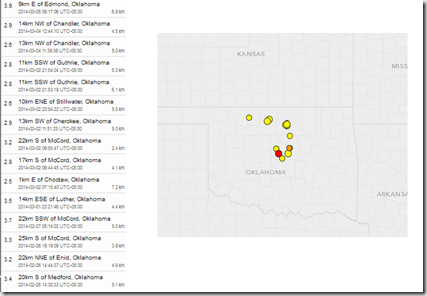
M2.5+  Swarm last 7 Days -  Credit USGS  Earthquake Map


# 8351


Last November, in Oklahoma Insurance Commissioner Warns On Earthquake Risks,  I wrote about the recent uptick in moderate earthquake activity in and around Oklahoma City, OK which began in earnest back in 2009. This `swarm’ includes the largest earthquake ever reported in Oklahoma, a 5.6 Mag Quake near Prague on Nov. 5, 2011.


While most of Oklahoma’s temblors since then have come in under 4.0, on average they’ve seen at least a couple of 2.5+ quakes every day for the past month.  Not strong enough to cause significant damage, but strong enough to be felt, and to raise concerns.


Today, the USGS is reporting a M3.9 - 9km E of Edmond, Oklahoma, the strongest temblor in that region since February 8th’s M4.1 quake. 


Earlier this year, the USGS produced the following update, which links the increase in earthquake activity in the Midwest and East to induced seismicity – or man-made causes.

Man-Made Earthquakes Update

Categories: Featured, Natural Hazards
Posted on January 17, 2014 at 1:00 pm
Last update 2:03 pm By: William Ellsworth (ellsworth@usgs.gov), Jessica Robertson (jrobertson@usgs.gov), and Christopher Hook (703-648-4460)

Seismicity of the coterminous United States and surrounding regions, 2009–2012. Black dots denote earthquakes with a magnitude ≥ 3.0 are shown; larger dots denote events with a magnitude ≥ 4.0. Background colors indicate earthquake hazard levels from the U.S. National Seismic Hazard Map (NSHM). Learn more about the NSHM at http://earthquake.usgs.gov/hazards/?source=sitenav.

Seismicity of the coterminous United States and surrounding regions, 2009–2012. Black dots denote earthquakes with a magnitude ≥ 3.0 are shown; larger dots denote events with a magnitude ≥ 4.0. Background colors indicate earthquake hazard levels from the U.S. National Seismic Hazard Map (NSHM). Learn more about the NSHM at http://earthquake.usgs.gov/hazards/?source=sitenav.


The number of earthquakes has increased dramatically over the past few years within the central and eastern United States. Nearly 450 earthquakes magnitude 3.0 and larger occurred in the four years from 2010-2013, over 100 per year on average, compared with an average rate of 20 earthquakes per year observed from 1970-2000.

This increase in earthquakes prompts two important questions: Are they natural, or man-made? And what should be done in the future as we address the causes and consequences of these events to reduce associated risks? USGS scientists have been analyzing the changes in the rate of earthquakes as well as the likely causes, and they have some answers.

USGS scientists have found that at some locations the increase in seismicity coincides with the injection of wastewater in deep disposal wells. Much of this wastewater is a byproduct of oil and gas production and is routinely disposed of by injection into wells specifically designed for this purpose.

Review Article on Injection-Induced Earthquakes

U.S. Geological Survey geophysicist William Ellsworth reviewed the issue of injection-induced earthquakes in a July 2013 study published in the journal Science. The article focused on the injection of fluids into deep wells as a common practice for disposal of wastewater, and discusses recent events and key scientific challenges for assessing this hazard and moving forward to reduce associated risks.

What is Induced Seismicity?

Although it may seem like science fiction, man-made earthquakes have been a reality for decades. It has long been understood that earthquakes can be induced by impoundment of water in reservoirs, surface and underground mining, withdrawal of fluids and gas from the subsurface, and injection of fluids into underground formations.

(Continue . . . )

While the scientific debate over the exact cause of, and best remedy for, this increased seismic activity continues, last October the USGS warned (bolding mine):


Important to people living in the Oklahoma City region is that earthquake hazard has increased as a result of the swarm. USGS calculates that ground motion probabilities, which relate to potential damage and are the basis for the seismic provisions of building codes, have increased in Oklahoma City as a result of this swarm.  While it’s been known for decades that Oklahoma is "earthquake country," the increased hazard has important implications for residents and businesses in the area.


Which means that Oklahomans (and anyone else who lives an a seismically active region) need to seriously include earthquake preparedness as part of their overall emergency plans. The State of Oklahoma maintains an earthquake safety webpage at EARTHQUAKE SAFETY,  while additional Oklahoma specific earthquake monitoring and research information can be found at the Oklahoma Geological Survey.


Although the west coast is most noted for its seismic hazards, much of America’s heartland and parts of the Eastern Seaboard are also susceptible to moderate to strong quakes.   A topic I covered more than a year ago in USGS: Eastern Earthquakes - Rare But Powerful


image


At a bare minimum, every household should have a disaster plan, a good first aid kit (and the knowledge to use it), an emergency battery operated NWS weather radio, and emergency supplies to last a minimum of 72 hours during a disaster.To become better prepared as an individual, family, business owner, or community, I would invite you to visit the following preparedness sites.


FEMA http://www.fema.gov/index.shtm

READY.GOV http://www.ready.gov/

AMERICAN RED CROSS http://www.redcross.org/

For more on increasing your level of preparedness, a partial list of some of my preparedness blogs include:

When 72 Hours Isn’t Enough

In An Emergency, Who Has Your Back?

An Appropriate Level Of Preparedness