Showing posts with label NSABB. Show all posts

Tuesday, July 15, 2014

Reshuffling The NSABB & A New Biosecurity Working Group Emerges

image

BSL-4 Lab Worker - Photo Credit –USAMRIID


# 8834


Although Crof covered both of these stories during the overnight hours (see here & here), they are well worth repeating here.


The NSABB or National Science Advisory Board for Biosecurity is a 23-member review panel, first formed in 2005, who meet rather infrequently and at the behest of the NIH to review research projects with possible biosecurity concerns.


Their role, as defined in their FAQ, is to


` . . . provide advice, guidance, and leadership regarding biosecurity oversight of dual use research to all Federal departments and agencies with an interest in life sciences research.

The NSABB advises on and recommends specific strategies for the efficient and effective oversight of federally conducted or supported dual use biological research, taking into consideration national security concerns and the needs of the research community.’


While frequently in the news in 2011-2012 during the controversy over the publication of the Fouchier H5N1 ferret study (see The Furor Over H5N1 Research Continues), they’ve been idle for roughly two years, with no quests from the NIH to reconvene. 


Yesterday, we learned via Science Magazine’s ScienceInsider, that 11 of the original board members have been abruptly informed that their services are no longer required.   Gone are such well known (and frequently outspoken) experts as Paul Keim from Northern Arizona University, Arturo Casadevall from Albert Einstein College of Medicine, Michael Imperiale of the University of Michigan, and Michael Osterholm from CIDRAP.


U.S. biosafety panel to come out of hibernation with new members

By Jon Cohen

14 July 2014 6:45 pm

On the heels of several mishaps involving deadly pathogens, U.S. officials are reconvening an expert advisory panel that hasn’t met in nearly 2 years. But the government has also dismissed 11 of the original members of the 23-person panel, called the National Science Advisory Board for Biosecurity (NSABB).

“We had no inkling it was going to happen this way,” says Paul Keim, a pathogen genomics researcher at Northern Arizona University in Flagstaff who formerly chaired NSABB and has been on the panel since it was formed in 2005. The 11 members learned they were being dismissed Sunday evening in an e-mail from the board’s executive director, Mary Groesch, who works at the U.S. National Institutes of Health (NIH), NSABB’s overseer. The e-mail prompted this tweet from NSABB member Michael Imperiale of the University of Michigan, Ann Arbor: “#NIH just gave remaining inaugural NSABB members pink sheets. Bizarre time to eliminate all institutional memory.”

(Continue . . .)


In a related matter, yesterday a new initiative appeared online called the Cambridge Working Group, that consists of 17 internationally known experts and researchers (including several former NSABB members) called:


The Cambridge Working Group

July 14, 2014

Cambridge Working Group Consensus Statement on the Creation of Potential Pandemic Pathogens (PPPs)

Recent incidents involving smallpox, anthrax and bird flu in some of the top US laboratories remind us of the fallibility of even the most secure laboratories, reinforcing the urgent need for a thorough reassessment of biosafety. Such incidents have been accelerating and have been occurring on average over twice a week with regulated pathogens in academic and government labs across the country. An accidental infection with any pathogen is concerning. But accident risks with newly created “potential pandemic pathogens” raises grave new concerns. Laboratory creation of highly transmissible, novel strains of dangerous viruses, especially but not limited to influenza, poses substantially increased risks. An accidental infection in such a setting could trigger outbreaks that would be difficult or impossible to control. Historically, new strains of influenza, once they establish transmission in the human population, have infected a quarter or more of the world’s population within two years.


For any experiment, the expected net benefits should outweigh the risks. Experiments involving the creation of potential pandemic pathogens should be curtailed until there has been a quantitative, objective and credible assessment of the risks, potential benefits, and opportunities for risk mitigation, as well as comparison against safer experimental approaches. A modern version of the Asilomar process, which engaged scientists in proposing rules to manage research on recombinant DNA, could be a starting point to identify the best approaches to achieve the global public health goals of defeating pandemic disease and assuring the highest level of safety. Whenever possible, safer approaches should be pursued in preference to any approach that risks an accidental pandemic.

  • Amir Attaran, University of Ottawa
  • Barry Bloom, Harvard School of Public Health
  • Arturo Casadevall, Albert Einstein College of Medicine
  • Richard Ebright, Rutgers University
  • Nicholas G. Evans, University of Pennsylvania
  • David Fisman, University of Toronto Dalla Lana School of Public Health
  • Alison Galvani, Yale School of Public Health
  • Peter Hale, Foundation for Vaccine Research
  • Edward Hammond, Third World Network
  • Michael Imperiale, University of Michigan
  • Thomas Inglesby, UPMC Center for Health Security
  • Marc Lipsitch, Harvard School of Public Health
  • Michael Osterholm, University of Minnesota/CIDRAP
  • David Relman, Stanford University
  • Richard Roberts, New England Biolabs
  • Marcel SalathĂ©, Pennsylvania State University
  • Silja Vöneky, University of Freiburg Institute of Public Law, Deutscher Ethikrat
  • Affiliations are for purposes of identification only and do not imply any institutional endorsement


A pretty good indication that we can expect continued debate on the topic of lab biosafety, and that many of the recently released members of the NSABB have no intention of going gentle into this good night.

Wednesday, May 23, 2012

Nature: Bird Flu Research Oversight


image

BSL-4 Lab Worker - Photo Credit –USAMRIID  


# 6342


From the journal Nature today, a detailed look by Brendon Maher at how the NSABB examined the Kawaoka and Fouchier H5N1 research papers, and the long, tortuous road towards a final decision on their publication.


For those who did not follow this story, briefly:


In September of 2011, one of the best known flu researchers in the world - Ron Fouchier of Erasmus Medical Centre in Rotterdam - announced at a scientific conference that he’d managed to turn H5N1 into a virulent, and easily transmissible (among ferrets, anyway) pathogen.


(You can read about this work in Katherine Harmon’s Sci-Am article and in a follow up to this story in New Scientist: Five Easy Mutations.)


Halfway across the world, Yoshihiro Kawaoka, a highly respected virologist at the University of Wisconsin-Madison School of Veterinary Medicine announced the creation of a comparable H5N1 super flu at roughly the same time.


Within weeks biosecurity experts began to question whether scientists should even be tinkering with this particularly lethal flu strain, and whether (or how) those results should be published.


The NSABB was tasked with reviewing these projects, and making a recommendation to the United States government.


After first recommending that the full studies not be published, the NSABB – under mounting pressure from a number of directions – reconsidered their decision in light of `revised and clarified’ manuscripts from Fouchier, and green-lighted their publication.


Brendon Maher explores the process by which these disparate decisions were reached, and the lingering concerns held by many involved in. 


This is an important story, and well worth reading in its entirety, so follow the link below:


Nature | News Feature

Bird-flu research: The biosecurity oversight

The fight over mutant flu has thrown the spotlight on a little-known government body that oversees dual-use research. Some are asking if it was up to the task.

  • Brendan Maher

23 May 2012

Friday, April 13, 2012

ScienceInsider: A Flawed Flu Papers Process?


# 6283


The `must read’ for today comes from the pen of CIDRAP director and NSABB  board member Michael Osterholm in a letter to the Associate Director for Science Policy at the NIH where he critiques the NSABB’s recent reversal of their previously unanimous decision to block the full publication of Ron Fouchier’s controversial H5N1 ferret studies.


Of the eighteen members who voted again on the issue, twelve recommended publication while six did not.  Osterholm voted in the minority.


Jon Cohen writing for Science’s ScienceInsider provides the background, in his report:


A Flawed Flu Papers Process?

by Jon Cohen on 13 April 2012, 4:26 PM


Last month, one-third of the members of the U.S. National Science Advisory Board for Biosecurity (NSABB) disagreed with the group's recommendation to publish in full two studies that describe how to make the bird flu virus transmissible in mammals. Now one of the six dissenters, influenza epidemiologist Michael Osterholm of the University of Minnesota, Twin Cities, has written a sharp critique of the meeting that led to the decision. In a letter sent yesterday to Amy Patterson, an official at the U.S. National Institutes of Health whose office oversees NSABB, Osterholm charged that the meeting was "designed to produce the outcome that occurred."

(Continue . . .)


Osterholm’s 7-page letter is available  HERE - and regardless where you stood on the publication of Fouchier’s research - Osterholm calls into serious question many aspects of the NSABB review process that should be of concern to all of us.


Helen Branswell has even more on all of this in her recently updated Canadian Press story:


Updated: April 13, 2012 | 6:39 pm

Flu expert slams bird flu panel process

By Helen Branswell The Canadian Press


In a world where we can now create `designer’ organisms in the laboratory, the biosecurity issues facing life sciences research are becoming increasingly complex. While the benefits of this kind of work may prove enormous, the risks are not trivial.


Despite reassurances from researchers, mistakes, laboratory accidents, and even intentional misuse of these new technologies are always possible.


Against this backdrop, public confidence in science and scientists continues to deteriorate (see Science at the Crossroads). Already there is a good deal of public resistance to the use of GM (Genetically Modified) food crops, and bio-engineered organisms, and the anti-vaccine movement continues to thrive.


If this type of research is to have a viable future, then it must first engender the public’s trust.


And based on their handling of this controversy over the past few months, the scientific community has got a long way to go.

Friday, April 06, 2012

NIH Video: Dual Use Research Of Concern (DURC)


image

NIH Brochure on Dual Use Research


# 6264


Over the past few months an obscure acronym has made it’s way into numerous blogs, news headlines, and even popular usage; DURCDual Use Research of Concern.


While it is the current debate over controversial H5N1 transmissibility studies that has prompted its emergence (see The Biosecurity Debate On H5N1 Research), DURC has been a matter of national concern for a number of years.


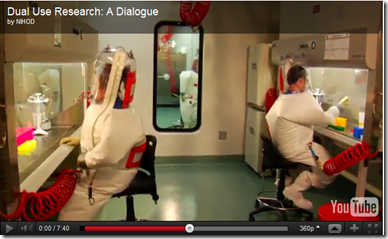
The NIH produced a 7 minute video in 2010 highlighting the concerns of DURC, called Dual Use Research: A dialogue.  Click the link, or the image below to watch.


image


Last week the  Office of Science Policy at the NIH released a 4 page set of guidelines for DURC (Duel Use Research of Concern) projects designed to beef up oversight and biosecurity of U.S. funded projects.


The scope of this new policy is to cover research on the most dangerous of biological organisms, listing;


a)  Avian influenza virus (highly pathogenic) 
b)  Bacillus anthracis
c)  Botulinum neurotoxin
d)  Burkholderia mallei
e)  Burkholderia pseudomallei
f)  Ebola virus
g)  Foot-and-mouth disease virus
h)  Francisella tularensis
i)  Marburg virus

j)  Reconstructed 1918 Influenza virus

k)  Rinderpest virus
l)  Toxin-producing strains of Clostridium botulinum
m) Variola major virus
n)  Variola minor virus
o)  Yersinia pestis


Specifically any research that seeks to:


a)  Enhances the harmful consequences of the agent or toxin; 

b)  Disrupts immunity or the effectiveness of an immunization against the agent or toxin without
clinical or agricultural justification;

c)  Confers to the  agent or toxin resistance to clinically or agriculturally useful prophylactic or
therapeutic interventions against that agent or toxin or facilitates their ability to evade detection methodologies;

d)  Increases the stability, transmissibility, or the ability to disseminate the agent or toxin; 

e)  Alters the host range or tropism of the agent or toxin;  

f)  Enhances the susceptibility of a host population to the agent or toxin; or

g)  Generates or reconstitutes an eradicated or extinct agent or toxin listed in Section (III.1) above.


For more on DURC, the NSABB, and the Office of Biotechnology Activities, you may wish to visit the following links.

Brochure on Dual Use Research

Video on Dual Use Research

International Meetings

NSABB FAQs

Summary of NSABB Reports and Activities

Responsible Communication of Life Sciences Research with Dual Use Potential

Global Status of Strategies for Addressing the Intersection of Science and Security

Roundtable at the ASM Biodefense and Emerging Diseases Research meeting

Friday, March 30, 2012

NSABB Clears H5N1 Studies For Publication


# 6254


From Helen Branswell this evening, a report that the NSABB – after reviewing new data submitted by flu researcher Ron Fouchier – has cleared the way for the publication of both his, and Yoshihiro Kawaoka’s work on ferret transmissible H5N1.


The vote to publish Karaoka’s paper was unanimous, while the vote for Fourchier’s was 12 to 6.


The NSABB serves in an advisory capacity only, and it will be up to the United States government to either accept or reject their recommendations.


Follow the link below for the story by Helen Branswell.


US biosecurity panel clears publication path for controversial bird flu studies

By Helen Branswell, The Canadian Press |   


For more on what the future of U.S. government sponsored life sciences research will look like, you may wish to revisit yesterday’s blog on U.S. Issues New DURC Oversight Rules.

Thursday, March 29, 2012

NSABB To Re-examine H5N1 Research Risks


image


# 6249


Today and tomorrow the NSABB (National Science Advisory Board for Biosecurity) will reconvene to re-examine the issues surrounding the publication of controversial H5N1 research that produced a ferret-transmissible strain of bird flu.


Last September, Ron Fouchier from the Netherlands (and almost simultaneously Professor Yoshihiro Kawaoka from Wisconsin) announced success in creating enhanced strains of the avian flu virus in the laboratory, which subsequently unleashed a firestorm of controversy.


For some background, see Katherine Harmon’s Sci-Am article , New Scientist: Five Easy Mutations, & NPR: Bio-Terrorism Concerns Over Bird Flu Research.


Over the ensuing six months we’ve seen a steady stream of opinion pieces from both sides of this debate (see H5N1 Research: A Plethora Of Positions), including side forays into the lethality of the H5N1 virus (see The Great CFR Divide).


This week we’ve seen the release of additional dueling commentaries, three of which Lisa Schnirring of CIDRAP NEWS  highlighted last night in her article:


Scientists volley ahead of more dual-use H5N1 debate

Lisa Schnirring * Staff Writer

Mar 28, 2012 (CIDRAP News) – As researchers from both sides of the debate over two controversial H5N1 studies weighed in yesterday on full publication versus a more cautionary approach, two US journals said they are developing policies to address any future such instances.

(Continue . . .)


The NSABB serves strictly in an advisory role, and any policy decisions must come from the United States government. Nonetheless, all eyes will be on the NSABB as they consider this issue.


And I can think of no one better than Helen Branswell  of the Canadian Press to preview this meeting for us:


Biosecurity panel reconvenes to reexamine controversial bird flu studies

3-28-12 6:31 PM EDT  By Helen Branswell

A bid from some quarters in the U.S. to resolve the ongoing controversy over two unpublished bird flu studies will begin to play out over the next two days as government biosecurity advisers reconvene to reconsider the issue.


The National Science Advisory Board for Biosecurity will meet Thursday and Friday in Washington, D.C., to go over revised versions of the two studies and hear about the work from their principal authors, noted flu virologists Ron Fouchier of Erasmus Medical Centre in Rotterdam, the Netherlands, and Yoshihiro Kawaoka of the University of Wisconsin-Madison.

(Continue . . . )

Wednesday, February 29, 2012

CIDRAP News: NSABB May Revisit H5N1 Research


# 6184


Robert Roos, News editor for CIDRAP News, has a detailed report on today’s ASM Biodefense panel discussion (see ASM BioDefense Meeting Video Now Online).


With new data presented by Ron Fouchier at this meeting, the NSABB may take another look at these studies.


With new data, NSABB may revisit H5N1 studies

Robert Roos * News Editor

Feb 29, 2012 (CIDRAP News) – The mutant H5N1 virus generated in one of two controversial studies was less lethal and contagious than has been generally understood, and the US government's biosecurity advisory committee will be asked to examine new and clarified data from the study, scientists and government officials revealed today.

(Continue . . . )


ASM BioDefense Meeting Video Now Online


image


# 6182


This morning’s ASM BioDefense panel discussion of the NSABB’s call to redact portions of two H5N1 research papers is now online, and available to all.


In a bit of a surprise, Erasmus University researcher Ron Fouchier characterized the results of his experiments somewhat differently than we’ve seen in the past.


While the mutated virus could be spread via the aerosol route between ferrets, Fouchier reassured, "Our data suggests this virus spreads very poorly."


Fouchier also downplayed the pathogenicity of virus, stating that ferrets infected this way only suffered mild illness (it required direct deep-lung inoculation to produce death/severe illness).


It is not highly lethal if ferrets start coughing and sneezing to one another”, he said.


One must note that when the news was `all bad’ about the transmission and pathogenicity of this mutated virus, many scientists were quick to caution us that ferrets aren’t a perfect model for how the virus will act in humans’.


Which means that the reduced pathogenicity and transmissibility in ferrets described by Fouchier today may not necessarily translate to how the virus would act in a human host.


The 70 minute video may now be viewed at THIS LINK.


Very much worth watching.


image

Featuring: 

Michael T. Osterholm, Ph.D., MPH  NSABB/CIDRAP

Anthony S. Fauci, M.D  (NIAID)

Bruce Alberts, Ph.D. Editor-in-Chief of Science

Ron A.M. Fouchier, Ph.D.    H5N1 Researcher

Tuesday, February 28, 2012

Webcast: Discussion Of NSABB’s H5N1 Recommendations


# 6181


My thanks to Helen Branswell for tweeting this event.


Set you alarm clocks accordingly, as tomorrow morning (Wednesday, February 29th) the ASM Biodefense and Emerging Diseases Research Meeting will provide a live webcast of an hour-long discussion over the NSABB’s recommendations to redact portions of two H5N1 research papers.


image

Featuring: 

Michael T. Osterholm, Ph.D., MPH  NSABB/CIDRAP 

Anthony S. Fauci, M.D  (NIAID)

Bruce Alberts, Ph.D. Editor-in-Chief of Science

Ron A.M. Fouchier, Ph.D.    H5N1 Researcher

Live Stream Details
Date: Wednesday, February 29, 2012
Time: 7:15 a.m. - 8:15 a.m. EST
Link:

If you are unable to watch the live feed, a video should be posted by 1:00pm.

Tuesday, January 31, 2012

NSABB Statement, mBio Commentaries & A `Dual Use’ Webinar


# 6112


About an hour ago a 3-page PDF statement from the NSABB appeared on Science/ AAAS.org’s Public Health, Biosecurity, and H5N1 Forum, providing that committee's rationale for requesting the redaction from science journals of key portions of recent controversial `dual use’  H5N1 research.


30 JANUARY 2012 | POLICY FORUM

Adaptations of Avian Flu Virus Are a Cause for Concern

K. I. Berns et al.

Members of the National Science Advisory Board for Biosecurity explain its recommendations on the communication of experimental work on H5N1 influenza.


Meanwhile, mBio has published four views on all of this from Paul S. Keim, Vincent R. Racaniello, Robert G. Webster, and Arturo Casadevall & Thomas Shenk.


I’m headed there now to read:


Mammalian-Transmissible H5N1 Influenza: the Dilemma of Dual-Use Research

Robert G. Webster doi:10.1128/mBio.00005-12


Science Should Be in the Public Domain

Vincent R. Racaniello  doi:10.1128/mBio.00004-12


The NSABB Recommendations: Rationale, Impact, and Implications


Paul S. Keim  doi:10.1128/mBio.00021-12


The H5N1 Manuscript Redaction Controversy

Arturo Casadevall and Thomas Shenk doi:10.1128/mBio.00022-12


And on Thursday night, many of the major players in the world of influenza virology and biosecurity will convene for a 2 hour panel discussion, to be webcast by the New York Academy of Sciences (this appears to be a Pay-per-view event for non-members).


Here is the Press Release from the New York Academy of Sciences


Dual use research: H5N1 influenza virus and beyond

Experts to discuss controversial studies on avian flu virus at live event

WHAT: Dual Use Research: H5N1 Influenza Virus and Beyond

WHEN: Feb. 2, 6pm to 8pm

WHERE: The New York Academy of Sciences

REGISTER: www.nyas.org/H5N1

The US National Science Advisory Board for Biosecurity (NSABB) recently recommended that journals Nature and Science remove certain methodological details from controversial studies on the avian influenza virus (H5N1) to minimize the risk of these findings being misused by would-be bioterrorists. On February 2 from 6pm to 8pm, the Emerging Infectious Diseases & Microbiology Discussion Group of the New York Academy of Sciences presents Dual Use Research: H5N1 Influenza Virus and Beyond, a discussion between scientists, publishers, and legal experts that will explore the myriad issues surrounding the impending publication of these two studies and measures that will need to be undertaken to ensure the security of future such research.


To weigh in on matters of censorship and public safety, W. Ian Lipkin, MD, Center for Infection & Immunity at Columbia University, will moderate a panel discussion with Arturo Casadevall, MD, PhD, Albert Einstein College of Medicine, and member, NSABB; Laurie Garrett, PhD, Council on Foreign Relations; Barbara R. Jasny, PhD, Science; Veronique Kiermer, PhD, Nature Publishing Group; Michael T. Osterholm, PhD, MPH, Center for Infectious Disease Research and Policy, University of Minnesota, and member, NSABB; Peter Palese, PhD, Mount Sinai School of Medicine; Vincent Racaniello, PhD, Columbia University; and Alan S. Ruldolph, PhD, Defense Threat Reduction Agency.

###

Attendees must register at www.nyas.org/H5N1. Media must RSVP to Diana Friedman, dfriedman@nyas.org.

Tuesday, December 27, 2011

Publish or Perish The Thought?


# 6039


This morning Helen Branswell of the Canadian Press brings us the debate on the possibility that the NSABB may request a temporary moratorium on the publication of sensitive bird flu research projects until a new policy on such matters can be established.


You’ll find comments by a virtual who’s who of influenza virology, including Paul Keim of the NSABBMalik Peiris of the University of Hong Kong, Richard Webby from the WHO reference laboratory at St Judes Children's Hospital in Memphis, Tenn., Dr. Anthony Fauci director of NIAID, and Michael Osterholm, director of CIDRAP.


As with any story from Helen, the only sensible thing for this blogger to do is to step aside and invite you read the entire story at the link below.


Bird flu study controversy could lead to research chill

12/27/2011  | Helen Branswell, The Canadian Press

The H5N1 Research Debate Goes On


image

BSL-4 Lab Worker - Photo Credit –USAMRIID

# 6038


As I’ve mentioned in two recent blogs (The Passing Parade Of 2011 and The Passing Parade Of 2011 – Pt. 2), the controversial tinkering with avian flu viruses in the laboratory to create a more transmissible strain is hardly unique.


Researchers all over the world, working mostly in BSL-3 labs, are creating new reassortant viruses to study.


Their hope is to identify the changes that nature would need to make in order to spark a pandemic, and in doing so, perhaps get a jumpstart on a vaccine.


And for the most part, until Ron Fouchier announced the creation of an airborne H5N1 strain last August (see Katherine Harmon’s Sci-Am article and in a follow up to this story in New Scientist: Five Easy Mutations), few in the media took notice.


Halfway across the world, Yoshihiro Kawaoka, a highly respected virologist at the University of Wisconsin-Madison School of Veterinary Medicine announced the creation of a comparable H5N1 super flu at roughly the same time.


The debate, which encompasses extremely serious and complex issues, has unfortunately devolved in many media outlets to simplistic hyperbolic rants against irresponsible `mad scientists’ creating `Frankenflus’ that will be the death of us all.


Luckily, not all of the coverage has taken the low road. A few examples include:


Debate Persists on Deadly Flu Made Airborne

By DENISE GRADY and DONALD G. McNEIL Jr.
Published: December 26, 2011 – NY Times


Studies of deadly H5N1 bird flu mutations test scientific ethics

Dutch scientists have created a version of the deadly H5N1 bird flu that's easily transmitted. In an unprecedented move, a U.S. board asks that some details of the research not be published.

By Eryn Brown, Los Angeles Times

December 26, 2011, 10:21 p.m.


But one of the best debates is going on at Vincent Racaniello’s Virology Blog in his recent blog post A bad day for science and the 30+ comments (including from Ron Fouchier and Mike Imperiale, a member of the NSABB) that follow.


Highly recommended.

Tuesday, December 20, 2011

NSABB Recommends Limiting Details In Publication Of Controversial H5N1 Research


UPDATED at bottom


# 6022


According an NIH press release, the National Science Advisory Board for Biosecurity (NSABB) has made a recommendation to the HHS regarding a pair of controversial H5N1 research projects awaiting publication.


These research projects have produced a highly virulent and transmissible strain of the H5N1 virus in the laboratory, prompting concerns that their publication could provide a blueprint for bio-terrorists (see The Biosecurity Debate On H5N1 Research).


Specifically, the non-binding recommendation reads:


NSABB recommended that the general conclusions highlighting the novel outcome be published, but that the manuscripts not include the methodological and other details that could enable replication of the experiments by those who would seek to do harm.


More details are available in the full press release below:


Press Statement on the NSABB Review of H5N1 Research

The U.S. government remains concerned about the threat of influenza, for the risks it poses seasonally, as well as its potential to cause a pandemic. Our domestic and global influenza surveillance efforts have become increasingly capable, along with expanded vaccine manufacturing capacity and assistance to other countries in their efforts to detect and respond to a pandemic. To enhance the detection of and response to influenza outbreaks, the U.S. government supports a broad range of domestic and global preparedness and response efforts that include research on better diagnostics, vaccines, and therapeutics.


Currently, H5N1 avian influenza virus — the strain commonly referred to as "bird flu" — rarely infects humans and does not spread easily from person to person. However, many scientists and public health officials are concerned that the virus could evolve in nature into a form that is transmissible among humans — an event that could potentially make this deadly virus an extremely serious global public health threat. Thus research on factors that can affect the transmissibility of the H5N1 virus is critically important to international efforts to prepare and prevent threats to public health.


While the public health benefits of such research can be important, certain information obtained through such studies has the potential to be misused for harmful purposes. The National Science Advisory Board for Biosecurity (NSABB) — an independent expert committee that advises the Department of Health and Human Services (HHS) and other Federal departments and agencies on matters of biosecurity — completed a review of two unpublished manuscripts describing NIH-funded research on the transmissibility of H5N1. These manuscripts — which describe laboratory experiments that resulted in viruses with enhanced transmissibility in mammals – concluded that the H5N1 virus has greater potential than previously believed to gain a dangerous capacity to be transmitted among mammals, including perhaps humans, and describe some of the genetic changes that appear to correlate with this potential.


Following its review, the NSABB decided to recommend that HHS ask the authors of the reports and the editors of the journals that were considering publishing the reports to make changes in the manuscripts. Due to the importance of the findings to the public health and research communities, the NSABB recommended that the general conclusions highlighting the novel outcome be published, but that the manuscripts not include the methodological and other details that could enable replication of the experiments by those who would seek to do harm.


The NSABB also recommended that language be added to the manuscripts to explain better the goals and potential public health benefits of the research, and to detail the extensive safety and security measures taken to protect laboratory workers and the public.


HHS agreed with this assessment and provided these non-binding recommendations to the authors and journal editors.


Recognizing the significant potential benefit of the information about the experimental details to the global influenza surveillance and research communities, the U.S. government is working to establish a mechanism to allow secure access to the information to those with a legitimate need in order to achieve important public health goals. The U.S. government is also developing a proposed oversight policy that would augment existing approaches to evaluating research that has the potential to be misused for harmful purposes.


The NSABB supports the overall goals of the National Institutes of Health, in conducting safe, ethical and informative research to enhance health, lengthen life, and reduce the burdens of illness and disability. To learn more about the NSABB, visit www.biosecurityboard.gov.


About the National Institutes of Health (NIH): NIH, the nation's medical research agency, includes 27 Institutes and Centers and is a component of the U.S. Department of Health and Human Services. NIH is the primary federal agency conducting and supporting basic, clinical, and translational medical research, and is investigating the causes, treatments, and cures for both common and rare diseases. For more information about NIH and its programs, visit www.nih.gov.


UPDATE:  1245 hrs EST 12/20/11


As these are non-binding recommendations, the ball is now firmly in the court of the scientific journals seeking to publish these studies.


The following statement from the journal Science, indicates they are considering the requests seriously, but have concerns, and are still evaluating how to proceed.


Science: Editor-in-Chief Bruce Alberts on Publication of H5N1 Avian Influenza Research