Thursday, June 23, 2011

NPM 2011: A Time To Remember, A Time To Prepare


# 5647


image


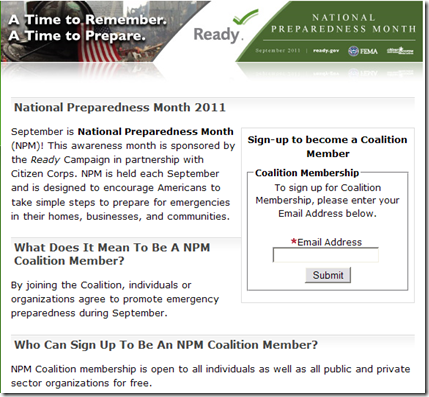
Although this is only June, and National Preparedness Month (NPM) 2011 happens in September, Ready.gov, FEMA, and the Citizen Corps are kicking off their awareness campaign and looking for coalition members.


This year – being the 10th anniversary of 9/11 – we are being asked to remember past disasters as well as prepare those that may come in the future.


As you might expect, Avian Flu Diary has already signed up.  And you can too.


I’ll let Ready.gov explain the process. Click on the image below to go to the sign up page.


image


I’ll have much more on this campaign over the next couple of months, and like last year, will highlight preparedness articles during the month of September.

Hong Kong: Scarlet Fever Update


# 5646


From Hong Kong’s Centre For Health Protection we’ve the latest daily update on Scarlet Fever cases.  Over the past 48 hours a total of 60 new cases have been reported.


image


Although a great deal has been made over the detection of a `new, more contagious strain’ of Scarlet Fever (see When Old Bacteria Learns New Tricks), it would appear that more than one strain is contributing to the current outbreak in the region.


According to the latest update:


“Laboratory investigation showed that the isolates from the two fatal cases belong to different strains. emm typing of the isolate from 7 year-old girl and 5
year-old boy are Type 12 and Type 1 respectively.”


While the number of cases in Hong Kong has just passed the 500 mark, in mainland China more than 9,000 cases have been reported; double the rate seen most years.

CDC Health Advisory (HAN) On Measles


# 5645


Earlier this year I wrote about the recent rise of measles cases across much of Europe (see Measles: Forgotten, But Not Gone), with details gleaned from the WHO’s WER (Weekly Epidemiological Record), and including a referral to an excellent 5-part series on measles by Ian York.


The WER report (Measles outbreaks in Europe) detailed an outbreak, which had – as of April 18th –had infected more than 6,500 people in 33 nations.


This spring a significant number of measles cases have been imported into the United States from this outbreak, and with the summer travel season upon us, the potential for seeing more cases is great.


For this reason, the CDC released a HAN Advisory on measles last night.


The CDC’s Health Alert Network (HAN) is designed to ensure that communities, agencies, health care professionals, and the general public are able to receive timely information on important public health issues.


You can sign up for HAN messages, and scores of other CDC and HHS email notifications, by going to the CDC - Quick Subscribe GovDelivery page.


There are 4 types of HAN releases.


Health Alert

Conveys the highest level of importance; warrants immediate action or attention.

Health Advisory

Provides important information for a specific incident or situation; may not require immediate action.

Health Update

Provides updated information regarding an incident or situation; unlikely to require immediate action.

Info Service
Provides general information that is not necessarily considered to be of an emergent nature.


This is an official

CDC HEALTH ADVISORY

Distributed via Health Alert Network
June 22, 2011, 16 :00 EST (04:00 PM EST)
CDCHAN-00323-11-06-22-ADV-N

High Number of Reported Measles Cases in the U.S. in 2011—Linked to Outbreaks Abroad


Summary and Background

The United States is experiencing a high number of reported measles cases in 2011, many of which were acquired during international travel. From January 1 through June 17 this year, 156 confirmed cases of measles were reported to CDC. This is the highest reported number since 1996. Most cases (136) were associated with importations from measles-endemic countries or countries where large outbreaks are occurring. The imported cases involved unvaccinated U.S. residents who recently traveled abroad, unvaccinated visitors to the United States, and people linked to these imported cases. To date, 12 outbreaks (3 or more linked cases) have occurred, accounting for 47% of the 156 cases. Of the total case-patients, 133 (85%) were unvaccinated or had undocumented vaccination status. Of the 139 case-patients who were U.S. residents, 86 (62%) were unvaccinated, 30 (22%) had undocumented vaccination status, 11 (8%) had received 1 dose of measles-mumps-rubella (MMR) vaccine, 11 (8%) had received 2 doses, and 1 (1%) had received 3 (documented) doses.


Measles was declared eliminated in the United States in 2000 due to our high 2-dose measles vaccine coverage, but it is still endemic or large outbreaks are occurring in countries in Europe (including France, the United Kingdom, Spain, and Switzerland), Africa, and Asia (including India). The increase in measles cases and outbreaks in the United States this year underscores the ongoing risk of importations, the need for high measles vaccine coverage, and the importance of prompt and appropriate public health response to measles cases and outbreaks.


Measles is a highly contagious, acute viral illness that is transmitted by contact with an infected person through coughing and sneezing. After an infected person leaves a location, the virus remains contagious for up to 2 hours on surfaces and in the air. Measles can cause severe health complications, including pneumonia, encephalitis, and death.

Recommendations for Health Care Providers

  • Ensure all patients are up to date on MMR vaccine* and other vaccines.
  • For those who travel abroad, CDC recommends that all U.S. residents older than 6 months be protected from measles and receive MMR vaccine, if needed, prior to departure.
    • Infants 6 through 11 months old should receive 1 dose of MMR vaccine before departure.†
    • Children 12 months of age or older should have documentation of 2 doses of MMR vaccine (separated by at least 28 days).
    • Teenagers and adults without evidence of measles immunity** should have documentation of 2 appropriately spaced doses of MMR vaccine.
  • Consider measles as a diagnosis in anyone with a febrile rash illness lasting 3 days or more, a temperature of 101ºF (38.3ºC) or higher, and clinically compatible symptoms (cough, coryza, and/or conjunctivitis) who has recently traveled abroad or who has had contact with someone with a febrile rash illness. Immunocompromised patients may not exhibit rash or may exhibit an atypical rash. The incubation period for measles from exposure to fever is usually about 10 days (range, 7 to 12 days) and from exposure to rash onset is usually 14 days (range, 7 to 21 days).
  • Isolate suspect measles case-patients and immediately report cases to local health departments to ensure a prompt public health response.
  • Obtain specimens for testing, including viral specimens for confirmation and genotyping.


Measles was considered eliminated in the United States by the year 2000 due to the introduction of the measles vaccine in the mid-1960s.


image


Despite this success, there remain enough unvaccinated individuals to create cracks in our hard won `herd immunity’, and that allow the virus an opportunity to spread.

Wednesday, June 22, 2011

NASA: Getting Ready For The Next Big Solar Storm


# 5644


A subject I’ve written on a number of times in the past  (see A Flare For The Dramatic, Solar Storms, CMEs & FEMA, A Carrington Event) is in the news once more, with officials gathering in Washington D.C. this week to discuss the potential impact of a major solar storm.


The occasion is the 5th annual Space Weather Enterprise Forum — or SWEF.  And in attendance are representatives from Congress, NASA, NOAA, FEMA, electrical utilities, and the United Nations.


Despite recent forecasts for diminished solar activity in over the next few decades (see Scientists Predicting A Quieter Sun) it is worth noting that the largest solar flare recorded in the past 500 years – the infamous Carrington Event - occurred during a relatively weak solar cycle (#10).


Since I’ve covered these issues in the recent past, I’ll simply give you the link to the NASA Science News story, and step out of the way.


Getting Ready for the Next Big Solar Storm

June 21, 2011: In Sept. 1859, on the eve of a below-average1 solar cycle, the sun unleashed one of the most powerful storms in centuries. The underlying flare was so unusual, researchers still aren't sure how to categorize it.  The blast peppered Earth with the most energetic protons in half-a-millennium, induced electrical currents that set telegraph offices on fire, and sparked Northern Lights over Cuba and Hawaii.


This week, officials have gathered at the National Press Club in Washington DC to ask themselves a simple question: What if it happens again?

SWEF (powerlines, 200px)

Modern power grids are vulnerable to solar storms. Photo credit: Martin Stojanovski


"A similar storm today might knock us for a loop," says Lika Guhathakurta, a solar physicist at NASA headquarters. "Modern society depends on high-tech systems such as smart power grids, GPS, and satellite communications--all of which are vulnerable to solar storms."

(Continue . . . )

Estimating The Economic Impact Of A San Andreas Quake


# 5643


Japan, a little more than 100 days after their massive 9.0 earthquake and Tsunami, finds itself in recession with hundreds of thousands of people either displaced from their homes or out of work, and much of their manufacturing base in disarray.


The damage from these types of disasters continue long after the shaking stops.


Over the past 18 months we’ve seen major earthquakes along the Pacific rim ranging from Chile, to New Zealand, to Japan. Spared, thus far, have been the Pacific coasts of North America.


But California, Washington, Oregon, British Columbia, and Alaska all have significant seismic risks. 


Accordingly, the U.S. Bureau of Labor Statistics released a report yesterday that estimated the crippling impact a highly feasible (and long overdue) 7.8 magnitude Southern California earthquake would have on jobs and local businesses.


image

Download PDF file


A quake of this magnitude, they estimate, could affect  430,000 businesses and 4.5 million workers and deliver a devastating – and prolonged – blow to the local economy.


While huge death tolls are considered unlikely in this scenario, the untimely demise of thousands of unprepared businesses is all but assured.


As the following story in the Los Angeles Times points out, it is imperative that local businesses prepare now for an inevitable quake.


Else they risk not only their own economic future, but the futures of their employees and of the local economy.


Southland businesses urged to get ready for 'The Big One' -- a 7.8 earthquake

June 21, 2011 |  3:03 pm


Yesterday’s announcement makes this a pretty good time to remind my readers about the study last year (see Revised Risk Of `The Big One’ Along San Andreas Fault) that suggests that Southern California may be more overdue for another major quake than previously thought.


For more on how you can prepare for `the big one’ (even if you live someplace other than Los Angeles), I would recommend you download, read, and implement the advice provided by the The L. A. County Emergency Survival Guide.


image


And finally, from  the USGS Great Southern California Shakeout website,  we’ve this 4 and 1/2 minute video called Preparedness Now (Streaming | Video) that  “depicts the realistic outcome of a hypothetical, but plausible, magnitude 7.8 earthquake on the San Andreas fault in Southern California.”

image


To become better prepared as an individual, family, business owner, or community to deal with these types of disasters: visit the following preparedness sites.


FEMA http://www.fema.gov/index.shtm

READY.GOV http://www.ready.gov/

AMERICAN RED CROSS http://www.redcross.org/

Egypt Announces Another H5N1 Fatality


image


# 5642


Although bird flu cases generally decline during the warmer summer months, today’s announcement from the World Health Organization is the third such update this month, reporting a total of 7 cases reported since mid-May.


Also surprising are the number of fatal cases (5 of 7), and that all of the victims have been somewhat older than we have normally seen in Egypt, ranging in age from 16 to 40.


Avian influenza - situation in Egypt - update 54

22 June 2011 - The Ministry of Health of Egypt has notified WHO of a new case of human infection with avian influenza A (H5N1) virus.


The case is a 27 year-old male from Qena governorate, Deshna district. He developed symptoms on 5 June 2011, was hospitalized and was put on oseltamivir treatment on 13 June. He died on 14 June 2011.


Investigations into the source of infection indicate that the case had exposure to poultry suspected to have avian influenza.


The case was confirmed by the Egyptian sub-national laboratory for Influenza in Aswan and the Central Public Health Laboratories in Cairo, a National Influenza Centre of the WHO Global Influenza Surveillance Network.


Of the 150 cases confirmed to date in Egypt, 52 have been fatal.


It should be noted that the newshounds on the flu forums continue to track a small number of other – as yet unconfirmed – reported cases in Egypt.


Today’s report brings this year’s total to 31 cases and 12 fatalities.  


While human cases in the middle-east outside of Egypt have not been reported in many years, the lack of accurate testing, surveillance, and reporting in many of these nations is somewhat less reassuring.


Bird flu remains primarily a threat to poultry - as the virus remains poorly adapted to human physiology – although there are signs that may be slowly changing (see PLoS: Human-Type H5N1 Receptor Binding In Egypt).


Despite ample opportunities to cause illness in humans, the virus only causes rare, sporadic infections.


The `official’ number of cases that are reported each year - due to limitations in global testing, surveillance, and reporting - likely represent a subset of the actual number of infections.


The concern, of course, is that over time that may change.  That the virus will mutate into a form that is easily acquired and passed on by humans.


And so we watch developments in places where the virus is endemic with particular interest.