Showing posts with label Netherlands. Show all posts

Thursday, March 26, 2015

Netherlands: Another (likely LPAI H7) Outbreak In Poultry

image

Photo Credit – FAO


# 9868


Two weeks after we saw the Netherlands: (Probably) Mild Bird Flu In Barneveld, we have another reported outbreak in Tzummarum on the northern coast.   While likely LPAI H7 (like the last outbreak)  these two farms are more than 100 km apart.


This announcement from Rijksoverheid.nl.


News

Mild flu in Tzummarum

News item | 26-03-2015

In Tzummarum (Friesland) is a poultry farm with 22,000 hens bird flu (avian influenza, AI) established. This company has one barn with outdoor access. It is likely that the mild H7 variant.

Because a low pathogenic (mild) H7 variant can mutate to a highly pathogenic (highly contagious and deadly for chickens) variant, the company has both a low culling as a highly pathogenic variant. This is based on European rules. Depopulation is by the Dutch Food and Consumer Product Safety Authority (NVWA).

Measures

From Thursday, March 26th, 2015 from 13:00 applies in an area of ​​over one kilometer around the holding in Tzummarum a ban on transporting poultry, eggs, poultry manure and used bedding. Within the area is one other poultry. This company is sampled and tested for avian influenza.

Friday, March 13, 2015

OIE Notification: LPAI H7N7 In Netherlands

image

credit Rijksoverheid.nl


# 9823


We’ve confirmation from the OIE of yesterday’s report (see Netherlands: (Probably) Mild Bird Flu In Barneveld) that this latest outbreak is of the far less dangerous LPAI H7N7 virus. 


First the OIE notification – which states : A 1 km restriction zone has been established on 12 March 2015. There are 17 other premises in the 1 km zone. All these premises are screened.


After which,  I’ll return with a bit more about this type of avian flu.


image

image


Starting a roughly a decade ago, the OIE began requiring  that all  H5 and H7 infections in birds be reported, and that steps be made to control and eradicate outbreaks.


LPAI (Low Pathogenic Avian Influenza) – which normally does little harm to flocks or humans – has the potential to evolve to HPAI (Highly Pathogenic Avian Influenza) if not controlled, particularly when introduced into a crowded farming environment.


Up until two years ago, human infection with H7 avian viruses were both rare, and almost inevitably mild.  Often little more than mild `flu-like’ symptoms and/or conjunctivitis. 


The one notable exception occurred in 2003 in the Netherlands,  when the largest known outbreak of H7N7 infected 89 people, one of whom died (see Eurosurveillance Journal Human-to-human transmission of avian influenza A/H7N7, The Netherlands, 2003).

But when H7N9 showed up in China two years ago - benign in birds but sporting an impressive morbidity and mortality rate in humans - suddenly H7 avian viruses were afforded with a lot more respect.   . 


In early February of this year the UK saw a similar outbreak of H7N7 in Hampshire, prompting the ECDC to publish a Rapid Risk Assessment On LPAI H7N7.  From that document, we get the following advice:


There is a low risk of zoonotic transmission to people who are directly exposed to infected birds during the culling and destruction process when there are outbreaks in poultry farms. The risk can be minimised if the exercise is performed under the safety measures recommended in Directive 2005/94/EC. Persons with direct contact to infected poultry before or during culling and disposal should be monitored for symptoms, and postexposure antiviral prophylaxis should be considered.

The risk for zoonotic transmission to the general public in EU/EEA countries is considered to be extremely low.

Wednesday, December 03, 2014

Erasmus MC & NIOO On H5N8 In Wild Birds

image

Wigeons (Dabbling ducks) – Credit Wikipedia


# 9402


Although we saw the announcement from the government of the Netherlands on Monday of the discovery of 2 wild ducks (wigeons) carrying the H5N8 avian flu virus, there still are unanswered questions over how the virus ended up in Western Europe – 8 thousand kilometers from where it emerged in Korea last January.


Despite a lack of hard evidence, the most plausible answer right now is via migratory birds who may have shared their Siberian summer nesting grounds with infected birds coming up from China or Southeast Asia.

image 

As you can see by the flyway graphic above (credit FAO), Siberia serves as a confluence for several international migratory bird flyways, providing an plausible environment to disseminate the virus.


We’ve two recent dispatches from the organizations that found, and indentified the virus among wild ducks in the Netherlands; Erasmus University MC and NIOO The Netherlands Institute of Ecology.  


This (machine translated) press release from Erasmus University.

H5N8 bird flu virus found in wild birds

Virus found in faeces samples of wigeon

On Monday 24 november 2014 are POO H5N8 widgeons in which the avian flu virus samples collected from was encountered. The sampling of wild bird monitoring in the context of H5N8 is a collaboration between the Erasmus MC and the Dutch Institute of ecology (NIOO-KNAW) particularly ducks, geese and swans are tested. Ducks, geese and swans are a natural host of ordinary mild variants of bird flu.

A group of 150 widgeons are 52 poo poo in which two samples samples collected the virus has been detected. The Eurasian wigeons stood on a grassland between Kockengen and Kamerik in the municipality Woerden, Utrecht province. The part of the bird flu virus of the widgeons that is examined, is genetically almost identical to the virus that has previously been found in a poultry farm in hekendorp.

Eurasian wigeons are ducks that especially in the winter come in large numbers in Netherlands for. More than 60% of the Northwest – European population wintering in Netherlands. It is expected that the wintering numbers of widgeons still in the next month will increase. The largest numbers of widgeons are observed in wetlands in the West, but also more to the East along the great rivers of Netherlands. Recently, the bird flu virus found in a Germany H5N8 teal. Will be more intensively in Netherlands teals also tested for the presence of H5N8 avian flu virus.

Or the virus also occurs at other wild bird species is still being investigated. The past few weeks have more than a thousand birds tested for the presence of bird flu H5N8. In sampled wild ducks, teals, pintails, shovellers, krakeenden, greylag geese and mute swans H5N8 avian flu virus was not detected.

More research is needed to find out how often the virus is common among H5N8 widgeons and other wild birds. In the presence of Eurasian wigeons H5N8 indicates that there should be additional attention in poultry holders regarding the hygiene to prevent further outbreaks and incursions. It does not make sense to take measures with regard to populations widgeons and other wild birds.

The detection of the virus in Eurasian wigeons has no direct impact on public health. The virus is not found in people who have had close contact with infected poultry.

The following excerpts come from a report posted today by  the Netherlands Institute of Ecology:


Ecofactsheet: migratory birds & bird flu

News

03-12-2014

(EXCERPT)


How did the virus reach the Netherlands?

The answer to this and related questions is as yet unclear. Bird flu can be spread through the transport of poultry, poultry products and fertilizer, as well as by wild birds  - both migratory and resident. The evidence so far does not point to any single route the virus might have travelled.

Without certainty on this point, it is extremely difficult to take effective measures both now and in the longer term.

Teal in Germany

On the German island of RĂ¼gen, six wild ducks were tested for bird flu that had been shot some 50 kilometres away from an outbreak on a turkey farm. Three turned out to have been healthy, two carried mild strains of the virus and one - a teal - was infected with H5N8. This German teal was the first wild bird in Western Europe confirmed to be a carrier, although the fact that it was flying around normally seems to suggest it wasn't very ill.

The German discovery does not settle the question of how H5N8 spread to Europe: the sick teal could have become infected through 'spill-back transmission' (see above). It is worth noting that no traces whatsoever of H5N8 bird flu have been found in samples from duck decoys as part of regular Dutch and European monitoring programmes.

Migration routes

image

Wild birds from Southeast Asia do not migrate to Western Europe. Their main point of contact with 'our' migratory birds is when both groups stop over in their breeding grounds in Siberia. It is possible that H5N8 was transmitted there, and that it reached Europe through some kind of relay involving more than one species of bird.

Samples from waterbirds in the Arctic have so far not produced any evidence of widespread infection, past or present. But monitoring in this area would need to be stepped up significantly before any conclusion can be reached.

Latest research into infection among wild birds

If migratory or other wild birds are indeed responsible for spreading H5N8, it should not be too hard at this stage to find traces of the virus in nature. That is why research teams from the Erasmus MC, NIOO-KNAW, the Centre for Avian Migration and the Dutch Centre for Field Ornithology set to work right away after the outbreak, taking samples from the surrounding area and analysing them.

NIOO-researchers have mainly collected fecal samples from mute swans, Bewick's swans and various species of ducks. They have also taken throat and cloacal swabs from mute swans, as well as some blood samples.

Initial results

On 1 December, deputy Economic Affairs minister Sharon Dijksma announced that feces of two wigeons near Kamerik (province of Utrecht) were found to contain traces of H5N8 bird flu.


Monday, December 01, 2014

Netherlands: HPAI H5 Detected In Wild Ducks

image

Credit Rijksoverheid.nl.


# 9394


From the Netherland’s Ministry of Economic Affairs we get confirmation that at least two wild ducks recently sampled in Utrecht province tested positive for HPAI H5 , although the N-type has not yet been established.


It is likely, given the recent outbreaks in the region, that they will test positive for H5N8.


This follows similar reports from Germany, Korea, and Japan and adds weight to the notion that the recently emerged H5N8 virus is being transported across long distances by wild and migratory birds.


First the announcement, then some excerpts from a letter from the Ministry on the state of play and the investigation into the possible cause bird flu outbreak.


Bird flu found in wild ducks

News item | 01-12-2014

In two samples from wild ducks (wigeon) around Kamerik in Woerden avian influenza of the H5 type (highly pathogenic) encountered. The sampling is part of the investigation into the possible role of wild birds in the spread of bird flu in the Netherlands.

In addition, an analysis of the Central Veterinary Institute (CVI) that the three highly pathogenic bird flu cases in Hekendorp, Ter Aar and Kamperveen occurred independently. Writes Dijksma Secretary of Economic Affairs in a letter to parliament.

Next Step

Based on results from the research of wild birds and the analysis of the CVI will Dijksma Tuesday, December 2nd, 2014 during the consultation with the industry to disclose what the next steps regarding the measures taken to combat avian influenza.


State of bird flu (1 December 2014)


Dear President,

Yesterday, 30 November last. I have informed you about the outbreak of bird flu oeterwoude. I hereby inform you about the state of affairs, as well as the research into the possible cause.


State of bird flu Zoeterwoude


On 30 November. Was established on avian flu in a legpluimveebedrijf Zoeterwoude. This company is therefore eliminated. Research has now determined that the bird flu concerns highly pathogenic H5N8 type.
In the area with a radius of 1 km around the infected holding is still one other poultry. As a precaution, it was decided to eliminate this business preventively.


This involves a company with about 50,000 broilers. Between 1 km and 10 km area are 3 other poultry farms.  Two companies is currently no poultry. The other company has been inspected and samples taken to be examined.

Investigate possible cause

In my letter of 24 November. I informed you about the investigation the possible role of wild birds in the spread of bird flu. In the previously surveyed 1,500 wild birds was the highly pathogenic virus type H5N8 not found.

Today it was announced that in two samples of feces wigeon (wild duck species) near Kamerik (province of Utrecht) the bird flu virus has been detected by the highly pathogenic H5 type. The type of N this virus is not yet known, it is still under investigation.


The investigation is continuing.


In addition, research has been done on the introduction of the virus on the different companies. It is based on all available information, the most likely that there are three separate introductions of the bird flu virus  occurred in the areas Hekendorp, Ter Aar and Kamperveen. this is shown include analysis of the Central Veterinary Institute (CVI), part Wageningen UR, how the viruses that are found on the infected companies genetically similar.

Information about the virus in Zoeterwoude is expected at the end of this week.


Based on the above information, I deliberation me the continuation of the measures established to combat the outbreak of bird flu. In the government meeting that tomorrow I enter the sector, I will make my proposal present. Obviously, I will inform you of developments.


Sharon A.M. Dijksma
State Secretary for Economic Affairs

Sunday, November 30, 2014

Netherlands: Bird Flu Outbreak In Zoeterwoude

image

Credit http://www.rijksoverheid.nl/


# 9387


It’s been more than a week since the last announced bird flu outbreak in the Netherlands (see Netherlands: 2nd Farm At Kamperveen Showing Signs Of Bird Flu), but it appears this respite was short lived, as today the Central Government website announced the culling of 28K chickens for an H5 infection at a farm in Zoeterwoude. 

This farm is about 10 km from Ter Aar which reported an outbreak 10 days ago.

image


My thanks to Gert van der Hoek on FluTrackers for a better translation of the government announcement than my software could manage.   The exact subtype has not been determined, but it is likely to prove a match to the H5N8 virus which has affected 5 other farms in the Netherlands over the past couple of weeks.


Bird flu in Zoeterwoude

News item | 30-11-2014

In Zoeterwoude in a chickenfarm with around 28,000 animals bird flu (avian influenza, AI) had been established. This company has no outdoor access. The affected chickens are to be culled today. This is based on European rules. Depopulation is by the Dutch Food and Consumer Product Safety Authority (NVWA).


This infection is an H5 strain of bird flu. It is not yet clear whether it is a low pathogenic or highly pathogenic variant. Further analysis by the CVI should reveal this. It is expected that the results of this analysis are available tomorrow.


Surrounding the company in Zoeterwoude establishes a 10 mile area. Within this area are four other poultry farms. These companies are sampled and tested for avian influenza.

No H5 bird flu found in ducks companies

Meanwhile, the investigation into all ducks companies was completed in the Netherlands. There is no bird flu virus of the H5 type found on these companies.

Central Government

Sunday, November 23, 2014

Netherlands Institutes New Bird Flu Control Measures

image

"Map of restricted compartments Netherlands"


# 6365


The surprise arrival of avian H5N8 in European poultry farms just months after it emerged in South Korea has put agricultural interests (and to a lesser extent, public health) on alert.  The UK and Germany have each reported a single outbreak in poultry, although Germany yesterday reported an infected wild bird. 


The Netherlands has thus far been the hardest hit, with farms in three locations now reporting either confirmed or suspected H5N8 infections.


Although we tend to think of Asia when it comes to large avian flu outbreaks, in 2003 HPAI H7N7 was isolated from poultry on a farm in the Netherlands, marking the start of a large epizootic that also spilled into Germany and Belgium.


Before it was through, the virus had forced the culling of 30 million chickens across more than 1300 farms, along with infecting at least 89 people – killing one. Details on that cluster were reported in the December 2005 issue of the Eurosurveillance Journal (see Human-to-human transmission of avian influenza A/H7N7, The Netherlands, 2003).


Having already learned the hard way how devastating an avian flu outbreak can be, today the central government site for the Netherlands (Rijksoverheid.nl) has released an update on the farms currently affected, along with details of a new bird flu control plan.


Locations bird flu

After infection with a company in Hekendorp also been found on poultry farms in Ter Aar and around Kamperveen bird flu.

To combat the outbreak of bird flu in the Netherlands, have been taken on November 23, 2014 new measures . More information about bird flu can be found in the document  Frequently Asked Questions and Answers bird flu .

Bird flu Kamperveen

In Kamperveen (Overijssel) is November 21, 2014 to set a poultry bird flu (avian influenza, AI) . The infected farm is cleared as soon as possible. Also, bird flu is established in two other nearby businesses .

Bird flu Ter Aar

On a farm in Ter Aar is determined bird flu on November 20, 2014 . Because of the discovery apply again a nationwide transport ban for poultry and eggs.

Preventive culling Barneveld

In Barneveld on 22 November 8000 a company with ducks culled as a precaution . Research has shown that this company is visited by a truck that had done previously the infected ducks company Kamperveen. Secretary Dijksma wants given the location of the ducks in the poultry business rich Barneveld take any risks.

There are currently no suspected cases of bird flu in Barneveld.

Severe bird flu in Hekendorp

On November 16, 2014 determined that the bird flu is highly pathogenic virus at a poultry farm in Hekendorp (municipality Oudewater). The highly pathogenic strain of avian influenza is very contagious among poultry. For chicken, this version is deadly. Avian influenza is a zoonosis. That means that the infection from animals to humans can be transferred. Protective measures to be taken for that reason.

(Continue . . .)

New measures against bird flu

News item | 23-11-2014

To combat the outbreak of bird flu in the Netherlands, Secretary Dijksma takes a new package of measures. The national movement ban of 72 hours is replaced by a focused regional approach with additional measures for the coming weeks. Proclaimed zones around the infected farms in Hekendorp, Ter Aar and Kamperveen remain in force. All measures are designed to prevent bird flu can spread and are expected to remain 21 days in stand.

Four regions to avoid

Netherlands is divided into 4 regions, between which the contacts are kept to a minimum. These regions are structured so that the two poultry rich areas (Gelderland Valley and the Peel) are each in a different region. Also, the format so that these two poultry rich areas find themselves in a different region of the 3 and 10 km zones established around the places where an outbreak has occurred (Hekendorp, Ter Aar and Kamperveen). Thus spread of bird flu prevented.

Hygiene measures vital

The measures remain focused on the number of contacts between poultry and mixed (for example by means of transport or persons) to limit as much as possible. When transports are necessary hygiene measures very important. Per trip may be visited only one poultry farm, and the trolleys should be re-cleaned and disinfected. Moving poultry manure has a significant risk, and therefore remains prohibited.

No new supply chicks for poultry

In addition, it is not desirable that new poultry being supplied at present to companies. A larger quantity of poultry can lead to increased contamination of other poultry farms. Calculations of the CVI show that almost inevitable that the release of virus in regions with many poultry leading to an epidemic. Therefore, it remains forbidden to transport day-old chicks to poultry farms in the Netherlands.

The transport of day-old chicks has a very low health risk, as opposed to transporting other types of poultry. Therefore transport for export of day-old chicks of clean companies outside the 10 kilometer zones under strict conditions allowed.

Friday, November 21, 2014

Netherlands: Third Farm Affected By Bird Flu – Ter Aar Confirmed H5N8

image

Credit - Wikipedia

Third Farm located in Overijssel 

# 9355


From the central government site for the Netherlands (Rijksoverheid.nl) we get confirmation that the second poultry farm affected by bird flu (in Ter Aar) has been confirmed due to the H5N8 virus, and that a third farm – roughly 90km away from the first two – has tested positive for an H5 avian flu virus.


Kamperveen is a small town about 5 miles south of Kampen, a city of about 35,000 in North West of Overijssel.


If confirmed as H5N8 (a high probability), this would make the 5th recent outbreak in Europe (1 each in UK & Germany, 3 in the Netherlands) of this recently emerged avian flu virus.  For more on this virus see (ECDC Updated Rapid Risk Assessment On H5N8 & H5N8: A Case Of Deja Flu?).


 (translation)

Bird flu in Kamperveen

News | 21-11-2014

In Kamperveen (Overijssel) is a poultry farm with fixed total of around 10,000 animals bird flu (avian influenza, AI). The infected farm is cleared as soon as possible. This is based on European rules. The depopulation is by the Dutch Food and Consumer Authority (NVWA).

It is with this infection to an H5 strain of bird flu. It is not yet clear whether it is a low pathogenic or a highly pathogenic variant. Further analysis by the CVI must determine this. It is expected that the results of this analysis are available today. This writes Dijksma Minister of Economic Affairs in a letter to the Lower House.

A 10 km zone established around the company Kamperveen. Within this area are 34 other poultry farms. These companies are sampled and tested for bird flu.

Variant bird flu in Ter Aar determined

Researchers have now found that as the bird flu at the farm in Ter Aar, the highly pathogenic H5N8. This variant was also found on the company Hekendorp. The cull is expected to be completed today. There are no businesses in the 10 km radius circle around Ter Aar found with bird flu.

Health risks for poultry serious, people limited

The highly pathogenic strain of avian influenza is very contagious among poultry. This version is for chickens fatal. Avian flu is a zoonosis, which means that contamination of the animal can be transmitted to humans. Protective measures for that reason made for people who can come into direct and close contact with infected poultry. If people become infected, they generally experience mild flu symptoms.

The measures proclaimed on November 20, 2014 remain intact.

Thursday, November 20, 2014

H5 Bird Flu At Second Netherlands Farm – Ter Aar

image


# 9349


Located (according to Google map directions) about a 30 minute drive (28km) from the last weekend’s announced bird flu outbreak in Hekendorp, today we are learning of another outbreak of an H5 (N subtype unspecified) in Ter Aar, in the Netherlands.


A hat tip to Gert van der Hoek on FluTrackers to the link to the following announcement from the central government site for the Netherlands (Rijksoverheid.nl).

We should know the precise subtype (likely H5N8) in the next 12 to 24 hours.  Once again poultry transport is at a standstill in the Netherlands, as concerns of seeing even more outbreaks across Europe increase.


Bird flu in Ter Aar

News | 20-11-2014

In Ter Aar (Zuid-Holland) is a holding with three stables set in total around 43,000 laying hens bird flu (avian influenza, AI). The company is immediately cleared. This is based on European rules. The depopulation is by the Dutch Food and Consumer Authority (NVWA).

It is with this infection to an H5 strain of bird flu. It is not yet clear whether it is a low pathogenic or a highly pathogenic variant. Further analysis by the CVI must determine this. It is expected that the results of this analysis are at the earliest morning at the end of the day. This writes Dijksma Minister of Economic Affairs in a letter to the Lower House.

Again standstill poultry transport throughout the Netherlands

Measures Due to the recent outbreak of highly pathogenic avian influenza in Hekendorp taken immediately to prevent further spread. Precaution applies from Thursday, November 20, 2014 14:00 pm a total ban on transporting poultry and other poultry, eggs, poultry manure and used bedding from poultry and from poultry farms and slaughterhouses. For mixed farms with poultry applies these bans also for other animals from other animals of those companies. And manure This prohibition applies to up to 72 hours.

Ophok- and guard duty

Also the ophok- and cover requirement for hobby farmers of poultry and other birds for this period of up to 72 hours reset. For commercial poultry farms that requirement already applies to at least December 18, 2014.

Visitors policy and ban on hunting

In this period also applies a rating scheme on all poultry farms and mixed farms with poultry. Also applies to the Netherlands a ban on hunting the animals. Too, and a collective exhibition ban ban for poultry and other birds.

10-kilometer zone

Is a 10 km zone established around the company in Ter Aar. Within this area are four other poultry farms. These companies are sampled and tested for bird flu.

Sunday, November 16, 2014

Confirmation Of HPAI H5N8 In The Netherlands

Photo: ©FAO/Tariq Tinazay

# 9333

 
Although it is a little rough, we’ve a translation of a letter posted on the central government site for the Netherlands (Rijksoverheid.nl) that confirms the subtype of the Highly Pathogenic Avian Influenza discovered on a local Poultry farm as being H5N8.

This comes just 9 days after the announcement of HPAI H5N8 having arrived in Germany.  Prior to that, the highly pathogenic form of that bird flu virus had only been reported in Korea and northeastern China.


As I wrote earlier today, in FAO On The Potential Threat Of HPAI Spread Via Migratory Birds, Europe once again appears vulnerable to the introduction of newly emerging avian flu viruses from Asia.


(machine translation)


Letter to Secretary of State Dijksma on the outbreak of bird flu in Hekendorp

Download "Letter to Secretary of State Dijksma on the outbreak of bird flu in Hekendorp"


Mr President-In-Office,

On a poultry farm in hekendorp (municipality of Oudewater) is on 15 november JL. an outbreak of bird flu (Avian Influenza, AI) of the H5 variant  established. It concerns high pathogenic avian influenza (HPAI) is of type H5N8. HPAI is  bestrijdingsplichtig in the European legislation.

With this letter I message you about this infection and the measures I have affected.

Monitoring and early warning

In Netherlands are on commercial poultry farms regularly samples taken, which are tested for bird flu (regular monitoring). In Addition There is a system in which veterinarians in certain disease symptoms, that may indicate bird flu, submit samples for research (early warning). For bird flu is a hailing at a suspicion.

Last Friday, 14 november. a poultry farm in hekendorp (municipality of Oudewater) samples submitted because the chicken disease symptoms had that possibly being on bird flu. Yesterday it became clear that it is the H5 variant of avian flu concerned and this morning was after laboratory testing clear that the avian flu virus is the highly pathogenic variant on this company.

Now is also clear that the virus is the type H5N8. This is the same type as has been established in Germany at the beginning of november.

Measures

The RIVM indicates that in rare cases some virus types passing poultry on people. This only happens if there is direct and intensive contact with infected poultry. People who get sick from bird flu get the same symptoms as a normal winter flu, generally expires bird flu in humans mild. To prevent people involved in the culling are protective measures become infected.

It is a legpluimveebedrijf with six stables with a total of around 150,000 laying hens. This company has no outdoor access. Today, Sunday november 16th, is with the culling of the company started. The chickens will be on the company  killed and be drained to destruction. The cull is carried out by the Dutch food and consumer product safety authority (VWA).

The highly pathogenic variant of bird flu is highly contagious for poultry.

This variant is deadly for chickens. Bird flu is a zoonosis, which means that the infection can be transferred from animals to humans.

Because of the high risk of infection is from Sunday 16 november 2014, 11.30 hours a total transport ban (standstill) for poultry and other poultry, eggs, poultry manure and litter from poultry companies set.

This is true for mixed farms with a transport ban pluimveehouderijtak also for other animals and manure of other animals.

In addition to the transport ban is also a guard duty and for poultry and ophok other fowl throughout Netherlands set and applies a visitors scheme on all poultry farms and mixed farms with poultry. Also is there for very Netherlands set up a hunting ban on all animals. Finally, a collect ban poultry and other fowl and exhibition prohibition of force. The obligations also apply to hobby poultry and animal holders other poultry.

European legislation requires that there is a 3 and 10 km area is set (protection and surveillance zone). Currently in force in this area the same measures as in the rest of Netherlands.  In the 10 km area are 16 other poultry farms. These companies be sampled and tested for bird flu. Also be contacts of the company investigated.

The coming days are focused on the origin and spread of the virus to find out and prevent further spread.

I will of course keep you informed of developments.

(signed) Sharon A.M. Denis

State Secretary for Economic Affairs

Netherlands: `Severe’ HPAI Outbreak In Poultry

image

Hekendorp – Credit Wikipedia


***  UPDATED ***

Reuters is now reporting the subtype has been identified as HPAI H5N8, the same strain that was reported at a German Poultry Farm 10 days ago.


# 9329


From the central government site for the Netherlands (Rijksoverheid.nl) this morning we get the first official statement on a large outbreak of Highly Pathogenic Avian Flu (HPAI) at a poultry farm in Hekendorp, which has resulted in the immediate culling of 150,000 chickens.


Although the exact subtype is not identified, this statement calls this outbreak `severe’, `very contagious among poultry’ and a zoonotic risk to human health. 


This is the second high profile HPAI outbreak in Europe in just over a week (see Germany Reports H5N8 Outbreak in Turkeys), and while we don’t know if these two are related, the recent surge in the number of newly emerging avian flu strains in Asia (H7N9, H5N6, H5N3, H5N8, H10N8) has all of Europe’s poultry industry on alert.


This strongly worded announcement from the Dutch Economic Ministry.


Severe bird flu in Hekendorp

News | 16-11-2014

This morning has been determined that the bird flu highly pathogenic variant appears at a poultry farm in Hekendorp (municipality Oudewater) are. The highly pathogenic strain of avian influenza is very contagious among poultry. This version is for chickens fatal. Avian flu is a zoonosis, which means that contamination of the animal can be transmitted to humans. Protective measures for that reason made for people who can come into direct and close contact with infected poultry. A temporary standstill for poultry and mixed farms with poultry also proclaimed in the Netherlands.

As reported yesterday, the company is cleared. It is a six poultry houses with a total of around 150,000 laying hens. This company has no outdoor access. The depopulation is by the Dutch Food and Consumer Authority (NVWA).

Standstill poultry transport throughout the Netherlands

From Sunday, November 16th, 2014 at 11.30 am a total transport ban applies to poultry and other poultry, eggs, poultry manure and used bedding from poultry farms. For mixed farms with poultry applies these bans also for other animals and manure from other dierenvan those companies. This prohibition applies to up to 72 hours. Is also a ophok- and cover requirement for poultry and other poultry in the Netherlands set. For this period , this standstill period set Due to the high risk of infection. In this period also applies a rating scheme on all poultry farms and mixed farms with poultry. Also applies to the Netherlands a ban on hunting the animals. Too, and a collective exhibition ban ban for poultry and other birds. The obligations also apply to hobby farmers of poultry and other birds.


For poultry farms in a zone of 10 kilometers around the holding in Hekendorp physical movement of poultry, eggs, poultry manure and used bedding applies in principle to 30 days. Within this area are 16 other poultry farms. The restrictions also apply to mixed farms with poultry. The ban also applies here for other animals from other animals. And manure These companies are sampled and tested for bird flu. For these companies, applies to this period a visitor control and should also be extra hygiene observed here.


As we saw repeatedly in 2006 and 2007 with the introduction of H5N1 into Europe, the arrival of HPAI to countries where it is not endemic can cause considerable economic and public health concerns. We’ll be waiting eagerly to see what subtype of avian influenza is involved.


For more on the rise of new flu strains in Asia, and the ability of migratory birds to carry this virus to countries thousands of miles away, you may wish to visit these recent blogs:


China: H5 AI Rising
FAO-EMPRES Report On The Emergence And Threat Of H5N6
Bird Flu Spread: The Flyway Or The Highway?
Japan: H5N8 In Migratory Bird Droppings

Thursday, May 29, 2014

Eurosurveillance: Rapid Communications On Netherlands Imported MERS Cases

image


# 8680


The journal Eurosurveillance has published a detailed rapid communications on the two related - imported (from KSA) - cases of MERS to the Netherlands reported earlier this month (see here & here).  


There is far too much information here to excerpt efficiently, so I’ll simply post the abstract, the link, and a snippet from the discussion – but I would invite you to read it in its entirety on the Eurosurveillance site.


Eurosurveillance, Volume 19, Issue 21, 29 May 2014

Rapid communications

Middle East respiratory syndrome coronavirus (MERS-CoV) infections in two returning travellers in the Netherlands, May 2014

M Kraaij – Dirkzwager ()1, A Timen1, K Dirksen2, L Gelinck3, E Leyten3, P Groeneveld4, C Jansen3, M Jonges5, S Raj6, I Thurkow7, R van Gageldonk-Lafeber8, A van der Eijk6, M Koopmans5,6, on behalf of the MERS-CoV outbreak investigation team of the Netherlands9


Citation style for this article: Kraaij – Dirkzwager M, Timen A, Dirksen K, Gelinck L, Leyten E, Groeneveld P, Jansen C, Jonges M, Raj S, Thurkow I, van Gageldonk-Lafeber R, van der Eijk A, Koopmans M, on behalf of the MERS-CoV outbreak investigation team of the Netherlands. Middle East respiratory syndrome coronavirus (MERS-CoV) infections in two returning travellers in the Netherlands, May 2014. Euro Surveill. 2014;19(21):pii=20817. Available online: http://www.eurosurveillance.org/ViewArticle.aspx?ArticleId=20817
Date of submission: 21 May 2014


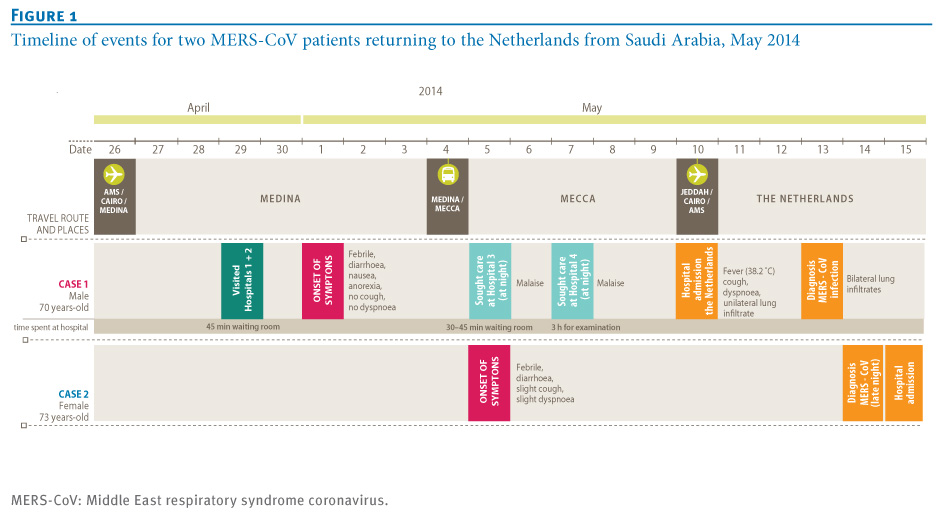
Two patients, returning to the Netherlands from pilgrimage in Medina and Mecca, Kingdom of Saudi Arabia, were diagnosed with Middle East respiratory syndrome coronavirus (MERS-CoV) infection in May 2014. The source and mode of transmission have not yet been determined. Hospital-acquired infection and community-acquired infection are both possible.


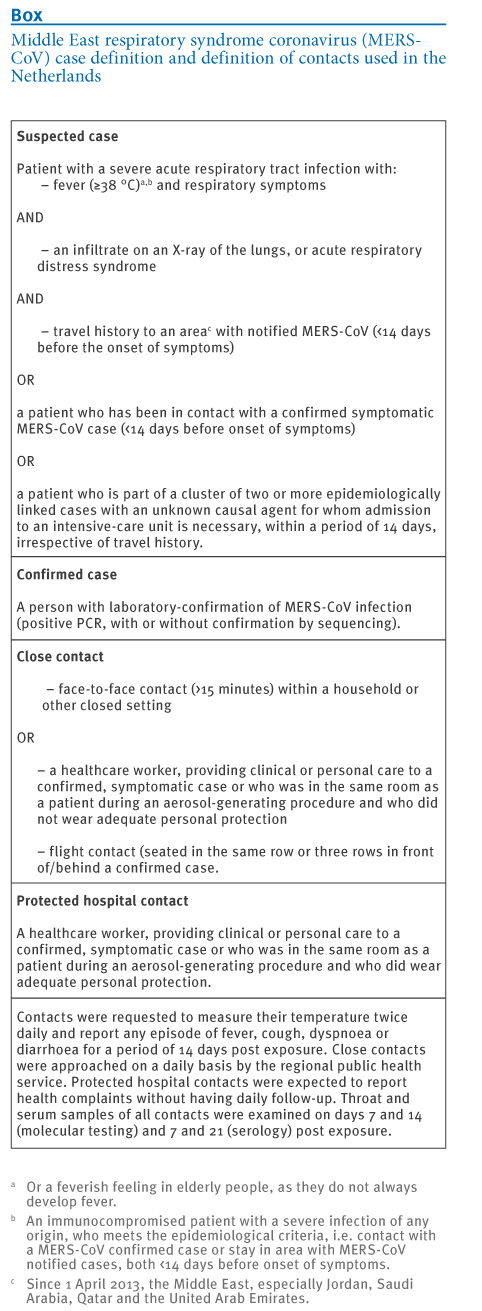
On 13 May 2014, a Dutch patient, returning to the Netherlands from pilgrimage in Medina and Mecca, Kingdom of Saudia Arabia, was diagnosed with Middle East respiratory syndrome coronavirus (MERS-CoV) infection, followed by diagnosis of a second patient, belonging to the same tour group, the day after. Here we describe the two cases and the public health response. The case definition that is used in the Netherlands is outlined in the Box.

<BIG SNIP>

Discussion

There are several options for the possible source of the infection of the two Dutch cases: Case 1 could have been infected during the hospital visit of his child on 29 April, after which he infected Case 2. Alternatively, both could have been exposed to a common, as yet unknown, source in Medina. Thirdly, each case could have been infected through different sources (hospital/ community), though this seems unlikely, as the (partial) virus sequence of both cases was nearly identical.

The resemblance in strain sequence between the Dutch cases and the case from the US is remarkable as the cases did not visit the same places in the Kingdom of Saudi Arabia. Exchange of information between the US Centers for Disease Control and Prevention and Dutch experts did not reveal any clues about mutual exposure of the Dutch and US cases.

The current, limited scientific information does not support any conclusion on the meaning of this genetic resemblance, knowing that multiple lineages of the virus can be found in camels and people [2,12]. Continued vigilance in evaluation of contacts of imported cases, including molecular testing and serology, will hopefully lead to better insights.

(Continue . . . )


Saturday, May 17, 2014

WHO MERS Update- Netherlands 2nd Case

image

# 8632


We’ve an update from the World Health Organization on the second confirmed MERS cases imported into the the Netherlands, a close contact of the original case we learned about on Wednesday (see Netherlands Reports 1st Imported MERS Case). 


This case illustrates how easily a `mildly’ infected person might go undetected, as this patient’s were not severe enough for her to seek medical help upon her return from Saudi Arabia.  Her condition was discovered during the contact investigation of the original case, and she was isolated, and now her contacts are being checked. 


Middle East respiratory syndrome coronavirus (MERS-CoV) – update

6/05/2014

16 MAY 2014 – On 15 May 2014, the National IHR Focal Point for the Netherlands notified WHO about a second laboratory confirmed case of MERS-CoV infection in the Netherlands. The case was discovered during the national contact investigation, performed in relation to the first MERS-CoV case in the Netherlands reported on 14 May 2014.

 
This second patient is a 73-year old female citizen of the Netherlands and a close family member of the first case. Both patients were on the same trip through the Kingdom of Saudi Arabia and shared a hotel room throughout the entire journey. This second patient has co-morbidities and developed first symptoms, including some breathing difficulties, on 5 May 2014 in Mecca, Saudi Arabia. Upon return to the Netherlands on 10 May, the patient presented with mild respiratory symptoms and fever, but these were not severe enough for her to seek medical help.


During contact investigation, her clinical condition was re-evaluated by a general practitioner and sampling for MERS-CoV was initiated. Samples taken from the patient are currently being tested, but initial findings confirm she is positive for MERS-Cov. Currently, the patient is in a stable condition with fever and mild respiratory symptoms and is hospitalized in isolation.


Identification of close contacts (including flight contacts) has been initiated, although the majority of her contacts overlap with those from the first patient.


Globally, 614 laboratory-confirmed cases of infection with MERS-CoV have officially been reported to WHO, including 181 deaths. The global total includes all of the case reported in this update, plus 41 laboratory confirmed cases officially reported to WHO from Saudi Arabia between 10 and 15 May. WHO is working with Saudi Arabia for additional information on these cases and will provide further updates as soon as possible.


(Continue . . . ) 

Thursday, May 15, 2014

RIVM On 2nd Dutch MERS Case

image


# 8627


My thanks to Crof for tweeting the news, and posting a media report, on the second MERS detection in the Netherlands in two days.  This second case is reportedly a relative and traveling companion of the case reported yesterday. 


The  Netherlands National Institute for Public Health and the Environment (aka Rijksinstituut voor Volksgezondheid en Milieu or RIVM ) has very recently posted the following (machine translated) statement on their website:


Second MERS -patient in the Netherlands

Publication Date:15-05-2014

Today, May 15, 2014, is a second Dutch patients infected with the MERS coronavirus identified. The woman is a relative of the man who is diagnosed with yesterday. She also has become contaminated during the same trip to Saudi Arabia. She is listed in Isala Zwolle and nursed in strict isolation. Her health condition is stable. All the people who have had contact with the patient are mapped by the health department. These people's health condition is monitored.

The woman holds in Saudi Arabia visited a dromedarissenboerderij. She has had close contact with the first patient, they shared a hotel room for two weeks. It is also known that both patients have underlying conditions that make them probably more susceptible to infection with this virus.


The Public Health Service , the health status of all travelers and people who have had contact with the patients good eye. If they get health research is done. It is therefore possible that an infection with more patients in the coming weeks MERS coronavirus is established. Dutch hospitals are well equipped to provide this care. MERS infections can cause severe respiratory symptoms, especially in people with other health problems. Diarrhea symptoms may also occur. Human-to-human transmission of the MERS coronavirus is rare, except in close contact with patients and unprotected care of seriously ill people.

Since 2012 there has been an outbreak of a new MERS coronavirus (Middle East Respiratory Syndrome) in the Middle East. Meanwhile, more than 500 patients in the Middle East have been reported to the World Health Organization. In April and May 2014, there is a sharp increase in the number of reports in the Middle East. The vast majority of reports come from this region (especially Saudi Arabia, as well as Qatar, Jordan, Oman, Yemen and United Arab Emirates). Since last year, there are some patients in whom infection with MERS coronavirus has been established in the United Kingdom, France, Italy, Greece, Philippines, Malaysia, Kuwait, Tunisia, Egypt, Germany and the United States. These were travelers who have been in the Middle East. Infected It is not unexpected that there are now patients in the Netherlands. MERS coronavirus Therefore since July 2013 a notifiable infectious disease.

Wednesday, May 14, 2014

Netherlands Reports 1st Imported MERS Case

image


# 8621


We’ve news this morning from the Netherlands’ RIVM and Erasmus Medical Center of that country’s first imported case of MERS, in this case, a traveler recently returned from Saudi Arabia. 


The following (machine translated) statement comes from the RIVM (Netherlands National Institute for Public Health and the Environment)

First MERS-patient in the Netherlands


Publication Date:

14-05-2014

On 13 May, the RIVM and the Erasmus MC for the first infection with the MERS coronavirus identified by a Dutch patient. He became infected during a visit to Saudi Arabia and is currently included in the Medical Center Haaglanden Westeinde. Here the patient is nursed in strict isolation. His health condition is stable. All the people who have had contact with the patient are mapped. These people's health condition is monitored.


MERS infections can cause severe respiratory symptoms, especially in people with other health problems. Diarrhea symptoms may also occur. Human-to-human transmission of the MERS coronavirus is rare, except in close contact with patients and unprotected care of seriously ill people.


Since 2012 there has been an outbreak of a new MERS coronavirus (Middle East Respiratory Syndrome) in the Middle East. Meanwhile, more than 500 patients in the Middle East have been reported to the World Health Organization. In April and May 2014, there is a sharp increase in the number of reports in the Middle East. The vast majority of reports come from this region (especially Saudi Arabia, as well as Qatar, Jordan, Oman, Yemen and United Arab Emirates). Since last year, there are also some patients are diagnosed in the United Kingdom, France, Italy, Greece, Philippines, Malaysia, Kuwait, Tunisia, Egypt, Germany and the United States. These were travelers who have been in the Middle East. Infected It is not unexpected that there is now a patient in the Netherlands. MERS coronavirus had therefore been a notifiable infectious disease.

Tuesday, March 19, 2013

Netherlands: Second Outbreak Of Bird Flu In A Week

image

Credit  http://www.rijksoverheid.nl/ministeries/ez

# 7015


Last week, in Netherlands: Bird Flu (Probably H7) Reported In Lochem, we learned of an outbreak of avian influenza that resulted in the culling of 85,000 birds.


Today, the Netherland’s Ministry of Economic Affairs reports a new outbreak (also likely H7), this time on an organic farm in Zeewolde, more than 100 km to the west of the first outbreak.


A hat tip to @martinenserink of Science Magazine for tweeting the announcement. The following is a machine translation:


Bird flu in Zeewolde

Newsflash | 19/03/2013

In Zeewolde is one organic farm with 24,000 hens bird flu (avian influenza, AI) was adopted. This company has 2 stables with outdoor access. It is probably the mild H7 variant.


Because a low pathogenic (mild) H7 variant can mutate into a highly pathogenic (highly contagious and lethal to chickens) variant, the company is both a low and a high pathogenic variant cleared. This is based on European rules. The depopulation is by the Dutch Food and Consumer Product Safety Authority (nVWA).

Measures

From Tuesday, March 19, 2013 at 13.00 is in an area of ​​over one kilometer around the holding in Zeewolde one for the transport of poultry, eggs, poultry manure and used. Within this area are no other poultry.

Documents and publications

Room Letter about bird flu in Zeewolde

Letter from Secretary Dijksma (EZ) to the House about an outbreak of bird flu (Avian influenza, AI) on a ...

Papers | 19/03/2013 | EZ

Scheme avian influenza outbreak in Zeewolde

Regulation of the Minister of Economic Affairs of 19 March 2013, No WJZ/13047850, amending the Regulations ...

Scheme | 19/03/2013 | EZ

Map of the 1 kilometer zone Zeewolde

Map of the area from 19 March 2013, 13.00 hours a transport ban applies to poultry, eggs, poultry manure and used ...

Brochure | 19/03/2013 | EZ

Tuesday, March 20, 2012

Netherlands: LPAI H7 Bird Flu Identified In Turkeys


image

Photo Credit – FAO


UPDATE:  The OIE REPORT filed for this incident now identifies this as an H5N2 (not H7 as previously reported) avian influenza strain. (Link)

# 6336


Although this news broke yesterday, I was away from my desk most of the day, and was unable to blog it.  Early reports had suggested an H5 strain, but the most recent reporting (via Reuters) is that a low pathogenic H7 avian influenza virus is the culprit.


My thanks to the reader who forwarded this Reuters story to me. I’ll return with a little background on the H7 avian viruses.


Dutch cull 42,700 turkeys after bird flu found

Reuters

12:06 p.m. CDT, March 19, 2012

AMSTERDAM (Reuters) - Dutch authorities said 42,700 turkeys have been culled at a farm in the south of the country after a mild variant of the H7 bird flu strain was reported over the weekend.

(Continue . . . )


While we pay greatest attention to the H5N1 virus due to its observed high mortality in the roughly 600 human cases we’ve identified, there are other – less deadly -avian influenza strains that have been known to infect humans.


Currently, H5s and H7s are both reportable diseases in poultry, due to their ability to mutate from a low pathogenic virus to highly pathogenic virus.


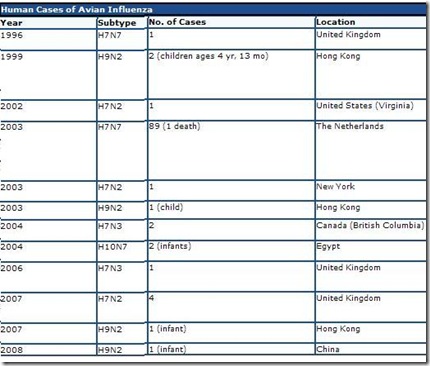
Below you’ll find a chart lifted and edited from CIDRAP’s excellent overview Avian Influenza (Bird Flu): Implications for Human Disease  showing non-H5N1 avian flu infections in humans over the past decade.


CIDRAP FluA


Perhaps the most notorious outbreak of H7 in humans occurred in 2003 in the Netherlands.  It  produced (mostly mild) symptoms in at least 89 people, but did cause 1 fatality. 


CIDRAP describes it this way:

During an outbreak of H7N7 avian influenza in poultry, infection spread to poultry workers and their families in the area (see References: Fouchier 2004, Koopmans 2004, Stegeman 2004). Most patients had conjunctivitis, and several complained of influenza-like illness. The death occurred in a 57-year-old veterinarian. Subsequent serologic testing demonstrated that additional case-patients had asymptomatic infection.


In 2006 and 2007 there were a small number of human infections in Great Britain caused by H7N3 (n=1)  and H7N2 (n=4), again producing mild symptoms.


Since surveillance is – at best - haphazard (or even non-existent) in many parts of the world,  how often this really happens is unknown.


For now, H7 avian influenzas pose only a minor public health threat


Since the H7 viruses generally produce mild symptoms in humans, you may be wondering why all the fuss over an outbreak of H7?


First, eradicating the virus can be time consuming, and horrendously expensive.  In 2003 outbreak in the Netherlands mentioned above required the culling of 30 million birds.


And second, the H7s, like all influenza viruses, are constantly mutating and evolving.


While considered mild today, there are no guarantees that the virus won’t pick up virulence over time, or reassort with another `humanized’ virus and spark a pandemic.


In fact, four years ago we saw a PNAS article that suggested that some `humanization’ of the virus was occurring.


Contemporary North American influenza H7 viruses possess human receptor specificity: Implications for virus transmissibility


As we all know, the last pandemic came out of left field; from a region of the world (North America), host species (swine), and influenza strain (H1N1) considered unlikely to spark a global epidemic.


Which is why even relatively benign avian strains are regarded as potential threats, and dealt with swiftly.

Friday, March 25, 2011

Netherlands: H7 Bird Flu Detected


# 5445


Due to its high mortality rate, H5N1 gets most of the world’s attention when it comes to bird flu.  While human infections remain rare, among those diagnosed, roughly 60% succumb to the virus.


But H5 isn’t the only avian flu strain we worry about.


There are other – less deadly strains – including the H7s, H9s and H11s that have demonstrated the potential to jump to humans.


Currently, H5s and H7s are both reportable diseases in poultry, due to their ability to mutate from a low pathogenic virus to highly pathogenic virus.


Today, we’ve news of an outbreak of bird flu on a poultry farm near Kapelle, in the Netherlands.  The virus has been identified as H7, but the exact subtype has not yet been established.


image


First a translation of the statement from the Dutch Ministry of Economic Affairs, Agriculture and Innovation, after which I’ll return with more.


Bird flu in Zeeland

News item | 03/25/2011

In Zeeland Schore, Chapel congregation is a poultry farm with 127,500 laying hens found bird flu. The H7 is a variant.


Because a low pathogenic H7 variant can mutate into highly pathogenic (highly contagious and lethal for chickens variant), the company both a low and a highly pathogenic variant in accordance with European regulations are removed. The new Food Safety Authority to carry out culling on March 25. In the afternoon of March 25 is known whether a low or a highly pathogenic variant,.


As of March 25, 2011, is 8.00 hours in an area of ​​one kilometer around the company a ban on transporting poultry, eggs, poultry and poultry manure and litter.


The infection probably comes from wild birds excrete the virus in their faeces.


Below you’ll find a chart lifted and edited from CIDRAP’s excellent overview Avian Influenza (Bird Flu): Implications for Human Disease  showing non-H5N1 avian flu infections in humans over the past decade.


CIDRAP FluA


Perhaps the most notorious outbreak of H7 in humans occurred in 2003 in the Netherlands.  It  produced (mostly mild) symptoms in at least 89 people, but did cause 1 fatality. 


CIDRAP describes it this way:


During an outbreak of H7N7 avian influenza in poultry, infection spread to poultry workers and their families in the area (see References: Fouchier 2004, Koopmans 2004, Stegeman 2004). Most patients had conjunctivitis, and several complained of influenza-like illness. The death occurred in a 57-year-old veterinarian. Subsequent serologic testing demonstrated that additional case-patients had asymptomatic infection.


In 2006 and 2007 there were a small number of human infections in Great Britain caused by H7N3 (n=1)  and H7N2 (n=4), again producing mild symptoms.


Since surveillance is – at best - haphazard (or even non-existent) in many parts of the world,  how often this really happens is unknown.


For now, H7 avian influenzas pose only a minor public health threat


Since the H7 viruses generally produce mild symptoms in humans, you may be wondering why all the fuss over an outbreak of H7?


The H7s, like all influenza viruses, are constantly mutating and evolving.  


While considered mild today, there are no guarantees that the virus won’t pick up virulence over time, or reassort with another `humanized’ virus and spark a pandemic.


Three years ago, we saw a study in PNAS that indicated that the H7 virus might be moving more towards adapting to humans.


Contemporary North American influenza H7 viruses possess human receptor specificity: Implications for virus transmissibility


You can read more about this in a couple of blogs from 2008, H7's Coming Out Party and H7 Study Available Online At PNAS.


For more on pandemic threats beyond H5N1 you may wish to revisit:


It Isn’t Just Swine Flu

Saturday, December 12, 2009

Q-Fever In The Netherlands


# 4149


The slightly alarming, if not exactly accurate headline yesterday coming from the Novinite New agency of Sofia read:


Killer Goat Flu Appears in Netherlands

There have been press reports of an alarming new epidemic that has struck the Netherlands. Following bird flu, then swine flu, now goat flu is causing panic.


According to online news sources, up to 2 300 people have succumbed to goat flu in the country, and six people have died.


During a time when tens of thousands of deaths have been attributed to swine flu, a `killer goat flu’ makes for pretty good news copy. But this isn’t a `flu’ at all, and this outbreak isn’t `an alarming new epidemic’ -  it’s been going on now for more than two years.


But other than that . . .


What this article is referring to in an ongoing zoonotic outbreak of Q-Fever in the Netherlands.   Since Q-Fever isn’t something that a lot of my readers may be familiar with, a little background is in order.


Q-Fever is spread by a bacteria Coxiella burnetii (not a virus), often found in Cattle, sheep, and goats, but also found in other livestock and even domestic pets (cats, dogs).  C. Burnetii doesn’t generally cause illness in these animals, although abortions in goats & sheep have been linked to the bacterial infection.

C Burnetii


The bacteria are excreted in the milk, urine and feces of infected animals, and most abundantly in the amniotic fluid released during birthing.   The bacteria are extremely hardy, and resistant to heat, drying, and many disinfectants.


Humans most often contract the bacteria through inhalation of contaminated barnyard dust.   Many infections are subclinical, but some may be very serious; causing severe pneumonia and rarely hepatitis and a form of endocarditis.


While treatment with antibiotics generally resolves the infection, some victims develop a chronic (and more dangerous) form of the disease.


Q-Fever has been a notifiable disease in the US since 1999, but reporting is not required in many other countries. The disease, therefore is underreported, and its true extent globally is unknown.


This `alarming new epidemic’ was first noticed in the Netherlands (there have been outbreaks in other countries) in May of 2007, when a local doctor in a rural village in the south of that country reported an unusual cluster of pneumonia cases.


image

At first they were suspected to have due to Mycoplasma pneumoniae, but further testing revealed acute  Coxiella burnetii infection. 


As you can see from the graph above, the number of human infections in the Netherlands has grown each year since 2007. 


In a normal year (2000-2006) the Netherlands might expect to see 5 to 20 infections with the bacteria.  Currently, they are diagnosing more than 2,000 cases a year.


While goats are traditionally considered to be the prime source of this disease, other reservoirs have been identified as well. 


For goats, mating generally occurs in the fall (gestation is about 5 months), and so kidding season falls in the spring.


In an attempt to curb the further spread of this disease, the RIVN [Dutch National Institute for Public Health and the Environment] is advising the Health Ministry to order the destruction of all pregnant goats from farms infected with Q-fever.


ProMed Mail  has been following the outbreak of Q-fever in the Netherlands since 2007, and has more than one dozen updates on file.   The latest was on December 9th of this year:


Archive Number     20091209.4198
Published Date     09-DEC-2009
Subject     PRO/AH/EDR> Q fever - Netherlands (13): control measures

Q FEVER - NETHERLANDS (13): CONTROL MEASURES

Minister of Health Ab Klink and Minister of Agriculture Gerda Verburg  have agreed that on infected farms where animals have not been  vaccinated, all pregnant animals must be slaughtered, whether or not they have the virus [sic; the agent is a bacterium].


Q-fever is caused by bacteria (_Coxiella burnetii_) released when pregnant goats or sheep have spontaneous abortions. The disease is prevalent in areas in the southern Netherlands with large-scale goat farms and a relatively dense population. This year [2009] alone, 2200 [in fact, 2293 cases as of 25 Nov 2009] people have contracted it, most of them in the southern rural province of Brabant. At least 6 people have died.


While these control methods are hoped to reduce the spread of this bacterial disease, the editors of ProMed Mail remind their readers that goats may not be the only source of infection:


While small ruminants, namely goats and sheep are traditionally regarded as the main potential source of human infection, other animals, such as cattle, dogs and cats, are not to be disregarded. In urban areas, littering cats have been seriously suspected as a significant source of human infection.


In the Dutch context, the earlier (1997) review "Q fever in Europe" is of interest. It included the following text: "In some human cases, no relation with "classical" sources can be found, and possible new sources must be sought. In a serological study of dogs and cats [in central Netherlands, 1992], 13.2 percent (91/688) of dogs and 10.4 percent (46/441) of cats were found to be positive for specific antibodies against _C. burnetii_. This implies that cats and dogs may be a source of infection.


It should be noted that Q-fever can also be spread by ticks, although human infection via that route is considered rare.   Since most cases of Q-fever result in mild or sub-clinical infections, the true extent of the spread of the disease is unknown.


While concerning, the potential for the spread of this disease is very low compared to influenza.  According to the University of Wisconsin’s VetMed page on Q-Fever:


Reports of human-to-human transmission are extremely rare, but C. burnetii has been isolated from human milk and human placental tissues, and there are reports of transmission to physicians during abortion procedures and autopsies.


So the good news in all of this is, Q-fever doesn’t have pandemic potential, even if it can present serious localized problems.  


For more on Q-Fever you may wish to check these resources:


Backgrounder: Q Fever

Emedicine Overview of Q-Fever


CDC Q-Fever Information