Showing posts with label pigs. Show all posts

Friday, August 16, 2013

HKU: A Novel Paramyxovirus in Pigs

 image

Parainfluenza virus. – Credit CDC PHIL


# 7576


History has shown that pigs can be an efficient reservoir host and `mixing vessel’ for influenza viruses.  The 2009 pandemic H1N1 virus had kicked around swine herds for  a decade or longer before it finally acquired the ability to jump to man.


But influenzas are not the only viruses that pigs can harbor, nor are they the only ones with zoonotic potential.  


We’ve a new study appearing in the Journal of General Virology that describes a novel paramyxovirus – which researchers at Hong Kong University have dubbed porcine parainfluenza virus 1 (PPIV-1) – detected in 12 of 386 pig carcasses collected from a slaughterhouse in Sheung Shu (located in the New Territories of Hong Kong) between 2008 and 2012.


Identification and characterization of a novel paramyxovirus, porcine parainfluenza 1 virus, from deceased pigs

Susanna K. P. Lau, Patrick C. Y. Woo, Ying Wu, Annette Y. P. Wong, Beatrice H. L. Wong, Candy C. Y. Lau, Rachel Y. Y. Fan, Jian-Piao Cai, Hoi-Wah Tsoi, Kwok-Hung Chan and Kwok-Yung Yuen1

Abstract

We describe the discovery and characterization of a novel paramyxovirus, porcine parainfluenza 1 virus (PPIV-1), from swine. The virus was detected in 12 (3.1%) of 386 nasopharyngeal and 2 (0.7%) of 303 rectal swab samples from 386 deceased pigs by RT-PCR, with viral load up to 106 copies/ml. Complete genome sequencing and phylogenetic analysis showed that PPIV-1 represented a novel paramyxovirus within Respirovirus, being most closely related to human parainfluenza virus 1 (HPIV-1) and Sendai virus (SeV).


In contrast to HPIV-1, PPIV-1 possesses mRNA editing function in phosphoprotein gene. Moreover, PPIV-1 is unique among respiroviruses in having 2 G residues instead of 3-5 G residues following the A6-run at editing site. Nevertheless, PPIV-1, HPIV-1 and SeV shared common genomic features and may belong to a separate group under Respirovirus. The presence of PPIV-1 in mainly respiratory samples suggested possible association with respiratory disease, similar to HPIV-1 and SeV.


The South China Morning Post has an interview with microbiologist Yuen Kwok-yung, lead researcher on the project, who warns this virus could one day mutate and jump to humans. 


The article quotes Yuen as saying:


“The new virus is closely related to some human influenza viruses. We should watch for possible cross-species transmission from pigs to humans, just as in the case of [human] swine influenza H1N1 and the Nipah virus."


Although this article refers to this virus as a `swine flu’ and `a new strain of influenza’, in fact, this virus is not a true influenza virus (family Orthomyxoviridae), but is a parainfluenza virus, of the family Paramyxoviridae.


The journal states that this novel porcine virus is most closely related to human parainfluenza virus 1 (HPIV-1) – which is the most common cause of croup in young children -  and the Sendai virus (SeV), which primarily affects mice, but can also infect hamsters, guinea pigs, rats, and (rarely) pigs.


This table on the human parainfluenza viruses from the CDC.


HPIV Seasons

In the United States, human parainfluenza viruses (HPIVs) commonly cause respiratory tract illnesses.

There are four types of HPIVs and two subtypes that circulate at different times of the year.

  • HPIV-1 infections often cause croup in children. There are usually more cases in the fall of odd-numbered years.   
  • HPIV-2 infections can also cause croup. HPIV-2 infections occur more commonly in the fall. It is less frequently detected than HPIV-1 and HPIV-3.
  • HPIV-3 infections usually occur in spring and early summer months each year. However, HPIV-3 infections can occur throughout the year, particularly when HPIV-1 and HPIV-2 are not in season.
  • HPIV-4 (subtypes 4a and 4b) seasonal patterns are not as well characterized.

According to the Hong Kong Post interview, researchers believe this novel paramyxovirus has been circulating in pigs for some time.  Dr. Yeun is calling for enhanced surveillance of pigs and other animals in Hong Kong.


While the future of this virus is unknown, we’ve seen other paramyxoviruses jump from swine to humans, with dramatic results. Perhaps the best example being Nipah, which emerged in the late 1990s.


In 1999, hundreds of abattoir workers in Malaysia and Singapore were infected from pigs carrying the virus (see MMWR Update: Outbreak of Nipah Virus -- Malaysia and Singapore, 1999) killing more than 100.


And once infected, they discovered that humans can transmit the virus on to others, albeit not terribly efficiently (see EID Journal Person-to-Person Transmission of Nipah Virus in a Bangladeshi Community).


Note: Nipah (and its Australian cousin Hendra, discovered in 1994) are sufficiently different from other members of the Paramyxoviridae family to have led to the creation of a new genus; Henipavirus.


Nipah was eventually traced to bats, and swine were determined to have been an intermediate host. 


While Hong Kong actively does surveillance for new or emerging viruses in swine, the same cannot be said for most places around the globe. A topic Helen Branswell addressed in her terrific piece in SciAm  from late 2010 called Flu Factories.

Flu Factories

The next pandemic virus may be circulating on U.S. pig farms, but health officials are struggling to see past the front gate

By Helen Branswell  | December 27, 2010 |


For more on the human strains of parainfluenza, you may wish to visit the CDC’s website.


Human Parainfluenza Viruses (HPIVs)

Wednesday, July 10, 2013

Arch Virology: Isolation Of H5N1 In Swine – China

Reassortant pig[6]

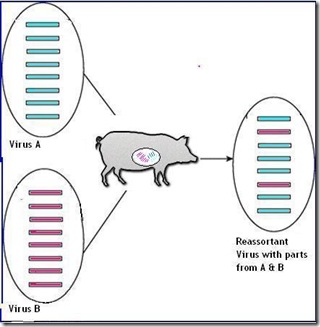
Since pigs can be infected by more than one flu virus at the same time, it is possible for two viruses to swap genetic material (reassort), resulting in a new hybrid strain.


# 7466


Although the potential exists for viral reassortment in just about any host susceptible to influenza, swine – which can carry a wide variety of human, swine & avian strains – are considered to be excellent potential `mixing vessels’.


Swine possess both avian-like (SAα2,3Gal) and human-like (SAα2,6Gal) receptor cells in their respiratory tract, which many researchers believe can facilitate a `bridging’ between avian and human strains.


The pandemic virus that emerged in the spring of 2009 was the end product of several  influenza strains that had kicked around the world’s swine population for many years, trading bits of genetic material back and forth, until they produced a version capable of jumping to humans.


The H3N2v virus is likewise a reassortant virus; swine H3N2 combined with the M (matrix) gene from the 2009 H1N1 virus. While the odds of seeing a pandemic emerge from this H3N2v virus appear low right now, they are not zero. 


Of particular concern, due to its severity when it infects humans, is the H5N1 avian flu virus (and now, H7N9). The worry is - that given enough opportunities – one of these avian strains could reassort (swap genes) with a more `humanized’ flu virus, and produce a pandemic strain.


Despite the risks, surveillance of swine in the United States, and around the world, is dismally low. A topic Helen Branswell addressed in her terrific piece in SciAm  from late 2010 called Flu Factories.

Flu Factories

The next pandemic virus may be circulating on U.S. pig farms, but health officials are struggling to see past the front gate

By Helen Branswell  | December 27, 2010 |


Today we’ve a new study appearing in the Archives of Virology (h/t Tetano on FluTrackers), that reinforces the concern that the H5N1 virus can, and does, infect pigs  (I’ll have more on that, after the abstract)


While the body of the article is behind a pay wall, we can get a pretty good idea of the findings from the abstract.


Isolation and characterization of two H5N1 influenza viruses from swine in Jiangsu Province of China

Liang He, Guo Zhao, Lei Zhong, Qingtao Liu, zhiqiang Duan, Min Gu, Xiaoquan Wang, Xiaowen Liu, Xiufan Liu

Abstract

Pigs are susceptible to infection with both human and avian influenza A viruses and are considered intermediate hosts that facilitate virus reassortment. Although H5N1 virus has spread to a wide range of avian and mammalian species, data about swine H5N1 isolates are scarce.

To determine whether Asian H5N1 influenza viruses had been transmitted to pigs, a total of 1,107 nasal swab samples from healthy swine were collected from 2008 to 2009 in Jiangsu province of eastern China.

In this survey, two H5N1 viruses A/swine/Jiangsu/1/2008 (JS/08) and A/swine/Jiangsu/2/2009 (JS/09) were isolated and identified.

Phylogenetic analysis showed that JS/08 and JS/09 belonged to clade 7 and clade 2.3.4, respectively, and shared over 99.0 % sequence identity with poultry H5N1 isolates of the same clade in China. Receptor specificity analysis also showed that both of the swine H5N1 isolates bound preferentially to avian-type receptors. However, experiments in mammals indicated that JS/09 was moderately pathogenic to mice without prior adaption, whereas JS/08 had limited ability to replicate.

Our findings suggest that pigs are naturally infected with avian H5N1 virus and highlight the potential threat to public health due to adaption or reassortment of H5N1 virus in this species.


Obviously viral reassortment that results in a biologically `fit’ pandemic virus is a rare event, else we’d be hip deep in novel viruses all of the time.  But history has shown – given enough opportunities – these types of reassortments can happen.


While it has been documented previously, the evidence for how well the H5N1 virus infects pigs has been both limited, and mixed.


In previous experiments, domestic pigs were shown to have low susceptibility to the H5N1 virus, producing asymptomatic to mildly symptomatic infection of the respiratory tract and tonsils.


Viral titers were lower than normally seen with swine influenzas, suggesting a limited ability to adapt and spread among pigs.


Late last year, in Seroprevalence Study: Avian Flu In Chinese Pigs, we looked at a study that found low levels of H3, H4, and H6 subtypes of avian influenza in Chinese pigs. Somewhat reassuringly, no evidence of previous infection with the H5N1 virus was found.


But an earlier study out of Indonesia (see 2010’s EID Journal: Asymptomatic H5N1 In Pigs) found during the period of 2005-2007 that 7.4% of pigs surveyed in Indonesia carried the H5N1 virus, and that phylogenic analysis showed at least 3 separate introductions into the pig population.


More recent surveillance, during 2008-2009 did not turn up any active infections, but 1% of pigs tested carried antibodies to the H5N1 virus.


Of note, in today’s study (and the others mentioned above) infected pigs almost always appear healthy, or asymptomatic.


The ability of influenza viruses to evolve, mutate, or reassort in swine hosts has been a frequent topic of discussion in this blog.  For more on this, you may wish to revisit:


H3N2v: When Pigs Flu

You Say You Want An Evolution?

The (Swine) Influenza Reassortment Puzzle

Tuesday, April 09, 2013

China: Currently No Positive H7N9 Tests In Pigs

image

Credit Wikipedia


# 7102


Determining the reservoir host (or hosts) for the emerging H7N9 virus remains a a top priority (see Declan Butler’s Urgent search for flu source) if this bird flu outbreak in China is to be quickly quashed. 


While traces of the virus have been found in a small number of birds (see Shanghai: Testing Reveals No Widespread H7N9 In Market Poultry) sold in live markets, another focus of the investigation has been on pigs.


The deaths, and illegal dumping, of thousands of pigs into the Huangpu river that flows into Shanghai last month has raised suspicions, but so far none of the limited samples tested have yielded a cause of death.


Today we get a story reassuring that thus far, no pigs in China have tested positive for the H7N9 virus. 


Missing from this report are such useful details as:


  • how many pigs have been tested
  • when and where these samples were collected
  • the type (and sensitivity) of the tests used


These are still early days in the epidemiological investigation into this outbreak, and so it is probably safe to say that pigs have not yet been completely eliminated from the suspect list.


This from Xinhua News.


Currently no positive samples of H7N9 found in pigs: WHO

English.news.cn   2013-04-09 23:09:35
 

GENEVA, April 9 (Xinhua) -- No positive samples of the H7N9 virus have been found in pigs or farms in China so far, the World Health Organization (WHO) announced on Tuesday.


WHO spokesperson Gregory Hartl said animal samples that tested positive were from poultry markets, including live bird markets.


"So the focus at this point is on poultry markets," said Hartl.


However, Hartl told reporters that for the moment, "we don't have 100 percent surety on what the source of infection is. That might not be the correct source or the only source.


"He added close contacts of confirmed cases of the deadly disease had been closely monitored with none so far testing positive for H7N9.


"At this point, there is no evidence of sustained human to human transmission," he said, adding that there are some "suspected but not yet confirmed cases of perhaps very limited transmission between close family members."


"They are still being investigated," he said.


Hartl told Xinhua one of the suspected family clusters was in Shanghai, with three family members having similar symptoms and one of them being confirmed of H7N9.


The confirmed case died, so has another suspected family member, according to Hartl.


The other suspected family cluster, which included two family members with one of them being confirmed, was in Jiangsu Province, he said.


Hartl said that even if the infection of H7N9 is confirmed in other family member, further investigations are still needed to make sure whether that's a human to human transmission between constant and close contacts or an infection with virus from the same environmental source.


He said Chinese health authorities had been working openly and closely with WHO.


Monday, March 11, 2013

Shanghai Govt.: Thousands Of Dead Pigs Retrieved From River

image   

Location Shanghai China


# 6996


The Huangpu river - a tributary of the Yangtze that rolls across 113 km of China’s countryside before emptying into the East China Sea – provides many of the 23 million residents of Shanghai with their drinking water.


This weekend, various news reports indicate that between 900 hundred and 3000 dead pigs have been retrieved from the Huangpu river - dumped for reasons, and by persons, thus far unknown.


A statement – machine translated – from Shanghai’s government website (www.shac.gov.cn) this morning reads:


Floating the Huangpu Jiang Songjiang paragraph waters the dead pigs sampling detection

The the floating dead pig incident in the Huangpu Jiang Songjiang paragraph waters, the Shanghai Animal Disease Prevention and Control Center, in conjunction with the animal epidemic control center in Songjiang District, collected at the scene a dead pig heart, liver, spleen, lung, kidney, lymph nodes, tonsils and other viscera samples 5 sets.


Shanghai Animal Disease Control Center laboratory using fluorescence PCR method to detect the six pathogens, including swine foot-and-mouth disease, swine fever, highly pathogenic blue ear pig disease and other major animal diseases, as well as swine pseudorabies, porcine circovirus The three kinds of pig disease, porcine epidemic diarrhea and other common disease.


Detection of porcine circovirus pathogen positive results from a sample, the remaining samples were negative for all test items. We will continue to trace the source, the investigation of the cause and teamed up with brothers areas and take measures to put an end to throw to the river to throw dead pig.

Note: porcine circovirus disease is caused by porcine circovirus type 2 an infectious disease of pigs, pig infectious epidemics hair a more in recent years, does not belong to the zoonoses.


The detection of porcine circovirus (PCV) type 2 among the 5 samples tested doesn’t tell us much. Not considered a zoonotic threat, PCV can be found in pigs worldwide (see University of Iowa site Porcine Circovirus Associated Diseases (PCVD, PCVAD)).


PCV is usually associated with a slow and progressive `wasting’ disease, casting doubt over whether it would have killed thousands of pigs simultaneously.


So the suspicion remains of another  – as yet unidentified – reason behind these pigs deaths.


CNN International this morning is reporting that a large-scale die off of pigs has been ongoing in the nearby city of Jiaxing since the first of the year. 


Hundreds of dead pigs fished from Shanghai river

By Katie Hunt and Zhang Dayu

(Excerpt)

A local newspaper in Jiaxing, a city in Zhejiang province south of Shanghai, reported on March 6 that tens of thousands of pigs had died of an animal disease in a major pig farming village in the past two months.


"According to our records, 10,078 pigs died in January, another 8,325 died in February. More than 300 pigs die everyday in our village, and we barely have any space left to dispose of the dead pigs," a local villager was quoted by the paper as saying.


Over the years we’ve seen other instances where diseased livestock have been dumped into rivers – an illegal disposal method that simply spreads the problem downstream (see here, here, and here).


During early 2009 (see The Winter Of Our Disbelief), a number of dead H5N1-infected chickens washed up on the shores of Hong Kong, which led many to believe that large numbers of chickens were being disposed of somewhere up the Pearl River in Guangdong province.


The following year, more infected birds turned up on the beaches and islands of Hong Kong.


Despite local and internet uproar, Shanghai authorities continue to assure that the city’s drinking water is safe. This assessment from the local government:


Shanghai Water Authority, said the requirements related to water supply enterprises to be taken to strengthen the conventional treatment process, an appropriate increase in finished water residual chlorine to 2.0 mg / l, in order to ensure the safety of the water supply. Strengthen the monitoring of the quality of raw water.

The district water departments related to tracking and monitoring of raw water quality and laboratory analysis, focusing on oxygen consumption, ammonia nitrogen, total bacterial count, total coliforms and other indicators. At present, the indicators are in the normal range.


And finally, from Xinhua news (the media arm of the Chinese government), we get this rather Spartan report.


Pig virus detected in Shanghai river water

2013-03-11 13:24:51

SHANGHAI, March 11 (Xinhua) -- A pig virus has been found in a water sample of a river where 1,200 dead pigs had been fished out, Shanghai authorities said.


Laboratory tests found porcine circovirus (PCV) in one of the water samples taken from Huangpu River, a water source for city residents, sources with Shanghai municipal agricultural commission said Monday.


The virus causes porcine circovirus disease in pigs but does not spread to human beings, a commission statement said.


All other tests of the river water provided negative results, including tests for common pig-borne diseases such as foot and mouth, swine fever, hog cholera and epidemic diarrhea.


Authorities are investigating where the dead pigs came from. The commission said they are working with neighboring provinces to trace their source, and have warned riverside residents to refrain from dumping animals into the river.


Local media reports said the pigs mainly came from Shanghai's neighboring Jiangsu and Zhejiang provinces.


The city and Songjiang district governments retrieved the pigs from Friday night to Sunday.


If and when we know more, I’ll update this story.

Saturday, March 09, 2013

A Streptococcus suis Round Up


image

Credit Japan’s NARO (National Agriculture and Research Organization)


# 6993


This morning Hong Kong’s CHP is reporting a relatively rare, fatal infection from S. suis in an 85 year old man. This adds to a growing list of recent news stories about this emerging zoonotic pathogen.


While not the sort of stuff that pandemics are made of, S. suis may have more of an impact on human health than is currently appreciated.


Streptococcus suis is a Gram-positive bacterium, well entrenched in global pig populations, capable of causing serious (even fatal) infection in humans.


With 35 known serotypes - S suis represents a large and diverse species of bacteria – many of which are carried asymptomatically by healthy pigs.


Serotypes 1-8 are most often associated with disease in pigs, and among humans, infection is most commonly by serotype 2.


The Merck Veterinary Manual states:

S suis is found in the upper respiratory tract, particularly the tonsils and nasal cavities, and the genital and alimentary tracts of pigs.


Clinical infections are seen mainly in weaners or growing pigs and less frequently in suckling piglets. S suis has been isolated from a wide range of animal species, eg, cattle, sheep, goats, horses, and birds, as well as humans. Its presence in the environment is transitory.


Last month, the Canadian Swine Health Intelligence Network announced Strep Suis Identified as Top Reason for Calling Vets to Swine Farms.


In 2007  The Lancet carried the following report identifying S. suis as an important emerging pathogen.


Streptococcus suis: an emerging zoonotic pathogen.

Lun ZR, Wang QP, Chen XG, Li AX, Zhu XQ.

Abstract

Streptococcus suis is a major porcine pathogen worldwide, and can be transmitted to human beings by close contact with sick or carrier pigs. S suis causes meningitis, septicaemia, endocarditis, arthritis, and septic shock in both pigs and human beings, and mortality is high.


Human infection with S suis occurs mainly among certain risk groups that have frequent exposure to pigs or pork. Outbreaks of human S suis infection are uncommon, although several outbreaks have occurred in China in recent years.


In July, 2005, the largest outbreak of human S suis infection occurred in Sichuan province, China, where 204 people were infected and 38 of them died. There have been 409 cases of human S suis infection worldwide, most of which have occurred in China, Thailand, and the Netherlands, and these infections have led to 73 deaths.


More recently, in Frontiers in Microbiology, researchers suggested that S. suis may serve as an important antibiotic resistance reservoir, and may be contributing to the spread of resistance genes to other bacteria.


Streptococcus suis, an Emerging Drug-Resistant Animal and Human Pathogen

Claudio Palmieri, Pietro E. Varaldo, and Bruna Facinelli

Abstract

Streptococcus suis, a major porcine pathogen, has been receiving growing attention not only for its role in severe and increasingly reported infections in humans, but also for its involvement in drug resistance.


Recent studies and the analysis of sequenced genomes have been providing important insights into the S. suis resistome, and have resulted in the identification of resistance determinants for tetracyclines, macrolides, aminoglycosides, chloramphenicol, antifolate drugs, streptothricin, and cadmium salts.


Resistance gene-carrying genetic elements described so far include integrative and conjugative elements, transposons, genomic islands, phages, and chimeric elements. Some of these elements are similar to those reported in major streptococcal pathogens such as Streptococcus pyogenes, Streptococcus pneumoniae, and Streptococcus agalactiae and share the same chromosomal insertion sites.


The available information strongly suggests that S. suis is an important antibiotic resistance reservoir that can contribute to the spread of resistance genes to the above-mentioned streptococci. S. suis is thus a paradigmatic example of possible intersections between animal and human resistomes.


(Continue . . . )


Confirmed human infection with Streptococcus suis in North America remains very rare, but there are at least 4 known cases in the United States. Recently the CDC's EID Journal carried a letter detailing Streptococcus suis Meningitis in Swine Worker, Minnesota, USA.


To the Editor: Streptococcus suis is a major bacterial pathogen in swine worldwide. Historically, cases in humans have occurred sporadically, mostly in Asia (1,2). However, an outbreak in China involved 215 human cases and 39 deaths (3). Only 3 human cases of S. suis disease were documented in the United States before 2011: 2 domestically acquired cases in New York and Hawaii, and 1 case in a person in California who was probably exposed in the Philippines (4). We describe a case of S. suis disease in a swine worker in Minnesota, USA.


(Continue . . . )


This year we’ve seen a substantial number of cases of S. suis out of Vietnam, as evidenced by this story from Thanh Nien News.


Say no to pig blood pudding, doctors advise as swine bacteria kill 4


Last Updated: Friday, March 01, 2013 10:10:00


Vietnamese Lunar New Year festivities in February, during which many pigs were slaughtered and served, sometimes raw, sent at least 12 people to hospital, with swine bacteria killing four.


Two died in hospitals and two others died at home in central Vietnam.


A source from the National Hospital of Tropical Diseases in Hanoi last week said they received 16 people infected with the Streptococcus suis bacteria, a pork-based pathogen, since the beginning of this year, including nine during the ten days of the festival that began on February 10.


(Continue . . .)


And from another recent EID Journal letter we get an idea of just how prevalent this infection is in Vietnam:


Streptococcus suis and Porcine Reproductive and Respiratory Syndrome, Vietnam

In Vietnam during September 2006–November 2007, the carrier rate of S. suis among slaughterhouse pigs was 41% (222/542); SS2 was the most frequently identified serotype in 14% (45/317) of S. suis isolations (4)


All of which leads to today’s story out of Hong Kong, that unfortunately, has not determined the route of infection.


A case of Streptococcus suis infection under investigation


The Centre for Health Protection (CHP) of the Department of Health is today (March 9) investigating a fatal case of confirmed infection by Streptococcus suis (a kind of bacteria isolated from pigs).


The patient is a 85-year-old man with an underlying medical condition. He developed fever and vomiting on March 2 and was admitted to Kwong Wah Hospital on March 3. He was diagnosed to have septicaemia. His condition deteriorated on March 4. He was transferred to intensive care unit on the same day and passed away a few hours later.


His blood grew Streptococcus suis.


A CHP spokesman said the patient had no recent travel history. His home contact did not have any symptoms.

<SNIP>

Ends/Saturday, March 9, 2013

Issued at HKT 16:25


While seemingly a minor concern in North America, a study conducted in 2008 at the University of Iowa - by Tara C. Smith (Aetiology Blog) et al. – suggests that this bacterial infection may be more prevalent than we know.


Occupational Exposure to Streptococcus suis among US Swine Workers

Tara C. Smith, Ana W. Capuano, Brenda Boese, Kendall P. Myers, and Gregory C. Gray
Abstract

Despite numerous cases of human infection with Streptococcus suis worldwide, human disease is rarely diagnosed in North America. We studied 73 swine-exposed and 67 non–swine-exposed US adults for antibodies to S. suis serotype 2.


Serologic data suggest that human infection with S. suis occurs more frequently than currently documented.

(Continue . . .)


The authors provide two reasons why this bacterial infection may be going under reported in North America.


One possibility is under diagnosis or misdiagnosis, rather than a true absence of the disease.


A second possibility is that S. suis strains colonizing swine in the United States may be less virulent than Asian strains and therefore unlikely to cause overt human disease even when transferred between species.


Should the second possibility prove correct, then the potential of seeing a more virulent strain emerge outside of Asia cannot be discounted.


All of which makes S. suis both a fascinating and important pathogen to watch.

Friday, November 16, 2012

When Viruses Jump Cages


image

Ebola Virus - Credit CDC


# 6722


With Uganda’s second outbreak of Ebola Sudan in recent months announced earlier this week, along with their ongoing outbreak of Marburg Hemorrhagic Fever, the news that researchers in Canada have documented the transmission of Ebola Zaire from pigs to monkeys – without direct contact - has captured a good deal of attention this week.


This transmission occurred in an artificial laboratory setting, with prolonged-close, but-not-direct-contact, and doesn’t necessarily represent how things happen in the `real world’.


Nonetheless, it is notable since the conventional wisdom of how Ebola viruses are spread has long been:


People can be exposed to Ebola virus from direct contact with the blood and/or secretions of an infected person. Thus, the virus is often spread through families and friends because they come in close contact with such secretions when caring for infected persons. People can also be exposed to Ebola virus through contact with objects, such as needles, that have been contaminated with infected secretions.CDC Special Pathogens Branch


At this point it is important to note that there is nothing in this new research to suggest that the Ebola virus has suddenly gone `airborne’. 


But we’ll get to that a little later. 


We’ve known since 2008 that pigs can carry some Ebola viruses (see When Viruses Jump Species), usually without showing ill effects. 


First detection of Ebola-Reston virus in pigs

23-12-2008

FAO/OIE/WHO offer assistance to the Philippines

Manila/Roma, 23 December 2008 - Following the detection of the Ebola-Reston virus in pigs in the Philippines, FAO, the World Organization for Animal Health (OIE) and the World Health Organization (WHO) announced today that the government of the Philippines has requested the three agencies send an expert mission to work with human and animal health experts in the Philippines to further investigate the situation.

(Continue . . .)


Roughly a month later, we learned that several farm workers in contact with infected pigs tested positive for antibodies to the Ebola-Reston virus.  None displayed any signs of illness.


Ebola Reston in pigs and humans in the Philippines

3 February 2009 - On 23 January 2009, the Government of the Philippines announced that a person thought to have come in contact with sick pigs had tested positive for Ebola Reston Virus (ERV) antibodies (IgG). On 30 January 2009 the Government announced that a further four individuals had been found positive for ERV antibodies: two farm workers in Bulacan and one farm worker in Pangasinan - the two farms currently under quarantine in northern Luzon because of ERV infection was found in pigs - and one butcher from a slaughterhouse in Pangasinan. The person announced on 23 January to have tested positive for ERV antibodies is reported to be a backyard pig farmer from Valenzuela City - a neighbourhood within Metro Manila.

(Continue . . .)

Ebola-Reston is the only one of five known Ebola viruses that is not pathogenic in humans.  It can kill simians, and its ability to infect pigs is worrisome given how similar human and porcine immune systems are to each other.


The natural reservoir for Ebola viruses are believed to be fruit bats of the Pteropodidae family. While the route of initial transmission to a human host is often undetermined, the assumption is that it is usually linked to the consumption of infected bushmeat (probably an intermediate host).


Although Ebola-Reston has been documented in pigs in the Philippines, it isn’t clear what role – if any - pigs play in the ecology of Ebolaviruses virus in Africa.


In 2011 researchers showed that pigs were also highly susceptible to Ebola-Zaire, which can be up to 90% fatal in humans. 


This from the Journal of Infectious Diseases.


Replication, Pathogenicity, Shedding, and Transmission of Zaire ebolavirus in Pigs

Gary P. Kobinger, Anders Leung, James Neufeld, Jason S. Richardson, Darryl Falzarano, Greg Smith, Kevin Tierney, Ami Patel and Hana M. Weingartl


This week’s study, which appears in Scientific Reports, takes this information one step further. Researchers placed four macaques in a wire cage inside a pig pen where pigs, infected with Ebola-Zaire, were kept.


Although sharing common living space, they were separated by the wire cage. Yet after 2 weeks of shared confinement, all four macaques had contracted the virus.


Transmission of Ebola virus from pigs to non-human primates

Hana M. Weingartl,Carissa Embury-Hyatt,Charles Nfon,Anders Leung,Greg Smith& Gary Kobinger

Article number: 811 doi:10.1038/srep00811


Abstract (Excerpt)

Here we show ZEBOV transmission from pigs to cynomolgus macaques without direct contact. Interestingly, transmission between macaques in similar housing conditions was never observed. Piglets inoculated oro-nasally with ZEBOV were transferred to the room housing macaques in an open inaccessible cage system. All macaques became infected. Infectious virus was detected in oro-nasal swabs of piglets, and in blood, swabs, and tissues of macaques. This is the first report of experimental interspecies virus transmission, with the macaques also used as a human surrogate. Our finding may influence prevention and control measures during EBOV outbreaks.


Researchers speculate that:


. . .  transmission of ZEBOV could have occurred either by inhalation (of aerosol or larger droplets), and/or droplet inoculation of eyes and mucosal surfaces and/or by fomites due to droplets generated during the cleaning of the room. Infection of all four macaques in an environment, preventing direct contact between the two species and between the macaques themselves, supports the concept of airborne transmission.

While there is some degree of ambiguity here, the idea that large droplet transmission over a very short distance occurred in this setting is not unreasonable. The researchers conclude by stating (reparagraphed for readability):

The present study provides evidence that infected pigs can efficiently transmit ZEBOV to NHPs in conditions resembling farm setting.


Our findings support the hypothesis that airborne transmission may contribute to ZEBOV spread, specifically from pigs to primates, and may need to be considered in assessing transmission from animals to humans in general.


The present experimental findings would explain REBOV seropositivity of pig farmers in Philippines that were not involved in slaughtering or had no known contact with contaminated pig tissues.


The results of this study also raise a possibility that wild or domestic pigs may be a natural (non-reservoir) host for EBOV participating in the EBOV transmission to other species in sub-Saharan Africa.


According to a report by Ed Yong in The Scientist  (see Ebola from Pigs to Monkeys), these researchers are now planning a trip to Africa to do serological testing of pigs in areas that have experienced Ebola outbreaks.

Tuesday, August 21, 2012

Osterholm: Time To Close The Pig Barns

image

Credit Wikipedia


# 6504


While the CDC has yet to find evidence of sustained and efficient human-to-human transmission of the emerging H3N2v flu virus, more than 200 human cases reported over the past couple of weeks have made it pretty apparent that this virus jumps readily from pigs to humans.


The CDC – citing the lack of H2H transmission and the relative mildness of infections – has advised county fairs and animal exhibits to screen pigs for signs of illness and urge better hygiene among visitors, but has stopped short of recommending the closing of pig barns to the public.


Complicating matters, last week we saw a study that showed pigs often carry flu viruses asymptomatically (see EID Journal: Flu In Healthy-Looking Pigs), which makes the advice to identify and isolate sick pigs problematic.


This morning, Helen Branswell has a long interview with well known flu expert and CIDRAP  director Michael Osterholm, who believes the time has come to close the pig exhibits at county fairs.


Osterholm stresses that we don’t yet know where this virus is going, or how much of a public threat it poses, but that the level of transmission at these venues is sufficient to warrant stronger measures.


A link to Helen’s article, then I’ll return with a postscript.


August 21, 2012 | 7:00 am

Time to close the pig barns, flu expert says

By Helen Branswell The Canadian Press

TORONTO – It’s been found in pigs and-or people in more than 10 U.S. states and counting. In less than a month, more than 200 people — most young children — have been infected by an unwanted visitor to many of the state and county fairs that are held at this time of year.


A new swine flu virus is infecting a growing number of people in the United States. But the official response to this outbreak is substantially different from the one that greeted the swine H1N1 virus that emerged in 2009.

(Continue . . .)


As I’ve pointed out before, every time this virus jumps from a pig to a human it gets another chance to better adapt to human physiology. Given enough chances, it could evolve into a greater public health threat.


So far, we’ve been lucky enough not to have seen a child’s death, or serious illness from this virus.


But when we do, you can be sure some aspects of the media a will have a field day excoriating the county fair, local officials, and health department that `let it happen’.


Admittedly, the suggestion to close the pig exhibits to the public will not be popular in the farm belt, or among pork producers (who have gone to great lengths to distance themselves from any connection to `swine flu’).


But whether the industry likes to admit it or not, pigs are highly susceptible to the influenza virus - and can even serve as `mixing vessels’ - allowing viruses to reassort into new hybrid strains.


Reassortant pig[6]


The pandemic virus that emerged in the spring of 2009 was the end product of several influenza strains that had kicked around the world’s swine population for many years, trading bits of genetic material back and forth, until they produced a version capable of jumping to humans.


The H3N2v virus is likewise a reassortant virus; swine H3N2 combined with the M (matrix) gene from the 2009 H1N1 virus. While the odds of seeing a pandemic emerge from this H3N2v virus appear low right now, they are not zero. 


Whatever negative publicity the pork industry might suffer from temporarily shuttering pig exhibits would pale in comparison to the backlash they would see should another swine-origin flu virus take off in a big way in the human population.


Nevertheless, the proposal to shutter pig barns is bound to be a sensitive one. It is going to be interesting to see how public health departments, fair officials, and the pork lobby react to Dr. Osterholm’s suggestion in the coming days. 


For more on the flu risks from swine reassortments, I’d heartily recommend Helen Branswell’s terrific piece in SciAm  from late 2010 called Flu Factories.

Flu Factories

The next pandemic virus may be circulating on U.S. pig farms, but health officials are struggling to see past the front gate

By Helen Branswell  | December 27, 2010 |


And for some of my earlier looks at swine influenza, you may wish to revisit:


H3N2v: When Pigs Flu

You Say You Want An Evolution?

The (Swine) Influenza Reassortment Puzzle

Friday, July 27, 2012

H3N2v: CDC Offers Advice To Fair Goers


image

Credit Wikipedia


# 6455


In the wake of this week’s announcement of another fair-related outbreak of H3N2v influenza (see MMWR On The H3N2v Outbreak In LaPorte, Indiana), the CDC has put together a summary of the event and some advice to the fair-going public (and those who raise or come in contact with pigs).


I’ve only excerpted portions of this lengthy `Flu News’ report, follow the link to read it in its entirety.


CDC Reports Cases 14-17 of H3N2v Infection; Shares Advice for Safe Fair-Going

July 27, 2012 -- The state of Indiana this week reported the first novel influenza virus outbreakExternal Web Site Icon associated with a fair this season. Following reports of ill swine and humans during a fair in Indiana from July 8-14, samples were taken from swine and humans. Twelve swine were randomly sampled by Indiana state animal health officials, tested at Indiana and federal animal diagnostic laboratories, and found to be infected with swine influenza A (H3N2) viruses. Four people tested positive for influenza A (H3N2) variant virus.* Genetic testing confirmed that the viruses found in humans and those found in swine are nearly identical and both have the M gene from the pandemic H1N1 virus. These cases bring the total number of detected infections with the H3N2v virus containing the pandemic M gene in the United States since 2011 to 17.

<SNIP>

Take Action to Prevent the Spread of Flu Viruses Between People and Pigs**
  • Wash your hands frequently with soap and running water before and after exposure to animals.
  • Never eat, drink or put things in your mouth in animal areas and don’t take food or drink into animal areas.
  • Young children, pregnant women, people 65 and older and people with weakened immune systems should be extra careful around animals.
  • If you have animals – including swine – watch them for signs of illness and call a veterinarian if you suspect they might be sick.
  • Avoid close contact with animals that look or act ill, when possible.
  • Avoid contact with pigs if you are experiencing flu-like symptoms.

If you must come in contact with pigs while you are sick, or if you must come in contact with pigs known or suspected to be infected, or their environment, you should use appropriate protective measures (for example, wear protective clothing, gloves, masks that cover your mouth and nose, and other personal protective equipment) and practice good respiratory and hand hygiene.

Certain People at Higher Risk

“For influenza, certain people may be at higher risk of getting infected, or may be at higher risk for more severe outcomes,” says Jernigan. Studies conducted by CDC have indicated that children younger than 10 would have little to no immunity against H3N2v, whereas adults may have some cross-protective immunity. Most cases of H3N2v have occurred in children at this time. Other people who are at higher risk for seasonal flu-related complications include people with asthma, diabetes, heart disease or neurological disorders. “Prevention is especially important for these people,” says Jernigan.

(Continue . . .)

Friday, December 24, 2010

Branswell: Podcast On Flu Factories


# 5175


If you were tasked with finding a medical reporter with a better understanding of influenza than Helen Branswell  . . . well, you’d be searching a long, long time.  Ms. Branswell heads a very short list of truly excellent reporters in that field. 


Helen is a long time medical correspondent for the  Canadian Press, and is currently a Nieman Fellow for Global Health Reporting at Harvard University.


This week, Helen has a feature article that looks at pig farms as incubators of influenza in the January edition of Scientific American, called  Flu Factories


If you have a subscription (there is a free synopsis), you can read the article online at:


Flu Factories

The next pandemic virus may be circulating on U.S. pig farms, but health officials are struggling to see past the front gate

By Helen Branswell  | December 27, 2011 


I am very happy to report that SciAm also has a freely available 15 minute audio interview with Helen, as well.


How You Gonna Keep Flu Down on the Farm?: Pig Farms and Public Health

Journalist Helen Branswell discusses her January Scientific American article, "Flu Factories," about the attempts to monitor new strains of flu that can originate on pig farms and the difficulties of balancing economic and public health constituencies.


Both the article, and the podcast, are highly recommended.

Tuesday, September 14, 2010

UK: Flu Prevalence In Pigs


# 4898


A presentation at the 21st International Pig Veterinary Society (IPVS) Congress held last July in Vancouver, Canada is making a bit of a stir in the farm trade magazines over the past week or so.


It details the discovery of a higher-than-expected rate of influenza infection among pigs in the UK.


The original abstract appears on page 269 the 1229 page Proceedings of the 21s IPVS PDF, which may be downloaded from the IPVS2010 website.


Towards risk-based surveillance for swine influenza virus

Barbara Wieland, Alexander Mastin, Dirk U. Pfeifer, The COSI Consortium


Farm publications covering the story include:


Swine 'flu more widespread in England than previously realised – Vetsonline

Swine Influenza Widespread in England, France - Thepigsite

Swine influenza widespread in England – FarmingUk


The researchers enrolled 146 farrow-to-finish farms representing roughly 17% of the English swine herd, and the conducted surveillance by taking serum samples from 20 animals from each farm.


Using Hemagglutination Inhibition (HI) assays, they tested for H1N1, H1N2, and H3N2 flu viruses. 


They also collected supplementary information on herd management, health, reproduction, and farm environment to help with their analysis.


The results showed that 59% of the farms tested turned up at least 1 (out of 20 pigs tested) with an HI titer of 1:40  or 2 pigs with lower titers.  


The most commonly detected virus was an avian-like H1N1, followed by H1N2, and with just one with H3N218% of farms tested positive for two strains – H1N1 and H1N2 – which the authors state could either represent a cross-reaction or infection with both strains.


According to the Vetsonline article, the incidence of swine influenza detected in France in 2009 was far higher, with 97% of the 29 farms tested positive for at least one strain of the virus.


These strains are consistent with what is normally detected in pig herds, although the prevalence is higher than many had expected in the UK. This from the CDC Factsheet on swine influenza.


Key Facts about Swine Influenza (Swine Flu)

Over the years, different variations of swine flu viruses have emerged. At this time, there are four main influenza type A virus subtypes that have been isolated in pigs: H1N1, H1N2, H3N2, and H3N1. However, most of the recently isolated influenza viruses from pigs have been H1N1 viruses.


H1N2 is assumed to be a reassortment between the H1N1 and H3N2 virus. It has occasionally been detected in humans, and appears to be no more virulent that its parents. 


Since its hemagglutinin and neuraminidase proteins are similar to the contributions from H1N1 and H3N2, the seasonal flu vaccine is believed to provide adequate protection.


While swine flu infections are often mild or subclinical in pig herds, and may not appear to have much impact, they can adversely affect productivity. Infection can result in abortion, still born piglets, and decreased lactation in sows.


Beyond the economics of farm production, there is an even greater reason to try to control swine influenza: the potential of seeing newly emerging viruses from the farm.


While influenza viruses normally mutate and change slowly over time time due to antigenic drift, bigger, more abrupt changes come about through a process known as antigenic shift.


Shift can occur when a novel virus makes a direct jump from another species to humans or (more likely) a reassortment of two flu viruses occurs in a host animal resulting in a new hybrid virus.


While rare, as any virologist will tell you.   Shift Happens.

mixing vessel

Although any susceptible host has the potential to serve as a `mixing vessel’ for influenza viruses, pigs appear particularly well adapted for this role. They are capable of being infected by a wide range of human, swine, and avian viruses.


Increasingly we are seeing research and surveillance showing how influenza viruses mutate and adapt within the pig host.   A few examples include:


When Pigs Flu
EID Journal: Swine Flu Reassortants In Pigs
If You’ve Seen One Triple Reassortant Swine Flu Virus . . .
Hong Kong: Swine Flu Reassortment
H3N2 Swine Flu


Although avian influenzas had captured the headlines up until a couple of years ago, since the outbreak of pandemic H1N1 in 2009 - which circulated under-the-radar in pigs for about 10 years – scientists are looking at pigs, and swine influenzas with keener interest today.


image

Source: FAO


With global pig production growing rapidly to meet the demands of a hungry world, each year we add millions more `mixing vessels’ to natures laboratory. 


The prevalence of influenza in UK pigs in the above report is obviously a concern, but it is the lack of surveillance and reporting on swine influenzas from around the world that is particularly worrisome.


A blind spot that could allow another novel influenza virus to emerge with virtually no warning, and spark another global pandemic.

Thursday, September 09, 2010

When Pigs Flu


# 4884


For the second time in a month we’ve a study on reassortant influenza viruses in pigs.  The first one I wrote about in August in a blog called EID Journal: Asymptomatic H5N1 In Pigs and again in earlier this month in A Bold Bird Flu Headline From Japan.


This study was also featured in a New Scientist article earlier this week called Bird flu jumps to pigs.


To recap briefly:


Chairul Nidom of the Institute of Tropical Disease, Airlangga University in Indonesia - along with colleagues in Japan - have been conducting surveillance of Indonesia’s pigs since 2005.


They found that between 2005 and 2007, 7.4% of pigs tested asymptomatically carried the H5N1 virus.  Phylogenic analysis showed at least 3 separate introductions into the pig population.


Of particularly concern, in one sample researchers found an adaptation of the virus to human-like receptor cells via an Ala134Ser mutation (swaping alanine with serine) at position 134.


The study can be viewed in the CDC’s  EID Journal at:

DOI: 10.3201/eid1610.100508

Nidom CA, Takano R, Yamada S, Sakai-Tagawa Y, Daulay S, Aswadi, D, et al. Influenza A (H5N1) viruses from pigs, Indonesia. Emerg Infect Dis. 2010 Oct;[Epub ahead of print]

Influenza A (H5N1) Viruses from Pigs, Indonesia


Which brings us now to the second study, this time out of China, that appears in the PLoS One  Journal this week called:


Reassortant between Human-Like H3N2 and Avian H5 Subtype Influenza A Viruses in Pigs: A Potential Public Health Risk

Yanlong Cong, Guangmei Wang, Zhenhong Guan, Shuang Chang, Quanpeng Zhang, Guilian Yang, Weili Wang, Qingfeng Meng, Weiming Ren, Chunfeng Wang, Zhuang Ding


Essentially what they found was that during the surveillance period between  2007 and 2008 H3N2 influenza viruses were regularly detected from domestic pigs in Jilin Province, China.


image


Phylogenetic analysis showed two distinct lineages:


  • One that closely matched the contemporary strain of human-like H3N2 viruses
  • And another consisting of double-reassortant viruses containing genes from human H3N2 viruses and avian H5 viruses.


It’s a long and informative study (with a lot of technical detail on how it was conducted), but their conclusion reads:


Conclusions

The present study reports for the first time the coexistence of wholly human-like H3N2 viruses and double-reassortant viruses that have emerged in pigs in Jilin, China. It provides updated information on the role of pigs in interspecies transmission and genetic reassortment of influenza viruses.


As we’ve talked about many times before, pigs have long been believed to be ideal `mixing vessels’ for influenza because they possess both avian-like (SAα2,3Gal) and human-like (SAα2,6Gal) receptor cells in their respiratory tract.


That means pigs are susceptible to human, swine, and avian strains of flu.  And they are capable of being infected by more than one flu virus at a time.


This raises the possibility that two flu viruses could swap genetic material inside a pig, and create a hybrid (reassortant) strain.  One that could go on to infect humans.


mixing vessel


This is basically how the 2009 H1N1 pandemic virus evolved, although it took multiple gene swaps over a decade or longer before it finally emerged into the human population.


We know that reassortments happen, but only rarely do they result in a biologically fit virus capable of causing a pandemic.  Most hybrids are evolutionary dead-ends and die out within the host.


image

Source: FAO


But as global pig production grows to meet the demands of a hungry world we have a rapidly escalating global pig population - playing host to numerous strains of human, swine and avian influenzas – all of which creates increasing opportunities for a new virus to emerge.


Crowded factory farming techniques, the transport of live pigs across long distances, and a lack of biosecurity controls and surveillance at many pig farms around the globe all compound the risk.


For more insight on these practices, you may wish to view Michael Greger’s eye-opening video Flu Factories.


Admittedly, it may be years or even decades before another `swine flu’ emerges and threatens the human population. The timing of these events is impossible to predict.


But surveillance studies like the two mentioned above show that nature’s laboratory is vast, open 24/7, and actively engaged in genetic experimentation.


Which means that it isn’t a matter of if a new virus will emerge. 


It is probably just a matter of when.

Thursday, September 02, 2010

A Bold Bird Flu Headline From Japan


# 4860


Arkanoid Legent has a story this morning from the Asahi Shimbun in Japan with this attention getting headline:


Mutated avian flu can infect humans

BY YURI OIWA THE ASAHI SHIMBUN

A strain of highly pathogenic avian influenza (H5N1) that mutated in pigs in Indonesia has acquired the ability to infect humans, researchers have found.

(Continue . . .)


If all of this sounds a bit familiar, it may be because I wrote about this study at some length in mid-August (see EID Journal: Asymptomatic H5N1 In Pigs). 


While obviously an important piece of field research - one that illustrates why we need to do a much better job of surveillance of pigs (and other mammals) for emerging viruses – the headline and lede may be just a tad overstated.


Since this story is likely to get a good deal of play over the next few days, a revisiting of the original study seems in order.


First, the setup for the research via some excerpts (slightly reformatted for readability) from the EID Journal abstract . . . then some discussion.


DOI: 10.3201/eid1610.100508


Nidom CA, Takano R, Yamada S, Sakai-Tagawa Y, Daulay S, Aswadi, D, et al. Influenza A (H5N1) viruses from pigs, Indonesia. Emerg Infect Dis. 2010 Oct;[Epub ahead of print]

Influenza A (H5N1) Viruses from Pigs, Indonesia

Pigs have long been considered potential intermediate hosts in which avian influenza viruses can adapt to humans. To determine whether this potential exists for pigs in Indonesia, we conducted surveillance during 2005–2009.


Pigs have long been suspected as being ideal `mixing vessels’ for influenza because they possess both avian-like (SAα2,3Gal) and human-like (SAα2,6Gal) receptor cells in their respiratory tract.


That means pigs are susceptible to human, swine, and avian strains of flu.  And they are capable of being infected by more than one flu virus at a time.


This opens the possibility for two flu viruses to swap genetic material inside a pig, and create a hybrid (reassortant) strain as depicted in the illustration below (other hosts can cause reassortments, too).


Reassortant pig


This is essentially how the 2009 H1N1 pandemic virus was born, although it took multiple gene swaps over a period of years before it emerged into the human population.


The highlights of this latest study were:


Researchers found that during the period of 2005-2007 that 7.4% of pigs surveyed in Indonesia carried the H5N1 virus.


Phylogenic analysis showed at least 3 separate introductions into the pig population.


More recent surveillance (2008-2009) did not turn up any active infections, but 1% of pigs tested carried antibodies to the H5N1 virus.


The pigs were asymptomatic, but the evidence points to ongoing transmission within the pig population.


In one sample researchers found an adaptation of the virus to human-like receptor cells via an Ala134Ser mutation (swaping alanine with serine) at position 134.


The last point is obviously a concern.


But just as obviously, if only one instance was detected – and that was at least 3 years ago – then that particular mutation isn’t exactly thriving in Indonesia’s pig population.


The point is . . .  if it happened once, it could obviously happen again. 


And the next time, the reassorted virus could be more biologically `fit’, and start efficiently spreading to other pigs, and eventually perhaps to humans. 


Which is why surveillance of farm animals (particularly, but not exclusively, pigs) is so important. 


And not just in Indonesia.


Despite the danger posed by emerging viruses there is considerable reluctance to testing herds of swine, both here in the US, and around the world.  


Pig owners fear negative publicity, or a culling of their herds, should anything be found. And of course, surveillance costs money.


`Swine flu’ proved to be an expensive public relations nightmare for the pork industry, and so pig farmers are understandably wary.


As the authors point out, the asymptomatic carrying of these viruses is of particular concern.  There are no outward signs to alert a farmer than their herd is sick.


This could lead to infected pigs being transported to new areas, or intermingled with uninfected swine, spreading a new virus further. 


The important point to this story is not so much the one human-adapted virus they discovered in 2007, but what we need to be looking for today.  


And in far too many places around the world, simply are not.