Monday, October 31, 2011

Brave New Mosquito


# 5932


Image: Dengue in the world

Global Spread of Dengue


Dengue is a rapidly expanding mosquito-borne virus that is estimated to infect around 50 million people every year. Tens of thousands die annually, and as yet, there is no effective vaccine.


The explosive growth of Dengue around the world is well illustrated by the following graph from the World Health Organization.


Average annual number of dengue cases reported to the World Health Organization - has steadily increased since the 1950s, with 908 cases average reported between 1950 and 1959 and 968,564 cases average reported annually between 2000 and 2007.

What this graph doesn’t indicate is another doubling of dengue cases has taken place over the past 5 years


Nearly a year ago I wrote about the controversial release of genetically modified mosquitoes (see The Cayman Island Mosquito Trials) by the Oxitec company in a bid to learn how to reduce these Dengue vectors.


Oxitec’s genetically altered terminator mosquitoes have been bio-engineered to carry a lethal gene that the males can pass on to their progeny that causes them to die in the larval stage.


And the early results were very promising.


An 80% reduction of mosquitoes in a 25 acre test area after 19,000 males mosquitoes were released over a 4-week period in 2010.


Since this  research was conducted quietly, with little publicity, some public concern has since risen. The Cayman Island government produced this short video explaining the process in an attempt to allay any fears.


Oxitec has a short  FAQ page on their technology, which you can access here.


This research was published yesterday in the Nature Biotechnology journal.


Field performance of engineered male mosquitoes

Angela F Harris, Derric Nimmo, Andrew R McKemey,Nick Kelly, Sarah Scaife, Christl A Donnelly, Camilla Beech, William D Petrie & Luke Alphey


Yesterday the New York Times and The BBC both carried extensive stories on this research. Of the two, the NYT’s article adopted a bit more of a cautionary tone. 


Concerns Are Raised About Genetically Engineered Mosquitoes

By ANDREW POLLACK
Published: October 30, 2011


While the BBC article simply states that the World Health Organization is `cognizant that genetic engineering is a technology that carries the potential for risks as well as benefits’, and is working on guidelines.


GM mosquitoes show fever promise

By Richard Black  30 October 2011


Both articles provide useful background.


Oxitec’s GM process isn’t the only bid to modify mosquitoes to reduce disease transmission. 


Earlier this year in A Mosquito STD To Fight Dengue I wrote about a project to infect mosquitoes with Wolbachia, a bacteria commonly found in fruit flies that – for reasons that aren’t entirely clear - inhibits a mosquito’s ability to transmit Dengue Fever.


Around the beginning of the year scientists in Queensland, Australia began releasing thousands of Wolbachia infected mosquitoes each week into the remote communities of Gordonvale and Yorkeys Knob.


The hope being that infected mosquitoes would eventually supplant the uninfected native mosquito population.  Helping this project along is the way that Wolbachia is transmitted among mosquitoes. 


You see . . .  among mosquitoes, Wolbachia is essentially an STD, a sexually transmitted disease.


The bottom line:  Within a matter of a few months the Wolbachia infected mosquitoes overran the uninfected mosquito population in these two test environments.


While extremely encouraging, more tests are needed, including confirmation that this process works against all dengue serotypes. The Gates Foundation is providing further funding to support the release of Wolbachia mosquitoes in Australia, Vietnam and Thailand.


While there are safety issues that must be addressed - and getting the public to accept genetically modified  mozzies may be an issue - the creation of a Brave New Mosquito may someday contribute to the reduction of Dengue, Malaria, and other mosquito-borne diseases around the world.


At least, that’s the hope.

Sunday, October 30, 2011

Watching Bali Again


UPDATED 0630 hrs 10/31 (See bottom of page)


image


# 5931


Ida at BFIC has a brief story (that I should also note has been picked up by the newshounds at The Flu Wiki and at FluTrackers) on the hospitalization and isolation of a mother and child in Bali suspected of H5N1 infection.


Denpasar, Bali ::: Sanglah hospital treats 2 bird flu suspects

Posted by Ida on October 30, 2011

Denpasar – A mother (42-year-old) and her daughter (10-year-old), residents of Banjar Pande, Abiansemal, Badung, treated intensively as bird flu suspect patients in Sanglah hospital. They were referred from Kapal hospital, Friday (28/10).


Spokesman of the hospital said the patients complained fever, and coughing. There is no history of contact with any birds. Hospital is still waiting for laboratory test for bird flu H5N1 diagnosis of both patients.


Patients are currently in stable condition. The fever and cough have stopped.


During 2011, Sanglah hospital has treated 20 bird flu suspect patients, and 2 of them tested positive H5N1 and died.


As noted in the article, of 20 suspected cases in Bali during the month of October, only 2 tested positive for the bird flu virus. Both of those died (see WHO: Indonesian Bird Flu Update #7).


A third case – the mother of the two children who – also died a week later, but we’ve not seen any confirmatory test results.


While unproven, H5N1 is strongly suspected.


As for the others who tested negative, the assumption is that they probably had some other illness (although it is possible – given well documented sensitivity issues with the tests - that some false-negatives may have been returned by the lab). 


This is a pattern we’ve seen all along, both in Indonesia and in Egypt, where only a fraction of those suspected of having the H5N1 virus ever test positive for the disease. 


Given the potential for spreading in the populace, it is only prudent to suspect H5N1 – and take the appropriate steps of isolation and testing of patients – in those regions where the virus is endemic.  


There are plenty of other viral pathogens co-circulating in these regions (ie. seasonal influenza, dengue, RSV, etc.) capable of producing `bird flu symptoms’, hence, we tend to see a great many `suspected cases’.


Ideally, those who tested negative would undergo serological retesting 4 weeks later to see if they’d developed H5N1 specific antibodies, but if that is being done in Indonesia, it isn’t being advertised.


In November of last year we saw a proposal to do just that sort of seroprevalence testing in Egypt (see A Prospective Avian Influenza Transmission Study For Egypt).


And last month, we saw a study that reported the results of this kind of serological testing conducted in a rural village in Thailand in 2008 (see Bangladesh To Share H9N2 Bird Flu Virus). 


Out of 800 villagers tested, the authors found 4.7% were seropositive for the Hong Kong H9N2 avian strain, 5.6% had antibodies to A/Thailand/676/2005 H5N1 bird flu, and 3.5% were shown to be seropositive to A/Thailand/384/2006 H5N1 .


Suggesting that mild or asymptomatic spread of these viruses may be going undetected in parts of Asia.


The simple fact that follow-up testing like this is the exception, and not the rule, is one of the reasons why there remain so many unanswered questions about how the virus transmits in humans.


But in many regions of the world where the virus is endemic (primarily Asia and the Middle East), a lack of political will, societal and religious customs, and economic barriers make this sort of testing extraordinarily difficult.


Although we continue to see isolated human infections around the world, and the virus continues to evolve (see H5N1: An Increasingly Complex Family Tree), for now H5N1 is primarily a threat to poultry.


The concern, of course, is that over time that could change.


And so the world remains at Pre-pandemic Phase III on the H5N1 virus, and we continue to watch for signs that the virus is adapting better to humans.


Updated 10/31/11:  Ida at BFIC has a report from the Bali Post indicating that both patients tested negative, and have been discharged (see Denpasar, Bali ::: Two suspects test negative).  A third patient – a 6 year-old with the initials JS – has been admitted for testing and treatment of a possible bird flu infection.

Saturday, October 29, 2011

EID Journal: Cholera In Haiti


# 5930


The first cholera epidemic in Haiti in more than a century has now been spreading for a full year, and according to a recent UN Radio report, The World Health Organization’s spokesman in Geneva, Tarik Jasarevic, gave the following update :

“As of 9 October 2011, the cumulative number of reported cholera cases was close to 470,000 of which 250,000 persons were hospitalized, and 6,595 persons had died. The exact figures could be found in the note at the back of the room. If current trends continued, they could expect another 75,000 cases by the end of the year, bringing the total cases to approximately 500,000 since the beginning of the epidemic.”


This ongoing tragedy comes on the heels of Haiti’s  2010 7.0 earthquake that claimed, by some estimations, more than 200,000 lives.


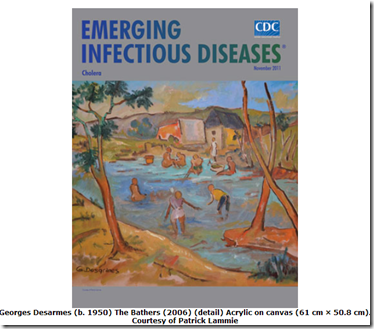
The November issue of the CDC’s  EID Journal devotes much of its content to this re-emerging disease threat.  Twenty-three articles, studies, and letters comprise this issue’s theme.


image


THEME ISSUE: CHOLERA IN HAITI


Synopses

Lessons Learned during Public Health Response to Cholera Epidemic in Haiti and the Dominican Republic

J. W. Tappero and R. V. Tauxe

Safe water and sewage systems must be constructed to prevent future epidemics.


Rapid Development and Use of a Nationwide Training Program for Cholera Management, Haiti, 2010

R. V. Tauxe et al.

Rapid training of health care staff was followed by lower death rates.

Cholera—Modern Pandemic Disease of Ancient Lineage

J. G. Morris

Environmental triggers may lead to increases in Vibrio cholerae in environmental reservoirs, with spillover into human populations.


Considerations for Oral Cholera Vaccine Use during Outbreak after Earthquake in Haiti, 2010−2011

K. A. Date et al.

Many logistical and operational challenges prevented implementation of a vaccination campaign.


Research

Comparative Genomics of Vibrio cholerae from Haiti, Asia, and Africa

A. R. Reimer et al.

A strain from Haiti shares genetic ancestry with those from Asia and Africa.


Characterization of Toxigenic Vibrio cholerae from Haiti, 2010–2011

D. Talkington et al.

A virulent clone from Africa or southern Asia was likely introduced at a single time point.


Historical Reviews

Cholera in Haiti and Other Caribbean Regions, 19th Century

D. Jenson and V. Szabo

Epidemic cholera did not occur in Haiti before 2010.

 
Dispatches

Risk Factors Early in the 2010 Cholera Epidemic, Haiti

K. A. O’Connor et al.


Rapid Assessment of Cholera-related Deaths, Artibonite Department, Haiti, 2010

J. A. Routh et al.


Epidemic Cholera in a Crowded Urban Environment, Port-au-Prince, Haiti

S. E. Dunkle et al.


Toxigenic Vibrio cholerae O1 in Water and Seafood, Haiti

V. R. Hill et al.

Drug-Resistance Mechanisms in Vibrio cholerae O1 Outbreak Strain, Haiti, 2010

M. Sjölund-Karlsson et al.


Cholera Management and Prevention at Hôpital Albert Schweitzer, Haiti

S. Ernst et al.


Knowledge, Attitudes, and Practices Related to Treatment and Prevention of Cholera, Haiti, 2010

V. E. De Rochars et al.


Cholera Prevention Training Materials for Community Health Workers, Haiti, 2010–2011

A. Rajasingham et al.


Cholera in United States Associated with Epidemic in Hispaniola

A. E. Newton et al.


Travel Health Alert Notices and Haiti Cholera Outbreak, Florida, USA, 2011

M. U. Selent et al.


Multinational Cholera Outbreak after Wedding in the Dominican Republic

M. L. Jiménez et al.


Commentaries

Haiti in the Context of the Current Global Cholera Pandemic

E. T. Ryan

Letters

Preparing Health Care Workers for a Cholera Epidemic, Dominican Republic, 2010

C. Mendoza et al.


Understanding the Cholera Epidemic, Haiti

S. B. Pun

Etymologia

Etymologia: Cholera

N. Männikkö

Conference Summaries

Academic Consortia: Untapped Resources for Preparedness, Response, and Recovery—Examining the Cholera Outbreak in Haiti

L. M. Gargano et al.

Nationwide Test Of Emergency Alert System (EAS) On Nov 9th


image

FEMA Director Craig Fugate - Photo Credit FEMA

# 5929


On November 9th of this year, at 2:00pm Eastern Time, FEMA, along with partners NOAA and the FCC, will conduct the first ever nation-wide test of the Emergency Alert System (EAS).


The EAS can be activated in the event of a national emergency by the President of The United States, and on a more localized level by the NWS to issue severe storm warnings, and by state governors and local emergency managers for more geographically limited emergencies.


Although those of us who grew up during the cold war are well familiar with early CONELRAD and later EBS alerts, we have become a `wired’ nation, and no longer depend primarily on over-the-air radio and TV broadcasts.


With newer technologies such as satellite TV,  cable TV, satellite Radio, etc. the task of alerting the nation during a crisis has grown considerably more complex. Telling people to turn to 640 or 1240 on their AM dial in the event of an emergency doesn’t cut it anymore.


Hence a need to test the system on a nationwide basis.


FEMA, which will spearhead this nationwide test, wants everyone to know – in advance – that the test messages to be issued on November 9th are just a test.


To that end, they have released a short video that will help to explain exactly what you may hear or see during this upcoming test.


For more on all of this, I would invite you to visit the FEMA BLOG.


FEMA Blog

October 28, 2011

Help Us Spread the Word – On November 9, “This is Just a Test”

Published by: Public Affairs


Over the past few months, we have written on this blog about the upcoming nationwide test of the Emergency Alert System, which is now less than two weeks away. The test will take place on Wednesday, November 9th at 2:00 pm eastern standard time, and will be the first time this system, which is often tested and used by officials at the local level, will be tested across the entire country.

(Continue. . . )

For those of you on twitter, I would also suggest you follow @FEMA, @CraigatFEMA, and @ReadydotGov for the latest Emergency information.

Friday, October 28, 2011

Lancet: Guillain-Barré Syndrome & H1N1 Vaccine In Children


image

Photo Credit – CDC PHIL 


# 5928


We’ve another study – published yesterday in The Lancet- on the safety of the 2009 pandemic vaccine that looked specifically at the development of Guillain Barre Syndrome among pediatric vaccine recipients in the UK.


Guillain-Barre Syndrome (GBS) is a neurological disorder that gained notoriety in 1976 after it was linked to an emergency flu vaccine that was rolled out in anticipation of a `swine flu’ pandemic.


As it turned out, the feared pandemic never came.


But before the campaign was abandoned - among the 40 million people who were vaccinated - around 500 people developed GBS and 25 died.


While not all of those cases were likely caused by the vaccine, the incidence of Guillian-Barre Syndrome was  around 1 in every 100,000 vaccinations. Or five times the expected background rate of this disease.


I was a young paramedic at the time, and chronicled my part in that bit of influenza history some time ago in Deja Flu, All Over Again


In the more than 3 decades since that fiasco, there has been little or no evidence of flu shots causing Guillain-Barre Syndrome


Still, memories of 1976 linger on, and anti-vaccine activists were only too happy to recall the unfortunate events of that year as they repeatedly warned that the `2009 swine flu vaccine was deadlier than the flu’.


Of course, the evidence clearly showed otherwise. 


Surveillance and reporting systems have not found any unusual pattern of deaths in the United States attributable to the pandemic vaccine, and the oft predicted spike in Guillain-Barré syndrome (GBS) never occurred (see CIDRAP VAERS study finds H1N1 vaccine safety similar to seasonal vaccines').


In fact, the VAERS report cited above found 0 deaths they could link to the pandemic Vaccine. Meanwhile, during the same period the CDC estimated that at least 12,000 (mostly younger) Americans died from the flu.


The CDC, along with many other public health agencies, have allowed that the flu vaccine might carry with it a very low risk of developing GBS. But most years the incidence is so low (perhaps 1 in 500,000 or 1 in a million) as to be nearly impossible to measure.


This from the CDC’s Guillain-Barré syndrome (GBS)  Q&A page.


What causes GBS?

Many things can cause GBS; about two-thirds of people who develop GBS symptoms do so several days or weeks after they have been sick with diarrhea or a respiratory illness. Infection with the bacterium Campylobacter jejuni is one of the most common risk factors for GBS.

People also can develop GBS after having the flu or other infections (such as cytomegalovirus and Epstein Barr virus). On very rare occasions, they may develop GBS in the days or weeks after getting a vaccination.


Recent studies have shown that you are many times more likely to develop GBS in the weeks following an influenza infection, than you are after getting the flu vaccine (see Lancet: The Influenza - Guillain Barré Syndrome Connection).


The irony here is, that the flu vaccine may turn out to be the best protection against the adverse vaccine effect that people seem to fear the most.


Adding a bit more weight to that argument, we’ve a letter published yesterday in The Lancet that looked at children who developed Guillain-Barré syndrome or Fisher's syndrome between September, 2009, and Aug 31, 2010.


doi:10.1016/S0140-6736(11)61665-6

Guillain-Barré syndrome and H1N1 influenza vaccine in UK children

Christopher Verity, Lesley Stellitano, Anne Marie Winstone, Nick Andrews , Julia Stowe , Elizabeth Miller


During the 12 months of surveillance, 55 children in the UK were diagnosed with GBS or Fisher’s syndrome. 


Of those, only 3 had received the pandemic flu shot, and of those, only 1 had received the shot within 6 weeks of developing neurological symptoms – a time frame that could suggest a causal relationship to the shot.


Among those same 55 children, 49 showed laboratory or clinical evidence of infection in the 90 days prior to developing symptoms.


  • 22 had respiratory infections
  • 13 had gastroenteritis
  • 7 had H1N1 influenza (5 laboratory-confirmed)
  • 2 had seasonal influenza (1 laboratory confirmed)
  • 2 had Epstein-Barr virus
  • 1 had chickenpox
  • and 2 had unexplained fevers


Which matches pretty close to the CDC GBS FAQ above that states: about two-thirds of people who develop GBS symptoms do so several days or weeks after they have been sick with diarrhea or a respiratory illness.


The authors conclude by stating:


The peak in the number of children with Guillain-Barré syndrome or Fisher's syndrome shortly after the peak of the second wave of H1N1 infection in November, 2009, might reflect this causal association (figure).


Given the proven effectiveness of pandemic influenza vaccine used in UK children, the vaccination programme might have had an overall protective effect against Guillain-Barré syndrome.


Another UK study I highlighted last July (see BMJ: No Substantial Link Between Flu Vaccines And Guillain-Barre Syndrome), similarly found: 


“Adjuvanted pandemic influenza A (H1N1) 2009 vaccines did not increase the risk of Guillain-Barré syndrome substantially, if at all.”


For more reassuring research on the safety profile of modern flu vaccines, you may wish to revisit the following blogs:


Harvard Study Reaffirms Safety Of Flu Vaccine
MJA: Safety Of Flu Shot In Young Children
NEJM: Study On China’s H1N1 Vaccine Safety
Lancet: Immunogenicity and safety Of Adjuvanted Flu Vaccines


While no vaccine (or drug) can be said to be 100% safeand rare but sometimes serious adverse effects have been reported - the preponderance of evidence continues to support the scientific consensus that flu vaccines are very safe and most years, reasonably effective.

Thursday, October 27, 2011

CDC Announces Preparedness Video Contest Winners


# 5927


September was  National Preparedness Month and the CDC asked the public to get creative and and submit their own short videos to drive home the message: Get A Kit, Make A Plan, Be Informed.

Yesterday, the CDC’s Public Health Matters blog announced the winner of the contest, and three runner up videos.


You can view all four videos at the link below. 


Are You Prepared? Video Contest Winners

October 26th, 2011 1:46 pm ET  -  Blog Administrator

woman holding a camera


The winner is a parody of the MTV’s Jersey Shore (which I confess was lost on me, since I’ve never seen the show).


I guess I now know how my parents must have felt every time the Rolling Stones appeared on The Ed Sullivan Show.


Very, very, old.  Sigh.


No matter, since I’m hardly the target audience here.


Quite understandably, finding ways to engage the younger generation in emergency preparedness is a major goal of these campaigns. Convince a twenty-something to prepare, and you’re likely impacting a growing family with small children.


More bang for the buck than targeting empty-nesters like myself.


Besides, if you get to be my age and haven’t figured out that bad things can happen without warning and its best to be preparedwell  . . . another 60 second PSA is probably not going to turn the tide.


So congratulations go to the winner, and to the runners up, and to everyone who submitted a video.


And kudos go to the HHS for embracing social media and continuing to find novel ways to involve the public in getting the preparedness message out.

Wednesday, October 26, 2011

WHO: Indonesian Bird Flu Update #7


image


# 5926


The World Health Organization has posted an update on the two Indonesian children who died from the H5N1 virus earlier in the month (see Bird Flu Claims Two Lives On Bali).


Complicating this story, the mother of these two children died about a week later. But from media reports it isn’t clear whether appropriate samples were taken for lab testing before she was buried (see Indonesia: Bali Bird Flu Suspect Dies, Suspect Cases Increase in Mataram).


For now, she remains an unconfirmed case.


The WHO statement reads:


Avian influenza – situation in Indonesia - update 7

26 October 2011 - The Ministry of Health of Indonesia has announced two new confirmed cases of human infection with avian influenza A(H5N1) virus.


The first case is a 5-year old female from Bangli district, Bali Province. She developed symptoms on 27 September, and was first admitted to a local general hospital on 5 October. She died on 9 October.


The second case is a 10-year old male, the brother of the first case. He developed symptoms on 30 September, and was first admitted to the hospital on the same day as his sister. He died on 10 October.


An epidemiological investigation conducted by the Ministry of Health and local health officers indicated that the children lived in an area with poultry, and household and neighborhood poultry had died prior to the children’s illnesses.


Laboratory tests have confirmed infection with avian influenza A(H5N1) virus.


Of the 181 cases confirmed to date in Indonesia, 149 have been fatal.


While accurate case counts are highly dependent upon surveillance, testing, and reporting – the quality of which vary considerably around the world -  the H5N1 virus still appears primarily a threat to poultry and wild birds.


The virus continues to cause rare, sporadic human infections in countries where the virus is endemic, but seldom appears to have been transmitted on to others. 


The concern, of course, is that over time the virus will better adapt to human physiology, and present a greater public health threat.


And so scientists continue to monitor the virus’s progress with considerable interest (see H5N1: An Increasingly Complex Family Tree).

Rina: An Uncertain Path For The Weekend


# 5925


image

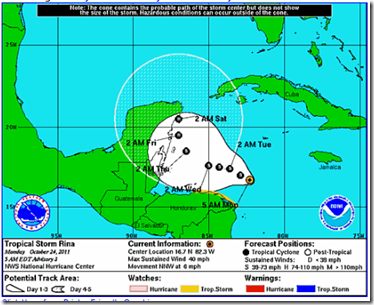
Hurricane Rina, a strong Category 2 storm may intensify further today as it moves slowly in the general direction of the Yucatan Peninsula. 


Hurricane warnings are posted for the east coast of the Yucatan Peninsula North of Punta Gruesa to Cancun.  Tropical storm warnings are posted along the coast from Chetumal to Punta Gruesa.


The latest advisory can be found at the National Hurricane Center’s website.


While the storm is expected to weaken a bit by the weekend, its path more than 72 hours down the road is less than certain, and the forecast currently puts most of south Florida in the 5-day cone.


The latest model runs place Rina - five days from now - as far north as Tampa Bay, and as far south as Havana, Cuba.


The majority of the models are clustered around the Florida Straits or the western tip of Cuba.


image


All of which means that interests from north Florida southward need to keep a weather eye out this weekend.  


As always, the National Hurricane Center website should be your primary source of forecast information, but if you are on Twitter, you should also follow @FEMA, @CraigatFEMA, @NHC_Atlantic, @NHC_Pacific and @ReadydotGov for the latest Emergency information.

Tuesday, October 25, 2011

CIDRAP: A Comprehensive Flu Vaccine Effectiveness Meta-Analysis


# 5924


I hadn’t intended today to be a `theme’ day at AFD, but things have certainly turned out that way.  


I started early this morning with a study on the reduced immune response from the flu vaccine among the obese (here), and this afternoon posted a link to the on-target comments by Dr. Jody Lanard on the CDC’s recent rollout of vaccine effectiveness numbers (here).


For the hat trick I’ve saved the best for last.


A comprehensive study lead by Michael T. Osterholm, director of CIDRAP (the Center for Infectious Disease Research and Policy) at the University of Minnesota, that provides a systematic review and meta-analysis on the efficacy and effectiveness of the TIV (trivalent Inactivated Vaccines) and LAIV (Live attenuated influenza vaccine) influenza vaccines.


Note: Most of the time, the terms `effectiveness’ and `efficacy’ can be used interchangeably, but in the scientific world there are subtle differences.


Effectiveness describes how well something works under day-to-day, real-world conditions.  In the following study, it is used to gauge the results of observational studies.


Efficacy describes how well something performs in a more controlled setting – and here it is used to describe the results of randomized placebo-controlled clinical trials.


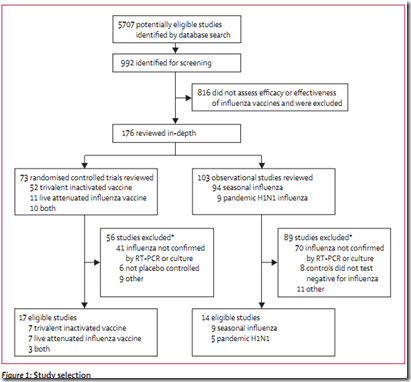
Researchers at CIDRAP, along with colleagues from  the Marshfield Clinic Research Foundation and Johns Hopkins University examined more than 5700 existing  vaccine studies going back to 1967, and found 31 that met their (admittedly strict) criteria for inclusion.


What they were looking for were well-mounted studies that used highly sensitive laboratory testing (RT-PCR or culture) to confirm influenza infection in its participants.


Since the flu vaccine cannot be reasonably be expected to protect against non-influenza respiratory illness (ie. rhinovirus, adenovirus, enteroviruses, etc.), studies that fail to do this sort testing are of considerably less value.


image


After an exhaustive examination and whittling down process, fewer than 3 dozen studies met their criteria. As a result there remain some significant gaps in the evidence.


For example, there were no randomized controlled trials (RTCs) showing efficacy of the TIV (trivalent Inactivated Vaccines) in those aged 2–17 years or in adults 65 years or older. 


Similarly, they found no RCTs showing the efficacy of the LAIV (Live attenuated influenza vaccine) for people aged 8–59 years.


In the discussion, the authors write:


The evidence from trials and observational studies suggests that presently available influenza vaccines can provide moderate overall protection against infection and illness, with LAIV providing a consistently higher level of protection in children aged 7 years or younger.


But they found the protective effects of the flu vaccine could vary considerably from one season to the next, and among different age groups. Some years, and in some cohorts, there was little evidence of protection.


Although some of the numbers are lower than have been commonly stated in the past, today’s flu vaccines were shown to provide a moderate level of protection. 


TIV showed efficacy in preventing influenza during 8 of 12  flu seasons (67%) with a combined efficacy of 59% among healthy adults (aged 18–65 years).


And among children aged 2-7, the LAIV proved even more protective, showing efficacy in 9 out of 12 flu seasons (75%) with a pooled efficacy of 83%


Beyond the numbers, which probably represent the most accurate assessment of influenza vaccine effectiveness to date, this study also highlights the folly of depending upon a vaccine technology that has changed little since the 1950s.


Not only does it take too long to produce an emergency vaccine in the face of a pandemic . . .  those at greatest risk from a novel influenza virus are likely to receive the least amount of benefit from today’s vaccines.


The study’s authors say their findings should be seen as a clarion call for the development of more effective influenza vaccines.


Until that can happen, and despite these lower efficacy numbers, they still recommend getting the seasonal flu vaccine.     


Robert Roos, News Editor for CIDRAP (which operates independently of CIDRAP’s  research and policy programs) provides a good deal more detail on all of this, including extensive remarks by Dr. Osterholm.


Strict meta-analysis raises questions about flu vaccine efficacy

Robert Roos  News Editor

Oct 25, 2011 (CIDRAP News) – A rigorous new analysis of 44 years' worth of studies is raising questions about the evidence for the effectiveness of influenza vaccines in elderly people and, for certain types of vaccines, in children and younger adults as well.


Applying very strict criteria to filter out potential bias and confounding, a US research team sifted more than 5,000 studies and found only 31 that they felt provided reliable evidence about the efficacy and effectiveness of flu vaccines. The findings were published online today by Lancet Infectious Diseases.

(Continue . . . )

(Cites)

Osterholm MT, Kelley NS, Sommer A, et al. Efficacy and effectiveness of influenza vaccines: a systematic review and meta-analysis. Lancet Infect Dis 2011 (published online Oct 25)

Kelly H, Valenciano M. Estimating the effect of influenza vaccines. (Commentary) Lancet Infect Dis 2011 (published online Oct 25)

Jody Lanard: Risk Communication & Flu Vaccine Effectiveness


# 5923


My thanks to Crof for picking up on a short posting by Dr. Jody Lanard on the CDC’s recent unveiling of flu vaccine efficacy numbers.


As most of my readers know, flu vaccine effectiveness studies have been all over the map in recent years, with some showing remarkably high levels of protection while others have returned less encouraging numbers. 


For years the CDC’s mantra has been for healthy adults under the age of 65, in years when the vaccine is a good match to circulating strains, effectiveness ranges from 70%-90%.

Of course, if you don’t fall into this `ideal’ cohort, or if the virus drifts away from the vaccine strain, your mileage may vary. 


Sometimes, considerably.


Which is something we’ve addressed numerous times in this space, including:


Study: Obesity, Influenza & Immunity

Study: Flu Vaccines And The Elderly

Flu Shots For The Elderly May Have Limited Benefits


Recently the CDC updated their FAQ on Flu Vaccine effectiveness, and as part of a much longer detailed posting, lowered the estimate of the inactivated flu shot’s effectiveness to read:


. . . recent RCTs of inactivated influenza vaccine among adults under 65 years of age have estimated 50-70% vaccine efficacy during seasons in which the vaccines' influenza A components were well matched to circulating influenza A viruses.


Dr. Jody Lanard, who along with her husband Peter Sandman, are considered among the most authoritative in the world on the subject of risk communications, has posted a brief commentary on the way this revised information has been rolled out by the CDC.


Highly recommended.


Follow the link to read:


Brief analysis of a risk communication error:

The CDC reports its newest estimate of influenza vaccine efficacy: 50-70% in healthy adults under 65


By Jody Lanard M.D. (posted on October 25 2011, 1:30 pm EDT)


Between Sandman and Lanard, they produce a wealth of invaluable risk management advice freely available on their website:


Peter Sandman Website logo


For anyone even remotely involved as a spokesperson for an agency, organization, or company during a crisis, this site should be viewed as essential reading. 


Over the years I’ve been happy to feature their writings a number of times, including here, here, and here.  


For more, simply do a blog search on `Sandman.

Study: Obesity, Influenza & Immunity


# 5922


Even in the earliest days of the 2009 H1N1 `swine’ flu outbreak, it was apparent that most people who contracted this novel virus experienced a relatively mild illness and recovered without incident.


There were exceptions, of course. 


Some small percentage of people were hit hard by the pandemic H1N1 virus, with some experiencing ARDS (Acute Respiratory Distress Syndrome) and a few sustaining severe lung damage.


Thousands died, with most of those deaths occurring in those under the age of 65


Many (but not all) of them had what was described as underlying `risk factors’; pregnancy, asthma, COPD, neurological disorders, heart failure, etc.


Extreme (or morbid) Obesity (BMI > 40) was one of the risk factors that emerged early in the 2009 outbreak, based primarily on anecdotal stories describing many of those admitted to intensive care units during the first wave of the illness. 


The earliest mention I can find in this blog of the link to obesity (and smoking) came on May 25th, 2009; scarcely one month after the first swine flu cases were announced in San Diego (see H1N1 Morbidity And Previously Existing Conditions).


During 2009 obesity was often mentioned as a possible risk factor (see Obesity Seen As Major Risk Factor For Flu Complications) - then later -  cautiously discounted as unproven (see More On The ACIP Meeting) in late July of 2009.


We saw more studies during 2010 that again raised the obesity question, and earlier this year in Extreme Obesity: A Novel Risk Factor For A Novel Flu we saw a study appearing in Clinical Infectious Diseases that found a three-fold increase in mortality among H1N1 patients who were morbidly obese.


Given the rising obesity rates in many countries around the world, an underlying risk factor that affects 25%-33% of the population is a pretty big deal.


image


All of which serves as prelude to a study that will appear later today in the International Journal of Obesity that looks at the immune response in those who are overweight, and finds significant differences from normal weight individuals.


This study found that while overweight people mounted a robust immune response from a flu vaccine during the first month after vaccination, within 12 months half saw a 4-fold decrease in antibody titers


That’s twice the rate of normal weight individuals.


Furthermore, they found significant differences in the immune response of obese subjects that suggest they are not only more susceptible to influenza, but are also more likely to see severe disease or complications.


While the study is not yet online, we have the press release from the University of North Carolina School of Medicine. Follow the link to read it in its entirety.


Study: Obesity limits effectiveness of flu vaccines

Public release date: 25-Oct-2011


New research from the University of North Carolina at Chapel Hill shows that obesity may make annual flu shots less effective.


The findings, published online Oct. 25, 2011, in he International Journal of Obesity, provide evidence explaining a phenomenon that was noticed for the first time during the 2009 H1N1 flu outbreak: that obesity is associated with an impaired immune response to the influenza vaccination in humans.


"These results suggest that overweight and obese people would be more likely than healthy weight people to experience flu illness following exposure to the flu virus," said Melinda Beck, Ph.D., professor and associate chair of nutrition at the UNC Gillings School of Global Public Health and senior author of the study.


"Previous studies have indicated the possibility that obesity might impair the human body's ability to fight flu viruses. These new findings seem to give us a reason why obese people were more susceptible to influenza illness during the H1N1 pandemic compared to healthy weight people."


The study reports for the first time that influenza vaccine antibody levels decline significantly in obese people compared to healthy weight individuals. What's more, responses of CD8+ T cells (a type of white blood cell that plays a key role in the body's immune system) are defective in heavier people.


(Continue . . . )


While the authors of this study can observe the decline in antibody response in the obese, the reasons behind it are less clear. They state:


"We need to continue to study the effect of obesity on the ability to fight virus infections. Influenza is a serious public health threat, killing up to half a million people a year worldwide. As rates of obesity continue to rise, the number of deaths from the flu could rise too.


We need to better understand this problem and to look for solutions."


Just as we’ve seen with those over 65 (see Study: Flu Vaccines And The Elderly and Flu Shots For The Elderly May Have Limited Benefits), those who are most at risk from influenza often see a reduced benefit from the current vaccine.


That isn’t to dismiss the flu vaccine as useless or a waste of time for these higher risk groups. Some protection is undoubtedly better than none.


But it is further evidence of the need to develop better flu shots that can help protect everyone.


Particularly those who mount a less-than-robust immune response to vaccines today.

Monday, October 24, 2011

H5N1: An Increasingly Complex Family Tree


# 5921


My thanks to Crof at Crofsblog for picking up this morning on the publication by the World Health Organization of their:


Updated unified nomenclature system for the highly pathogenic H5N1 avian influenza viruses


While many of you will want to follow the above link to read the report in its entirety, this document basically identifies and updates the known clades of the H5N1 virus that have emerged since the detection of the A/goose/Guangdong/1996 H5N1 virus strain back in the mid 1990s.


`Clades’ are essentially branches on the virus’s family tree. Each new branch has a clearly identifiable lineage from its parental strain, but has mutated far enough away to become a new strain.


The criteria, from the report:


Based on criteria used to distinguish various groups of the H5 hemagglutinin (HA) gene, the system has formally identified 20 distinct clades of the virus since its inception in early 2008 [1-2]. These clades are defined as meeting the following three specific clade definition criteria developed by the WHO/OIE/FAO H5N1 Evolution Working Group:

  • sharing of a common (clade-defining) node in the phylogenetic tree;
  • monophyletic grouping with a bootstrap value of ≥60 at the clade-defining node (after 1000 neighbor-joining bootstrap replicates); and
  • average percentage pairwise nucleotide distances between and within clades of >1.5% and <1.5%, respectively.


All of which means we are not watching just one H5N1 virus strain with pandemic potential, we are watching at least 20 genetically separate clades of the virus, with many minor variants of each clade thrown in the mix.


And over time, it is expected that even more clades will emerge as the virus mutates and/or swaps genetic material with other viruses.


To give you an idea of just how much the virus has diversified over the past 15 years, I’ve reproduced one of the WHO charts from in this report below.


image

(click to load larger image)


In WHO Report : Antigenic & Genetic Characteristics of H5N1 & H9N2 Viruses from last month we looked at some of this viral evolution including the spread of the 2.3.2.1 clade of the virus – which was the subject of an FAO announcement (see FAO Warns On Bird Flu) at the start of September.


Scientists at the WHO must occasionally select candidate viruses for the production of human vaccines. Should a pandemic erupt, having a candidate vaccine already in hand could save weeks in the time it would take to produce and deploy an emergency vaccine.


This `new’ 2.3.2.1 clade differs antigenically from the poultry vaccines currently being used in many Asian countries, and the concern is that a new wave of bird flu may spread through poultry this winter.


While newer 2.3.2.1 clade samples reacted well against a couple of candidate vaccines already selected, the 2.3.4.2 clade out of Bangladesh does not.


Therefore, the development of a new clade 2.3.4.2 candidate vaccine virus is proposed.


For more on the ongoing evolution of avian influenza, you may wish to revisit:


Variations On A Bird Flu Theme

What Goes Around, Comes Around

EID Journal: H5N1 Branching Out

IDSA: Flu Vaccines In Pregnancy


 image

Photo Credit – CDC


# 5920


Last week, in UK: Pregnancy And Swine Flu, we saw a study conducted at Oxford University by the National Perinatal Epidemiology unit that found a strong link between infection with the 2009 `swine’ flu and an increased number of stillbirths.


Fetal deaths among women infected with the H1N1 virus were 5 times higher than normal.


Very early into the 2009 H1N1 outbreak – even before the declaration of a pandemic by the World Health Organization – it became apparent that pregnant women were making up a disproportionate number of ICU admissions for influenza, and deaths.


Which is a pattern we’ve seen in pandemic outbreaks in the past (see Pregnancy & Flu: A Bad Combination).


While the CDC and other public health entities continue to stress the importance of seasonal flu vaccination for pregnant women, there remains some reluctance among pregnant women to get the shot.


Last week, several studies were presented at the 49th Annual Meeting of the Infectious Diseases Society of America (IDSA) reaffirming the benefits and safety of maternal vaccination.


The CDC has synopsized these studies and included a link to the IDSA press release.


Pregnancy and Influenza Vaccine Safety

Research shows:

Influenza vaccination during pregnancy protects newborns from getting influenza.

Pregnant women who get influenza vaccine pass their immunity to their babies in the form of flu antibodies. This protection lasts for several months after birth. Influenza protection was seen in newborns up to four months old. Babies born to women who were not vaccinated during pregnancy showed no antibody protection.

Influenza vaccination does not cause miscarriage.

Research shows no association between flu vaccination during pregnancy and miscarriage. This largest study conducted during the first trimester showed pregnant women who got the flu vaccine were no more likely to miscarry than those who did not get the flu vaccine.

More pregnant women are getting vaccinated against influenza.

The number of pregnant women receiving influenza vaccine has increased dramatically in the last couple of years in large part due to a national effort to vaccinate against the 2009 H1N1 pandemic influenza during the 2009-10 influenza season. Prior to 2009, less than 15 percent of pregnant women got vaccinated. In the past two influenza seasons, over half of pregnant women were vaccinated.

For more information on these studies, read the IDSA press release.


Vaccines are drugs, and there is no such thing as a 100% safe and 100% effective drug. Even taking over-the-counter medicines entail some risks.


But the safety profile of flu vaccines is excellent, and serious side effects are exceedingly rare.


The real risk comes from the virus, not from the shot.


While studies like the ones above are unlikely to dissuade most anti-vaccination activists, hopefully they will provide some reassurance to women who are considering the vaccine, but are still on the fence.

A Late Season Tropical Threat


# 5919


Since it has been chilly the past couple of mornings here in central Florida, it can be hard to remember that there are another 5 weeks left to the 2011 Altantic Hurricane season.


Hurricane season runs through the end of November.


It was just 6 years ago today that category 3 Hurricane Wilma struck south Florida, doing considerable damage to Ft. Lauderdale, Miami, Naples, and the Florida Keys while contributing to deaths of at least 35 people.


While it is too soon to tell if Tropical Storm Rinaforecast to intensify further – will affect the U.S. mainland, interests in the western Caribbean and all along the shores of the Gulf of Mexico need to keep an eye on this system.


image


While occurring far less frequently than do August and September storms, October hurricanes have a nasty habit of paying Floridians a visit.


Most form this time of year in the same general area as Rina sits right now, where the water temperatures are still toasty and wind shear is light, both of which are conducive to intensification. 


image

October Tropical Climatology – NOAA 


Rina has a long way to go before it could affect the Gulf coast - and a number of obstacles to overcome -  but history tells us not to be complacent.


Interests who may be impacted by this storm should follow the forecasts on the National Hurricane Center’s website.


And as my good buddy Cliff reminded me last week, it doesn’t have to be a tropical system to wreak havoc. No-Name Storms can deliver a sizable punch as well.


The ‘93 Superstorm – while not a hurricane – delivered hurricane force winds to the west coast of Florida and piled up a 7 to 12 foot surge tide, before tracking up the eastern seaboard as an unforgettable March blizzard.


Before it expired over the north Atlantic, this `no-name storm’  had claimed more than 300 lives and caused more than 6 billion dollars in damage from Cuba north to Canada.


All of which illustrates why those of us who went through her (I was aboard my 36’ sailboat, trying to keep her from being battered against the pilings at our marina) keep a wary eye on the weather year round.


Regardless of the season, everyone should have an emergency plan and preparations already in place to deal with a variety of threats. Storms, floods, wildfires, earthquakes, and tornadoes can happen anytime, and practically anywhere.


Ready.gov urges all Americans to follow these 3 steps to better preparedness:


image

GET A KIT

MAKE A PLAN

BE INFORMED


And for those who live in areas where tropical storms are a threat, I would invite you to download the NOAA, FEMA, and American Red Cross updated preparedness guide for the 2011 tropical season.


image

Sunday, October 23, 2011

Week 41 Flu Activity & Flu Shot Finder


# 5918


While the 2011-2012 flu season has yet to get rolling in North America and Europe, the experiences south of the equator over the last few months suggest we may see a fair amount of influenza activity later this year.


For now, the CDC’s weekly  KEY FLU INDICATORS report, aside from noting the single trH3N2 case in Maine, paints an  otherwise unremarkable picture of flu activity this fall. It should be noted, however, that many years influenza doesn’t make an impact until December or January.  


Influenza activity in the United States remains low according to the second FluView of the 2011-2012 season. Nationally, all key flu indicators were low. Below is a summary of the most recent key indicators:
  • Visits to doctors for influenza-like illness (ILI) remained below the national baseline this week. All 10 U.S. regions reported ILI activity below region-specific baseline levels as well.
  • No states reported widespread, regional or local influenza activity. Sporadic influenza activity was reported by 18 states (a decrease from 20 states last week) and the District of Columbia, Guam, Puerto Rico and the U.S. Virgin Islands. Thirty-two states (an increase from 29 states last week) reported no influenza activity.
  • The proportion of deaths attributed to pneumonia and influenza (P&I) based on the 122 Cities Mortality Reporting System increased slightly from last week, but remained within the level expected for this time of year.
  • No influenza-associated pediatric deaths were reported this week.
  • Nationally, the percentage of specimens testing positive for influenza in the United States was 0.5%, a decrease from what was reported last week (1.2%).
  • Though very few viruses have been submitted so far this season, these include 2009 H1N1 viruses, influenza A (H3N2) viruses and influenza B viruses. Overall, these viruses remain susceptible to the antiviral drugs oseltamivir and zanamivir.
  • One report of human infection with swine origin influenza A (H3N2) is being reported this week.


The CDC recommends getting your flu shot now – to give your body enough time to develop antibodies before you are exposed to the virus. I got my shot the last week of September, but I know many people are still putting it off.


To make it easier for you to get the jab, Flu.gov has a handy, interactive web app that allows you to input your location, and get a list of pharmacies, clinics, and stores where you can get the flu vaccine near you.


image


By entering my zip code, I’m presented with a local map showing 26 places offering flu shots, along with their prices, phone numbers, and hours of operation.


image


I’ve  made my case for getting the seasonal flu shot every year many times, including in Flu Shot Ethics and NPM11: Giving Preparedness A Shot In The Arm, so I’ll not repeat them here.


While the vaccine doesn’t offer 100% protection, the CDC maintains it is the single best thing you can do to protect yourself – and others – from influenza. 


And this year, just about everyone over the age of 6 months is encouraged to get the shot (see MMWR: ACIP Updated Flu Vaccination Recommendations).


The CDC reminds you that:


image